
Carpet Removal Disposal Made Simple for Homeowners
Discover easy ways for carpet removal disposal, from hiring local pros to DIY methods, ensuring responsible and efficient outcomes.
Carpet Removal Disposal Made Simple for Homeowners
If you want a low-effort, responsible outcome, hire a local junk- or carpet-removal team that routes reusable carpet to donation and recyclable material to CARE reclamation partners. If you have one room and a free afternoon, DIY removal followed by a municipal or recycler drop-off works fine too.
Your next move: request a photo-based estimate from a removal company, call your local waste authority about bulk pickup rules, or check the CARE reclamation map for a recycler near you.
The three fastest responsible routes:
- Hire a pro removal service that handles hauling and routes materials to donation or recycling.
- Use municipal bulk-item drop-off or a scheduled curbside pickup day.
- Do the removal yourself, then deliver the carpet to a reclamation center or transfer station.
Key Takeaways
Hiring a removal service that routes carpet to donation and recycling delivers the most responsible outcome with the least effort for most homeowners.
| Point | Details |
|---|---|
| Check CARE first | Search the CARE reclamation directory before assuming your old carpet has to go to landfill. |
| Budget by scope | Expect free or low-cost municipal options versus paid removal services running higher based on volume and location. |
| DIY works for one room | Cutting, rolling, and prying tack strips yourself is manageable for a single room, not a whole house. |
| Confirm municipal rules first | Call your local waste authority before leaving carpet at the curb to avoid rejected pickups or fines. |
| Hire Ohanapropertyexperts for volume jobs | Ohanapropertyexperts offers photo-based estimates and donation-conscious routing for whole-house and estate carpet removal. |
Table of Contents
- What Does Carpet Removal Disposal Typically Cost?
- How Do You Remove Carpet Yourself Safely?
- Where Can You Recycle or Donate Old Carpet?
- When Should You Hire a Professional Removal Service?
- How Do You Choose a Trustworthy Removal Company?
- What Mistakes Should You Avoid With Old Carpet?
- How Ohanapropertyexperts Handles Carpet Removal Responsibly
- Why Responsible Disposal Is the Smarter Default
- Get a Free Quote for Carpet Removal and Disposal
- Helpful Resources for Carpet Disposal
- Frequently Asked Questions
- Sources
What Does Carpet Removal Disposal Typically Cost?
Pricing depends on who does the labor and how the hauler bills the job. Removal companies usually quote by the room, by the roll, by vehicle load, or as a flat rate for the whole job. Ohanapropertyexperts prices by scope and volume instead of a flat per-room rate, since a bedroom with thin padding and a basement soaked in old adhesive are not the same job.
Quick cost snapshot: Municipal bulk pickup is often free or bundled into your existing waste fee, while paid curbside removal or hauling services commonly run from modest fees up to $100 or more depending on square footage and your location, according to a recent cost comparison of six disposal methods.
Timing varies just as much as price:
- Same-day pickup: available from most paid removal or junk-hauling services.
- Scheduled bulk collection: often a fixed day each month, set by your city or county.
- Municipal drop-off: instant, but only during posted facility hours.
Cost-saving moves worth trying first: check if your carpet qualifies for donation, search the CARE directory before assuming it’s landfill-bound, and ask a remodeling contractor if you can add your old carpet to their debris load.
How Do You Remove Carpet Yourself Safely?
DIY removal makes sense for a single room. It gets tedious fast across a whole house, especially with stairs or heavy padding involved.
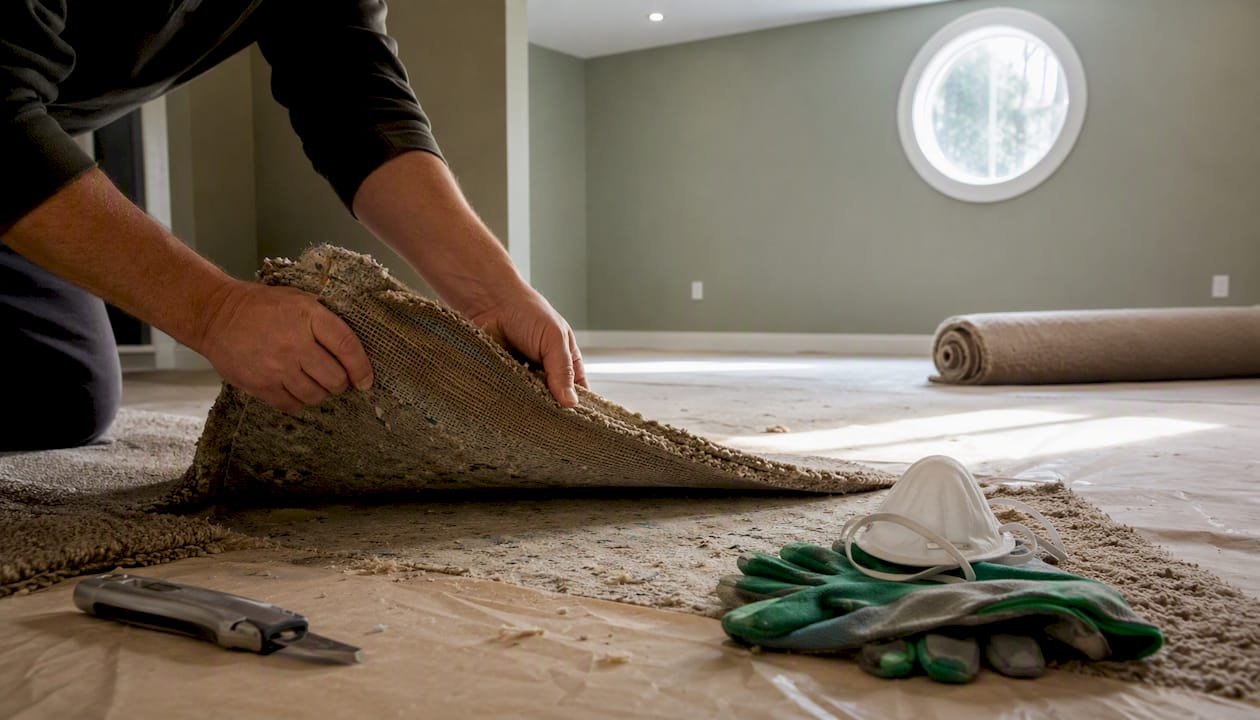
Before you start, gather: work gloves, safety glasses, a utility knife, a pry bar, pliers, a staple remover, knee pads, and a dust mask if the carpet is old or dusty.
- Clear the room completely, including furniture, and pull up any baseboards blocking the carpet edge.
- Cut the carpet into manageable strips, roughly 3 feet wide, using the utility knife.
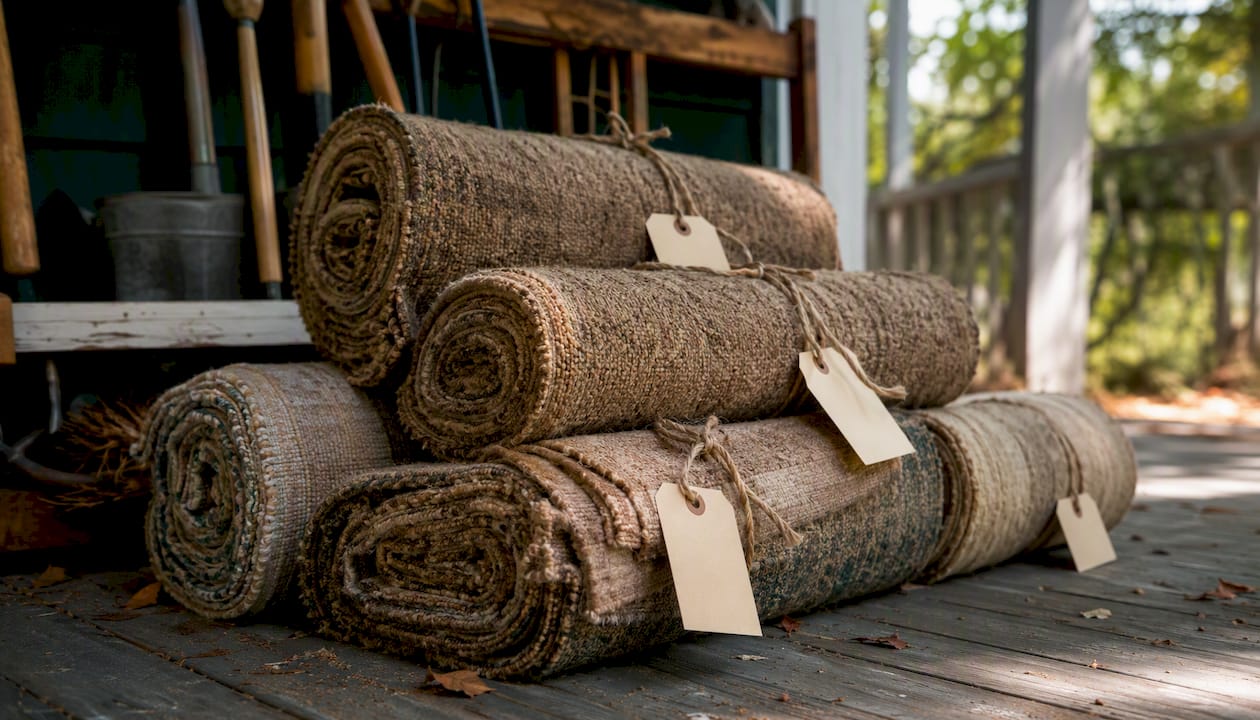
- Roll each strip tightly and tape it to keep it from unrolling in transport.
- Pull up the foam padding underneath, which usually separates easily by hand.
- Pry up tack strips along the walls with the pry bar, watching for exposed nails.
- Remove any remaining staples from the subfloor with pliers or a staple remover.
- Bundle rolled carpet and padding separately, then label each bundle for its intended destination, donation, recycling, or landfill.
- Sweep and vacuum the subfloor before moving on to new flooring or listing the property.
Pro Tip: Tack strips hide dozens of small nails pointing straight up. Slide the pry bar underneath and lift away from your body, then bag the strips immediately so nobody steps on a loose nail later.
Call a professional instead if you’re facing more than two or three rooms, adhesive-glued carpet, visible mold, a staircase, or a tight closing deadline. Those jobs eat entire weekends and often need equipment most homeowners don’t own.
Where Can You Recycle or Donate Old Carpet?
Landfill should be your last option, not your default one. Most carpet is recyclable, and its fibers and padding get broken down into products like industrial flooring, composite lumber, and new carpet cushion, according to BobVila’s disposal guide.
Here’s how the main pathways break down:
- Carpet recycling: Search the CARE reclamation partner directory, the primary national resource for finding facilities that accept old carpet.
- Donation or reuse: Clean carpet in good condition can go to shelters, reuse centers, or neighborhood listing sites; unused remnants are often accepted by groups like Habitat for Humanity.
- Municipal bulk drop-off or pickup: Contact your local solid-waste department directly, since rules and accepted materials vary by county.
- Junk removal services: Handle hauling and disposal routing for you, often sorting recyclable and donatable material along the way.
- Landfill: Reserve this for carpet that’s too contaminated, moldy, or degraded for any other route.
Worth knowing: counties don’t treat carpet uniformly. Hillsborough County, for example, publishes multiple named facility locations with specific hours for carpet drop-off, so calling ahead beats guessing.
Before dropping off or donating, clean the carpet if possible, roll it tightly, cut oversized pieces into manageable sections, and label bundles by destination so nothing gets mixed up at the curb.
When Should You Hire a Professional Removal Service?
Hiring makes the most sense for whole-house jobs, glued-down carpet, mold, staircases, tight closing timelines, or estate cleanouts where you’d rather not sort through decades of flooring yourself. It’s also the better call if donation and recycling routing matters to you but you don’t have time to research local programs.
A typical service workflow looks like this:
- You submit photos or request an on-site visit for an estimate.
- The company schedules removal and protects floors and furniture during the job.
- Crews remove and haul the carpet, padding, and tack strips.
- Materials get routed to donation, recycling, or landfill based on condition.
Before booking, ask any provider:
- Are you licensed and insured for hauling and property work?
- How do you handle disposal, and do you route reusable material to donation?
- Is pricing flat-rate or based on volume, and what’s included?
- What’s your typical turnaround time for scheduling and completion?
Retailers like Lowe’s also offer removal services tied to new flooring purchases, but a dedicated hauling company usually gives you more flexibility on timing and disposal routing.
How Do You Choose a Trustworthy Removal Company?
Run through this checklist before signing anyone:
- Licensed and insured, so you’re covered if something gets damaged during removal.
- Transparent pricing upfront, not a number that changes once the crew arrives.
- Documented donation or recycling partners, or at least a clear willingness to route usable material responsibly.
- Photo-based quotes, which speed up the process and reduce surprise charges.
- Local references or reviews you can actually verify.
Red flags to walk away from:
- Vague or dodging answers about where your old carpet actually ends up.
- Pressure to just toss it in with regular curbside trash.
- No mention of liability coverage when asked directly.
- A bid that’s suspiciously low and given without ever inspecting the space.
When comparing quotes, confirm what’s included: hauling labor, disposal fees, furniture moving, and cleanup. For larger jobs like estate cleanouts or full-property turnovers, a company built around debris removal at scale will usually beat a general handyman quote on both price and disposal accountability.
What Mistakes Should You Avoid With Old Carpet?
Never burn carpet, and never assume it can go in with regular curbside trash without checking first, since carpet is a mixed-material composite that many municipalities restrict to bulky-waste facilities.
- Don’t leave rolled carpet at the curb outside your city’s scheduled bulk-pickup day. It often gets rejected or draws fines.
- Watch for exposed nails and staples in tack strips throughout removal.
- If the carpet is decades old, ask a professional before disturbing it, since older installations can raise asbestos concerns.
- Wear a mask and gloves around moldy or heavily soiled carpet rather than handling it bare-handed.
How Ohanapropertyexperts Handles Carpet Removal Responsibly
A typical job starts with a photo-based estimate, so you know the scope before anyone shows up. From there:
- We assess condition to determine what’s donation-ready versus recycling-bound.
- Usable remnants get routed through our donation-conscious recovery network instead of automatically hitting a dumpster.
- We check regional reclamation options before defaulting to landfill.
- Hauling and cleanup happen on the same visit whenever the scope allows it.
This approach shows up most often in estate cleanouts, where families are juggling grief, timelines, and old flooring all at once, and a compassionate, organized process matters as much as the hauling itself.
Why Responsible Disposal Is the Smarter Default
Treating carpet disposal as an afterthought is how usable material ends up in a landfill for no good reason. The recycling and donation infrastructure already exists. Most homeowners just don’t know it’s there until someone points them to it.
I’ve seen the DIY-versus-hire decision get overcomplicated when it really comes down to volume and time. One room, a free Saturday, and a drop-off location nearby? Do it yourself. Anything bigger, messier, or tied to a tighter deadline is where a property cleanout team earns its fee, especially when disposal routing is handled without you having to ask twice.
Get a Free Quote for Carpet Removal and Disposal
Skip the sorting, hauling, and drop-off runs entirely. Ohanapropertyexperts handles the full job, estimate to disposal, so you’re not spending a weekend wrestling tack strips out of a floor.

Our carpet and debris removal work typically covers:
- Photo-based estimates so you get a price before we ever step on-site.
- Donation routing for carpet remnants still in usable condition.
- Full debris hauling for renovation jobs, estate cleanouts, or whole-property turnovers.
To get started, snap a few photos of the carpet and rooms involved, note the approximate square footage, and reach out through our services page for a free estimate. We serve Columbus, Seymour, North Vernon, Edinburgh, Franklin, Greenwood, Indianapolis, Lafayette, and the surrounding Central Indiana area, and most quotes turn around fast enough to schedule removal within the week.
Helpful Resources for Carpet Disposal
Check these before you commit to a disposal route:
- CARE reclamation directory: search by location to find carpet recyclers near you.
- BobVila’s carpet disposal guide: explains what recycled carpet material becomes.
- Lowe’s disposal guide: covers removal service options and DIY prep steps.
- Hillsborough County solid-waste page: an example of how specific and location-dependent county rules can be.
Frequently Asked Questions
How much does carpet removal and disposal usually cost? It ranges from free through municipal bulk pickup to $100 or more for paid curbside or hauling services, depending on square footage, location, and whether padding and tack strips are included.
What’s the best way to dispose of old carpet? For most homeowners, hiring a removal service that routes reusable carpet to donation and recyclable material to a CARE partner facility is the most responsible and lowest-effort option.
Can old carpet be recycled? Yes. Most carpet fibers and padding can be recycled into products like composite lumber, industrial flooring, and new carpet cushion, and the CARE directory is the fastest way to find a local recycler.
Do I need a permit to remove carpet myself? Typically no permit is required for DIY removal, but you should confirm your municipality’s bulk-waste rules before leaving carpet at the curb, since acceptance policies vary by city and county.
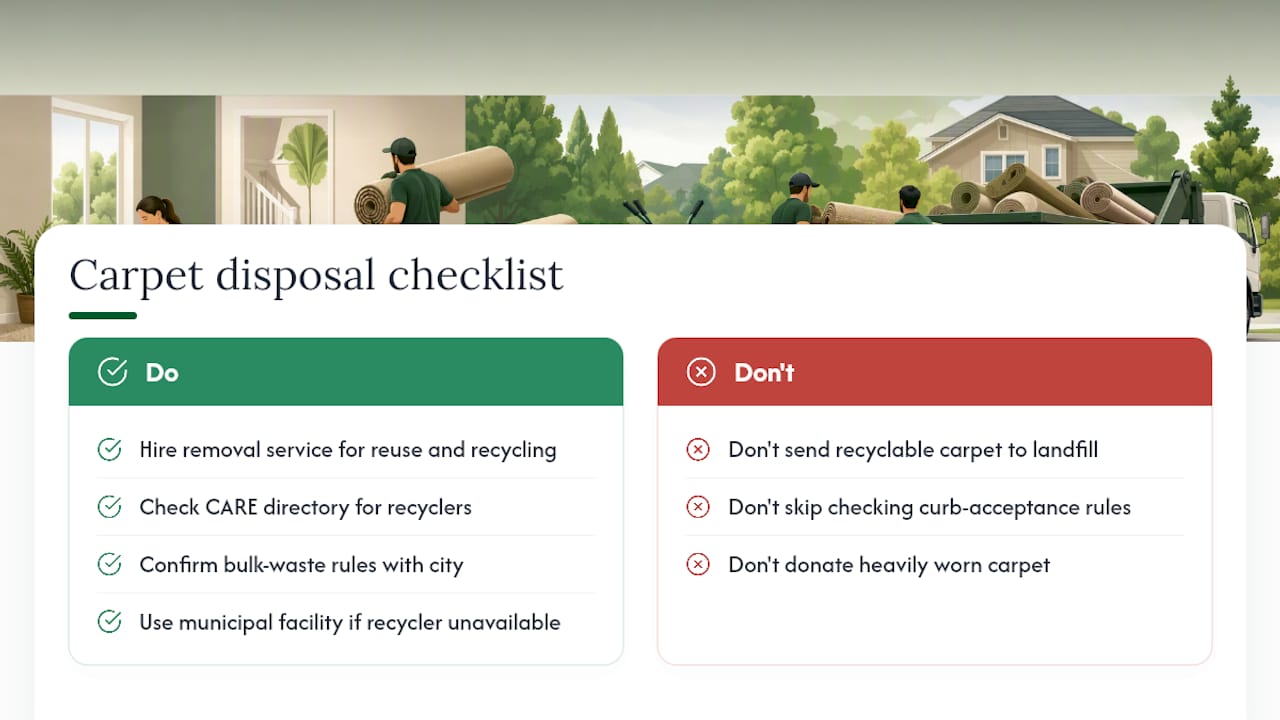
What should I do with carpet that’s too worn to donate? Route it to a CARE-listed recycler if possible, or take it to your municipal bulk-waste facility. Only send it to landfill if recycling and donation aren’t available locally.
Sources
- How to Dispose of Carpet | BobVila
- How to Dispose Your Old Carpets | Lowe’s
- Carpet | Hillsborough County, FL