
Central Indiana Homeowners: Photo Verified Eco Friendly Junk Removal
Central Indiana homeowners: discover a donate first system with photo quotes, donation routing, and documented receipts that help divert 60%+ of collected...
Central Indiana Homeowners: Photo Verified Eco Friendly Junk Removal
Eco-friendly junk removal means donate first, recycle second, landfill last. A responsible provider sorts your load and routes usable items to charities and certified recyclers instead of straight to the dump. The best operators document that routing, often diverting 60% or more of what they collect, and price it competitively with standard hauling. The EPA backs the environmental case, and Ohanapropertyexperts builds its Central Indiana cleanouts around this exact hierarchy.
TL;DR:
- Diversion rates are often overstated; a true landfill alternative depends on documented transfer to charities or certified recyclers, not just percentages.
- Manual sorting at local yards is crucial for high diversion percentages, but most competitors skip this step, reducing actual eco-friendliness.
- Proper routing and partnerships with donation centers and certified e-waste processors dictate the real environmental impact of junk removal.
- Heavy or hazardous items often require special handling and can increase costs, especially when additional licenses or transportation are necessary.
- Asking for proof of donations, specific recycling partners, and how diversion rates are calculated is essential to verify eco-friendly claims.
Table of Contents
- What Does Eco-Friendly Junk Removal Actually Mean?
- What Happens to Your Junk After Pickup?
- Where Does Your Old Furniture, TV, or Mattress Actually Go?
- How Much Does Eco-Friendly Junk Removal Cost?
- What Should You Do Before the Junk Removal Crew Arrives?
- How Do You Choose a Provider That Actually Recycles?
- How Ohanapropertyexperts Builds Donate-First Into Every Cleanout
- Why Donate-First Removal Builds Stronger Communities
- Get a Free Quote for Eco-Friendly Cleanout Service
- Where to Learn More About Responsible Junk Disposal
- Sources
What Does Eco-Friendly Junk Removal Actually Mean?
The industry term for what most people call “green junk removal” is landfill diversion, and it works on a simple order of operations. Usable furniture, appliances, and household goods go to donation partners first. Anything that can’t be reused goes to a recycler second. Only what’s left, contaminated, broken beyond repair, or unrecyclable, gets landfilled.
That hierarchy matters more than it sounds. Every couch that skips the landfill and goes to a family in need saves a resale value that would otherwise vanish, and every metal appliance that reaches a scrap processor keeps raw ore in the ground. Organic waste rotting in a landfill produces methane, a greenhouse gas the EPA tracks as one of the biggest reasons diversion matters at a national scale. Reducing what reaches a landfill also reduces the ongoing methane output from that site for years, since decomposition doesn’t stop when the truck leaves.
Here’s where you need to slow down and read the fine print on any provider’s “green” claims:
- “100% eco-friendly” is almost always marketing, not math. Real loads include soiled upholstery, moldy mattresses, and broken items with no reuse or recycling stream, and honest operators say so.
- Weight and volume tell different stories. A provider claiming “80% diverted” might mean 80% of the truck’s cubic footage, not 80% of the tonnage, and heavy landfill-bound debris can quietly dominate the weight column while looking small on a load sheet.
- Diversion rates only mean something with a destination attached. A percentage without a donation receipt or recycler name is a number, not proof.
Ask any provider how they measure their rate before you trust the figure on their website.
What Happens to Your Junk After Pickup?
The truck pulling away from your driveway isn’t headed to a landfill. It’s headed to a sort yard, and that stop is where diversion actually happens.
- Onsite walkthrough. The crew does a fast pass at your property, separating obvious donation candidates (furniture in good shape, working appliances) from debris before anything gets loaded.
- Loading and hub routing. Trucks follow a hub-and-spoke model, running collected loads back to a central transfer yard rather than driving straight to a disposal site, a pattern multiple operators describe in detail.
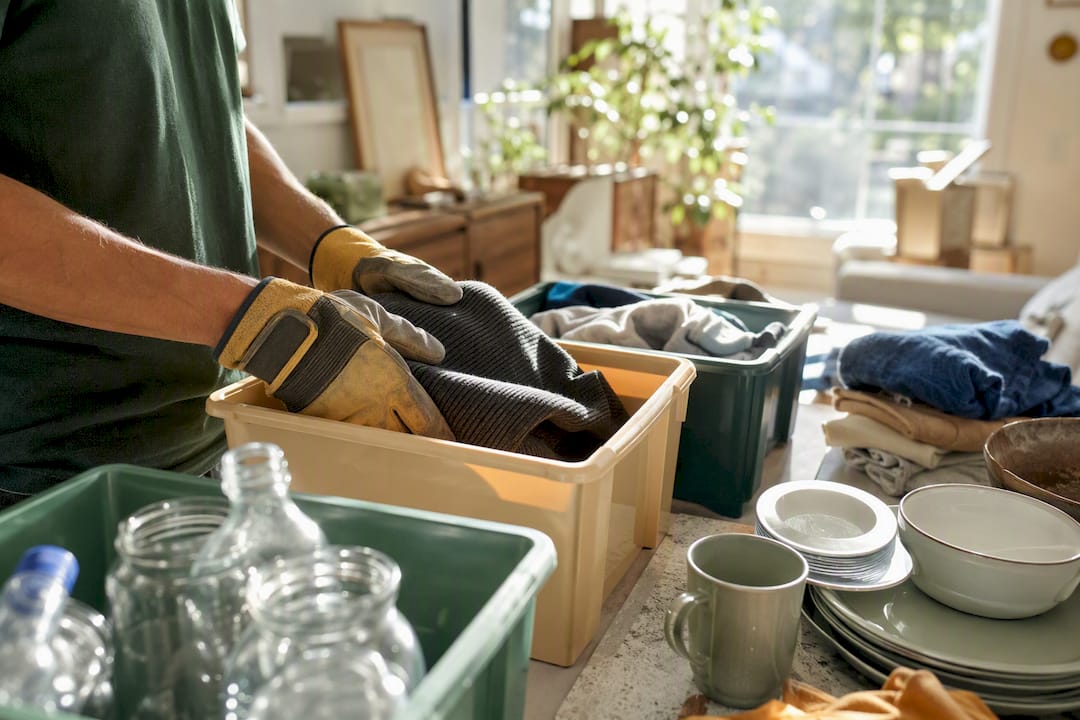
- Manual sorting at the yard. Crews physically separate the load: donations to one pile, scrap metal to another, electronics to a bin bound for a certified processor, hazardous items set aside for licensed handling.
- Distribution to final destinations. Furniture and household goods go to donation centers, e-waste goes to R2 or e-Stewards certified recyclers, metal goes to scrap yards, yard debris goes to composting facilities, and construction material goes to a construction and demolition (C&D) processor.
- Landfill as the last stop, not the first. Whatever has no home elsewhere goes to the landfill, ideally the smallest fraction of the load.
By the Numbers: Providers built around this donate-first model report diverting 60% or more of collected loads from landfills, a figure that depends entirely on step three, the manual sort, actually happening instead of getting skipped.
That manual deconstruction step is the part most homeowners never see and most competitors skip. A truck that drives straight from your curb to a transfer station without sorting isn’t practicing eco-friendly junk removal no matter what the website says. Diversion rates also live and die on local infrastructure. A provider can be fully committed to donation-first hauling, but if the nearest charity’s warehouse is full or the closest e-waste processor is two counties away, some of that commitment doesn’t translate into real numbers. This is why asking a local provider about their specific partnerships matters more than trusting a national average.
Where Does Your Old Furniture, TV, or Mattress Actually Go?
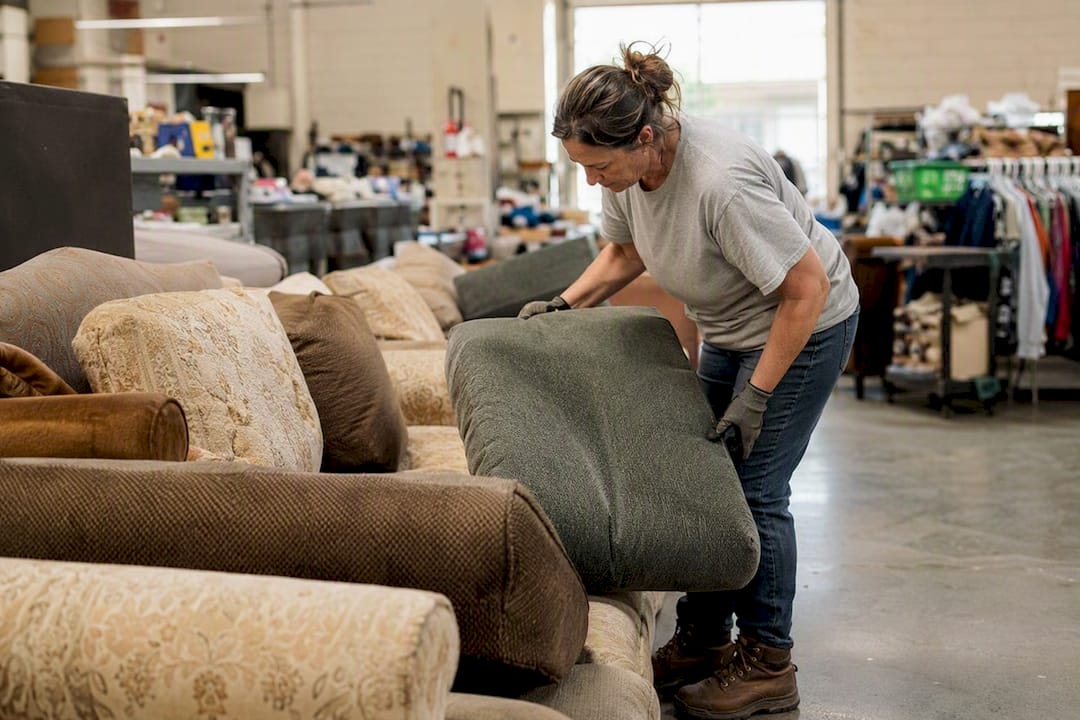
Different items follow genuinely different paths, and knowing them in advance helps you sort before the truck even arrives.
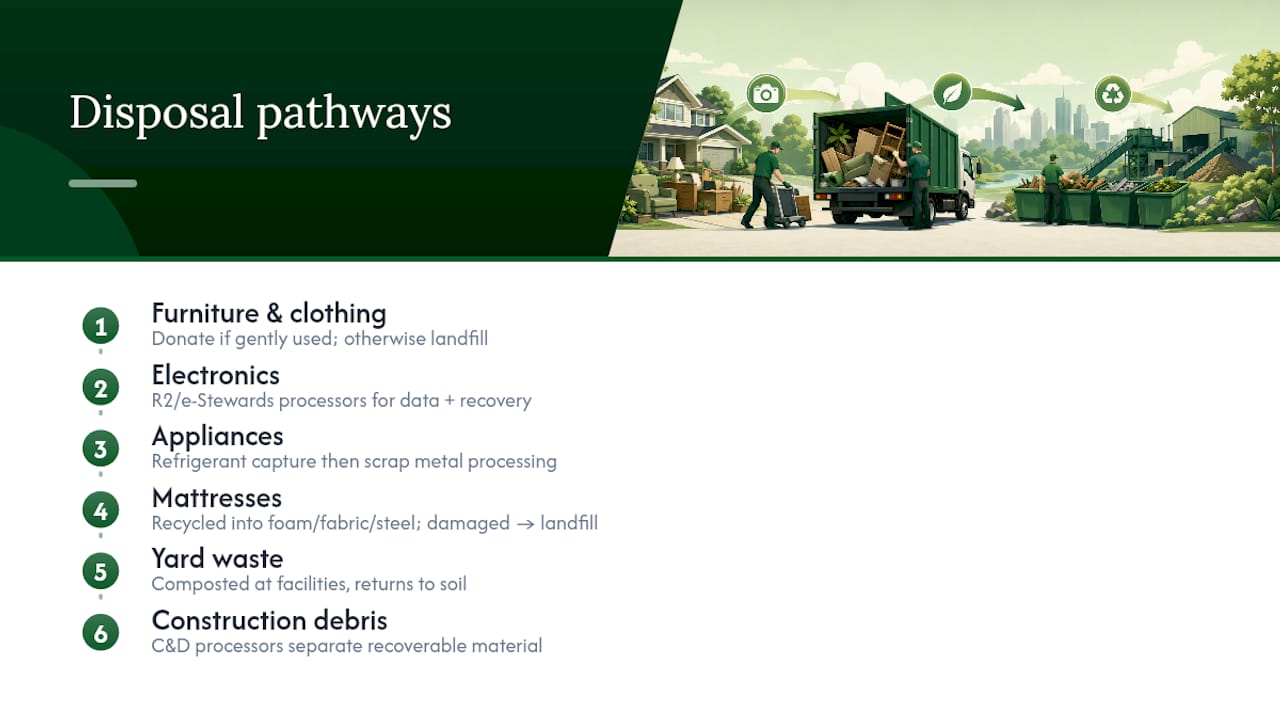
Furniture and clothing. Most charities accept furniture in gently used condition, meaning no major stains, structural damage, or odor. Anything below that threshold typically can’t be resold and gets routed to disposal instead, which is why a quick cleaning pass before pickup can shift an item from landfill to donation.
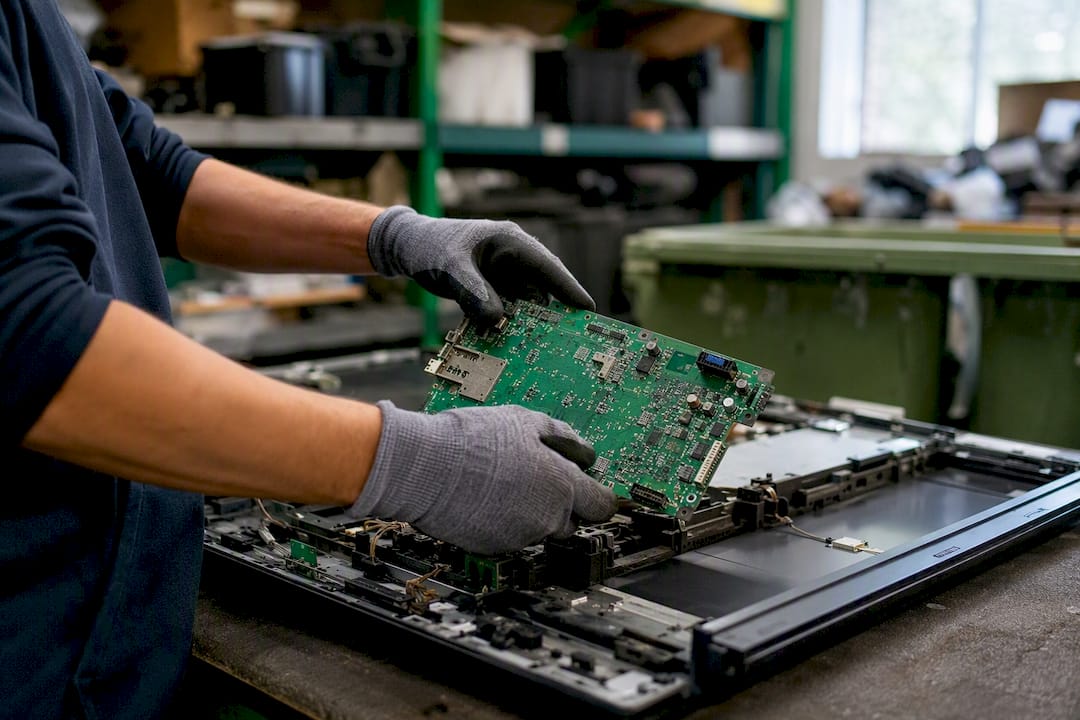
Electronics. TVs, computers, and monitors carry sensitive data and hazardous components like lead and mercury, and many states restrict them from landfills entirely. Responsible removal routes them to processors certified under R2 or e-Stewards standards, which handle data destruction and safe material recovery rather than just crushing the device.
Appliances. Refrigerators, freezers, and window AC units contain refrigerants that must be captured before the unit is scrapped for metal, a legal requirement, not an optional courtesy.
Mattresses. Mattress recycling programs strip foam, fabric, and steel springs into separate material streams, but a mattress that’s been water damaged or infested typically can’t enter that pipeline and goes to a landfill instead.
Yard waste. Grass clippings, branches, and leaves usually route to composting facilities rather than a transfer station, closing the loop back into soil rather than taking up landfill space.
Construction debris. Drywall, lumber, and shingles go to specialized C&D processors that separate recoverable material from waste.
The honest exception list matters too: contaminated insulation, chemically soaked wood, and anything biologically hazardous almost always ends up landfilled because no secondary market exists for it. A provider that tells you this upfront is being straight with you, not making excuses.
How Much Does Eco-Friendly Junk Removal Cost?
Pricing generally follows one of three models: truck volume (you pay for the space your junk occupies, often measured in eighths or quarters of a trailer), item-based flat rates for specific things like a couch or refrigerator, or a flat estimate quoted after a walkthrough or photo review.
By the Numbers: Residential eco-friendly junk removal often starts around $100 for smaller loads, with the final price climbing based on volume, weight, and how many separate destinations the load requires.
Several factors push a quote higher than that starting figure:
- Heavy items like pianos, safes, or hot tubs require extra labor and sometimes special equipment, adding to labor time regardless of volume.
- Multiple destination drops mean more stops for the crew, since a load headed to a donation center, a metal recycler, and a landfill takes longer than a single dump run.
- Hazardous item handling often requires a separate licensed transporter, since general haulers typically can’t accept paint, solvents, or propane tanks in the same load as household junk.
- Distance to sort yards or specialized processors adds fuel and time costs, particularly in rural areas farther from certified e-waste or C&D facilities.
Here’s the part that surprises people: choosing an eco-friendly provider rarely costs more than a traditional hauler charging for straight-to-landfill service. Efficient routing, where donation centers, recyclers, and the transfer yard are mapped out before the truck even leaves, tends to absorb the extra sorting labor rather than passing it on as a premium. The fee you’re really paying for is convenience and proper handling, not the “green” label itself.
What Should You Do Before the Junk Removal Crew Arrives?
A little prep work before booking can shift more of your junk from landfill to donation and keep your final quote accurate.
- Do a donation pass first. Set aside anything you’d want to sell or give away yourself, since a provider’s donation routing works best on items you’ve already deemed worth keeping in circulation.
- Photograph large or unusual items. Send photos of couches, appliances, or anything bulky when requesting a quote so the estimate reflects the real job, not a guess.
- List hazardous items in advance. Paint cans, solvents, and propane tanks generally need a licensed household hazardous waste facility or specialized transporter, not a standard haul.
- Clear a path and label donation items separately. A clear walkway speeds up the crew’s work, and labeling items you know are donation-worthy helps them sort faster onsite.
- Ask for proof of diversion if you need documentation. Estate executors and anyone tracking donations for tax purposes should request a receipt or diversion summary before the job, not after.
Pro Tip: Take five minutes to snap photos of your hazardous items separately from your general junk photos when requesting a quote. Providers often need to arrange a different pickup or drop-off for paint, batteries, and propane, and knowing in advance keeps that from becoming a surprise on pickup day.
How Do You Choose a Provider That Actually Recycles?
Anyone can put a recycling logo on a truck. Verifying the claim takes a few direct questions.
- Ask for their diversion rate and how they calculate it. A provider that answers with a specific number and explains whether it’s measured by weight or volume is giving you something you can verify. One that shrugs isn’t.
- Request documentation, not just a promise. Donation receipts and named recycler partners turn a marketing claim into a paper trail, something estate executors and anyone reporting for ESG purposes should insist on.
- Ask which certified e-recyclers they use. R2 and e-Stewards certification means electronics get processed safely rather than dumped or illegally exported.
- Watch for red flags. A provider that won’t name a single donation partner, gives vague answers about “recycling centers,” or pressures you to sign before explaining their process is worth a second look. Reading how other providers describe their evaluation process can help you calibrate what a straight answer sounds like.
- Documentation matters most for estate sales and business cleanouts. If you’re settling an estate or reporting sustainability metrics, get the diversion proof in writing before the job, not as an afterthought.
How Ohanapropertyexperts Builds Donate-First Into Every Cleanout
Ohanapropertyexperts runs its Central Indiana cleanouts on the same donate-first, recycle-second principle covered throughout this article, not as a marketing add-on but as the default workflow for every job.
Every estimate starts with photos of the items in question, letting homeowners and estate executors get an accurate quote without a stranger walking through their home first. From there, our full range of cleanout and removal services routes usable furniture, appliances, and household goods to local donation partners before anything gets hauled to disposal. That matters most in estate cleanouts, where families often want documentation that grandma’s dining set went to a family who needed it, not a landfill.
We offer free estimates across Columbus, Indiana and the surrounding Central Indiana communities we serve, and every job, from a single appliance pickup to a full property cleanout, follows the same sorting discipline: donate what’s usable, recycle what’s not, and landfill only what’s left with nowhere else to go.
Why Donate-First Removal Builds Stronger Communities
The environmental case for donate-first junk removal is easy to make. The community case gets overlooked, and it shouldn’t.
When a couch goes to a Habitat for Humanity ReStore instead of a landfill, that sale funds affordable housing construction in the same region. When a working refrigerator goes to a family furnishing their first apartment through a shelter partnership, that’s a direct transfer of value that never shows up in a diversion percentage. Marketing claims about “green” hauling are cheap to print on a truck door. Actual local partnerships, the kind that require a provider to know a ReStore manager by name or have a standing relationship with a shelter’s intake coordinator, are harder to fake and far more valuable.
Read past the diversion percentage on any provider’s site. Ask who receives the donations and whether they’ll put that answer in writing. The providers willing to document where your junk actually goes are the ones treating this as an operational commitment rather than a slogan.
— Olga
Get a Free Quote for Eco-Friendly Cleanout Service
Ohanapropertyexperts is the direct alternative to hauling companies that dump first and sort later, if at all. We build donation routing into every quote from the start, using photo-based estimates so you know the cost and the plan before a truck ever shows up at your property.
Whether you’re clearing out a loved one’s estate, prepping a rental for a new tenant, or finally tackling the garage, our property cleanout services follow the same donate-first, recycle-second approach outlined throughout this article. Estate executors get documentation. Homeowners get a fast, fair quote. Landlords and investors get properties cleared and ready for the next step without wondering where the junk ended up.
Call (812) 302-6833 or request a free estimate today, and find out how much of your junk never has to see a landfill at all.
Where to Learn More About Responsible Junk Disposal
A few resources worth bookmarking if you want to go deeper on donation and recycling standards:
- The EPA’s national waste and recycling overview explains the data behind landfill diversion and methane reduction.
- Habitat for Humanity ReStore accepts household donations and building materials at locations nationwide.
- The Salvation Army’s pickup scheduling page helps homeowners arrange furniture donation pickups directly.
- Our own cleanout tips and stories blog covers practical guidance on furniture disposal, bulk removal, and appliance recycling for Central Indiana homeowners.
Sources
- Sustainable junk removal: a better approach (Waste360)
- National overview: facts and figures about materials, waste and recycling (EPA)
- Where does your junk actually go? An honest look inside the sort. (STUFF Junk Removal)