
Landlord Junk Removal Rights Explained for 2026
Learn the landlord junk removal rights explained for 2026. Understand your legal authority to manage tenant belongings and avoid liability.

Landlord Junk Removal Rights Explained for 2026
Landlord junk removal rights are the legal authority property owners hold to manage, store, and dispose of belongings left behind by tenants after eviction or vacancy. These rights exist under state landlord-tenant statutes and local housing codes, not as a blanket license to throw everything away. The key distinction every landlord must understand is the difference between obvious trash and items of potential value. Get that wrong, and you risk a conversion lawsuit. Get it right, and you turn over a clean property fast, legally, and without dispute.
What legal rights do landlords have to remove tenant junk?
Landlord junk removal rights are defined by state law, not personal judgment. Most states give landlords the right to remove and dispose of property only after a writ of possession has been executed or the tenant has formally vacated. Acting before that point, even if the unit looks abandoned, exposes you to serious liability.
The most critical legal concept here is the distinction between trash and property of value. Obvious trash versus items of value is the line that separates a clean legal cleanout from a conversion claim. Obvious trash includes broken furniture, food waste, and items with no resale or sentimental value. Items of value include electronics, clothing, documents, tools, and anything a reasonable person would want back.

Standard practice requires landlords to hold valuables 24–72 hours after the eviction writ is executed. That window gives the tenant a realistic chance to retrieve belongings before disposal. Some states set longer holding periods, so always check your specific state statute.
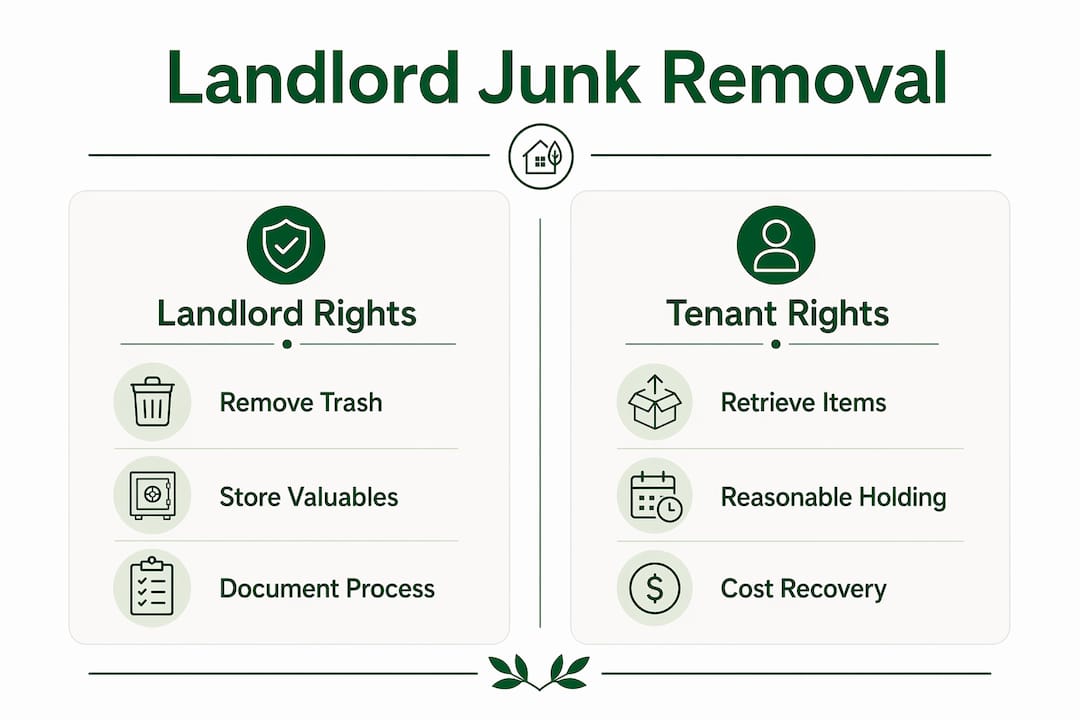
Key landlord rights and limitations at a glance:
- Right to remove obvious trash immediately after legal possession is granted
- Right to store items of value in a secure, weather-protected location pending tenant retrieval
- Right to dispose of unclaimed items after the legally required holding period expires
- No right to sell, keep, or destroy valuables before the holding period ends
- No right to enter or remove property before the writ of possession is executed
Pro Tip: Document the condition of every room with timestamped photos before you touch a single item. That photo record is your first line of defense if a tenant later claims you disposed of something valuable.
How should landlords handle tenant belongings to comply with legal requirements?
Compliance with tenant property disposal rules is not optional. Improper disposal without legal authority can result in a conversion lawsuit, where the tenant sues you for the value of items you discarded. The financial exposure from a single conversion claim can far exceed the cost of a professional cleanout.
The correct process follows a clear sequence:
- Confirm legal possession. Do not touch tenant belongings until the court has issued a writ of possession and it has been executed by law enforcement.
- Separate trash from valuables. Walk the unit and categorize items. Broken, unsanitary, or clearly worthless items are trash. Everything else is potentially a “item of value.”
- Send written notice. Written notice must inform the tenant about what property was left, where it is stored, any storage fees, and the deadline to reclaim it. Send this by certified mail and keep the receipt.
- Store items securely. Secure, weather-tight storage is required for any items you hold. A locked garage or storage unit works. An open yard does not.
- Handle special items with extra care. Firearms found in a vacated unit must be turned over to local law enforcement immediately. Do not store or dispose of them independently. Legal documents, medications, and financial records also require careful handling.
- Dispose after the holding period. Once the notice deadline passes and the tenant has not retrieved belongings, you may dispose of items per your state’s rules.
Pro Tip: Avoid storing abandoned tenant property on-site whenever possible. On-site storage creates liability if items are damaged or stolen. A licensed third-party storage facility shifts that risk away from you.
What are landlords’ responsibilities for trash removal during tenancy?
Landlord obligations for cleanouts and ongoing waste management do not begin at eviction. They run throughout the entire tenancy. Landlords are responsible for providing waste collection systems and maintaining waste areas in rental properties. That duty applies whether you own a single-family rental or a 20-unit building.
The table below outlines how responsibilities typically divide between landlords and tenants:
| Responsibility | Landlord | Tenant |
|---|---|---|
| Provide trash collection access | Yes, required by housing codes | No |
| Maintain common waste areas | Yes, non-delegable duty | No |
| Remove trash from individual unit | No, unless lease specifies | Yes |
| Dispose of bulk or junk items | Yes, after vacancy or eviction | Yes, during tenancy |
| Keep unit sanitary | Shared duty | Primary duty |
Lease agreements cannot exempt landlords from providing sanitary living conditions, including trash management in common areas. You can write lease clauses that require tenants to bag their own trash, use designated bins, and haul away bulk items. Those clauses are enforceable and reduce disputes. But they do not eliminate your baseline duty to maintain the property.
Landlords who neglect common waste areas in multi-unit properties face municipal fines, health code violations, and tenant complaints. A clear lease clause on junk removal, combined with regular property inspections, is the most practical way to stay ahead of these issues.
How can landlords document junk removal to protect themselves?
Documentation is the single most effective tool landlords have against tenant disputes. Itemized logs and timestamped photos prove that removal was systematic, professional, and legally compliant. Without that record, a tenant’s claim that you threw away something valuable becomes very difficult to disprove.
A solid documentation practice covers these areas:
- Timestamped photos of every room before, during, and after the cleanout
- Itemized removal log listing each item removed, its condition, and how it was handled
- Copies of all notices sent to the tenant, with certified mail receipts
- Records of storage arrangements, including the facility name, address, and dates
- Receipts from professional junk removal services, showing what was removed and when
Using insured professional cleanout services adds another layer of protection. A licensed, insured company carries its own liability coverage and can provide documented proof of removal. That documentation supports your case in any dispute and shows a court that you acted professionally.
Ohanapropertyexperts provides rental property cleanouts with documented removal processes built in, which is exactly what landlords need when legal compliance is on the line.
How can landlords recover junk removal costs from tenants?
Junk removal costs are recoverable from a tenant’s security deposit under specific conditions. Costs deducted must align with state security deposit laws and must be documented with receipts. You cannot estimate or guess at costs. Every dollar deducted needs a paper trail.
Practical rules for cost recovery:
- Deduct only documented, reasonable costs. Keep all receipts from cleanout services, storage facilities, and disposal fees.
- Follow your state’s itemization deadline. Most states require landlords to send an itemized deduction statement within 14–30 days of the tenant vacating.
- Do not deduct for normal wear and tear. Security deposit laws in most states prohibit deductions for routine deterioration.
- Charge separately for extraordinary junk. If a tenant left behind a truckload of furniture and appliances, costs may exceed the deposit. You can pursue the balance in small claims court with proper documentation.
- Be specific in your itemization. “Junk removal: $350, receipt attached” is defensible. “Cleaning and misc: $350” is not.
Landlords can deduct junk removal costs from security deposits when the lease clearly assigns that responsibility to the tenant and the charges are supported by receipts. A well-written lease clause on junk removal makes this process much cleaner.
Key Takeaways
Landlords who follow documented, legally compliant procedures for junk removal after eviction protect themselves from conversion claims, recover costs legally, and turn over properties faster.
| Point | Details |
|---|---|
| Distinguish trash from valuables | Remove obvious trash immediately; hold items of value 24–72 hours for tenant retrieval. |
| Send written notice | Notify tenants in writing of stored items, location, fees, and retrieval deadline before disposal. |
| Store items securely | Use locked, weather-tight storage; never leave valuables exposed on-site. |
| Document everything | Timestamped photos and itemized logs are your legal defense against tenant disputes. |
| Recover costs correctly | Deduct only documented junk removal costs from the security deposit within your state’s deadline. |
What I’ve learned from watching landlords get this wrong
I have seen landlords lose small claims cases over a $200 box of tools they tossed without documentation. The tenant showed up with a photo of the tools from a social media post, and the landlord had nothing to counter it. That case could have been avoided with a five-minute walkthrough and a phone camera.
The biggest mistake landlords make is treating eviction cleanouts like a personal cleanup project. They move fast, skip the notice, and assume the tenant forfeited everything. State law does not see it that way. The tenant’s right to retrieve belongings survives the eviction itself. That is a fact most landlords learn the hard way.
My honest recommendation is to treat every cleanout like it will end up in front of a judge. Write the notice, send it certified, photograph everything, and use a professional service that hands you a receipt. The cost of doing it right is a fraction of the cost of defending a conversion claim. And if you are managing multiple rental units in Central Indiana, building a relationship with a reliable cleanout partner is one of the best operational decisions you can make. Speed matters when a unit is sitting empty, but not more than compliance.
— Olga
Ohanapropertyexperts supports landlords with compliant property cleanouts
Landlords in Central Indiana trust Ohanapropertyexperts to handle rental property cleanouts with the speed and documentation that legal compliance requires.

Ohanapropertyexperts handles full property cleanouts for eviction scenarios, tenant move-outs, and foreclosure situations across Columbus, Seymour, Greenwood, Indianapolis, and surrounding communities. Every job includes documented removal, responsible disposal, and free estimates. The team is insured, experienced with landlord timelines, and ready to turn over your property fast. Call (812) 302-6833 or visit ohanapropertyexperts.com to request your free quote today.
FAQ
What is the legal definition of “items of value” after eviction?
Items of value are belongings a reasonable person would want to retrieve, including electronics, clothing, tools, and documents. Obvious trash such as broken furniture or food waste does not qualify and can be removed immediately after legal possession is granted.
How long must a landlord hold tenant belongings after eviction?
The standard holding period is 24–72 hours after the writ of possession is executed, though some states require longer periods. Always verify your specific state statute before disposing of any items.
Can a landlord deduct junk removal costs from a security deposit?
Yes, landlords can deduct documented junk removal costs from a security deposit when the lease assigns that responsibility to the tenant and receipts support every charge. Deductions must be itemized and sent within your state’s required deadline.
What should a landlord do if firearms are found in a vacated unit?
Turn firearms over to local law enforcement immediately. Storing or independently disposing of firearms creates serious legal liability. Do not handle them beyond securing the unit and contacting police.
Does a lease clause override a landlord’s duty to maintain trash areas?
No. Lease clauses can assign trash duties to tenants for their individual units, but landlords cannot delegate the duty to maintain sanitary conditions in common waste areas. That obligation exists under housing codes regardless of what the lease says.