
Cleanout Service Agreements Explained for Property Owners
Discover cleanout service agreements explained. Learn their importance for property owners, ensuring accountability and protecting your investment.

Cleanout Service Agreements Explained for Property Owners
A cleanout service agreement is a formal contract that specifies the tasks, timelines, payments, and responsibilities between property owners or managers and cleanout service providers. This document is the legal backbone of any professional cleanout, whether you are managing an estate cleanout, a rental turnover, or a full property transition. Without a written agreement, property owners often cannot recover costs or challenge damage claims effectively in dispute resolution forums. Understanding cleanout service agreements explained in full detail protects your investment and keeps every party accountable from day one.
What are cleanout service agreements explained?
A cleanout service agreement is the industry’s standard term for a written service contract covering property cleanout work. The agreement defines exactly what the provider will do, when they will do it, what it costs, and who is responsible if something goes wrong. Think of it as the operating manual for your cleanout project.
These contracts appear across a wide range of situations. Landlords managing rental turnovers, estate executors clearing inherited properties, real estate investors prepping foreclosures, and homeowners preparing for a sale all rely on these agreements to set clear expectations. Each use case carries its own risks, and the contract is the tool that manages those risks before work begins.

Without a written agreement, you have no documented basis for disputing a charge, requesting a correction, or recovering costs if property is damaged. That gap can turn a straightforward cleanout into a costly legal problem. A signed contract eliminates that ambiguity.
What are the essential components of a cleanout contract?
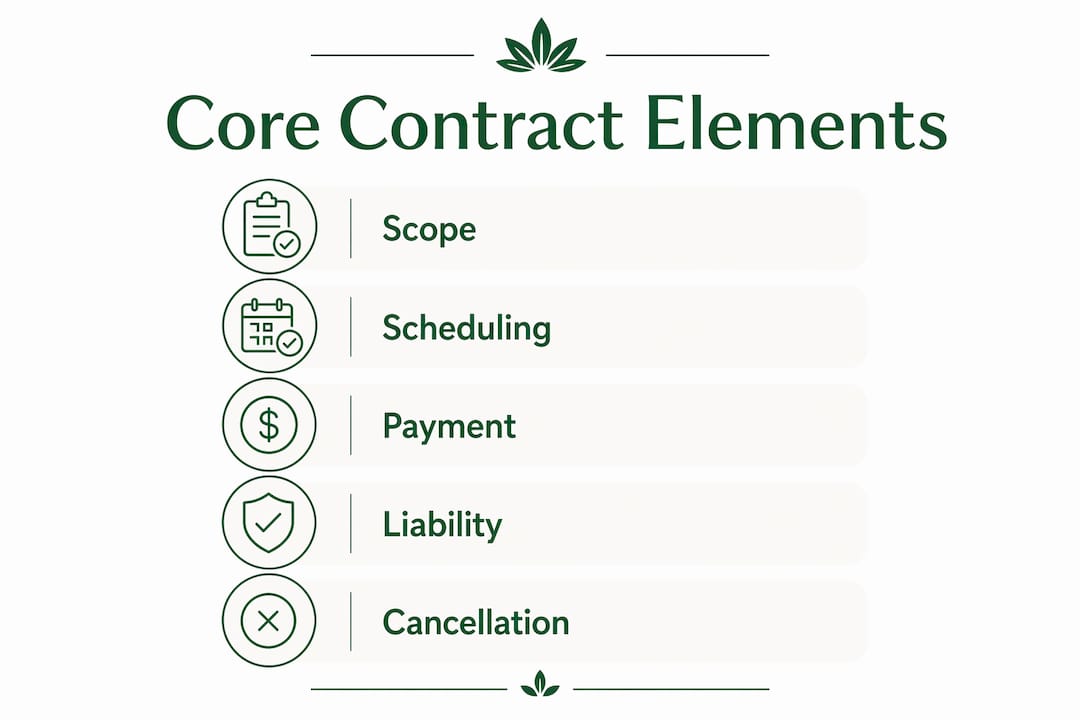
Every effective cleanout contract covers five core areas. Miss any one of them, and you create an opening for disputes, delays, or unexpected costs.
Scope of work
The scope of work is the most critical section of any cleanout agreement. It lists every task the provider will complete, every area they will access, and every item or area explicitly excluded from service. Explicitly listing tasks and exclusions prevents scope creep and reduces payment disputes. Vague language like “standard services” is the most common contract failure because it leaves both parties free to interpret the work differently.
A strong scope section includes:
- A room-by-room or zone-by-zone task list
- Item categories covered (furniture, appliances, debris, hazardous materials)
- Explicit exclusions (items requiring specialized disposal, areas locked or inaccessible)
- Notes on donation-conscious recovery or recycling preferences
Scheduling and payment terms
The scheduling section sets arrival windows, estimated duration, and any frequency requirements for recurring work. Precision here prevents the frustration of a crew showing up at the wrong time or a property owner expecting a two-day job to finish in one.
Payment terms deserve equal attention. Standard deposit amounts range from 10% to 50% of the total contract value, depending on the client’s financial history and the project’s risk level. That range reflects how much a provider needs upfront to cover labor and equipment before work begins. Late payment fees commonly run around 1.5% per month on overdue balances, with returned check fees typically between $35 and $50. Spelling these numbers out in the contract removes any surprise when invoices are due.
| Contract Element | What to Specify |
|---|---|
| Scope of work | Task list, areas covered, exclusions |
| Scheduling | Dates, arrival windows, estimated duration |
| Pricing | Total cost, deposit amount, payment methods |
| Liability and insurance | Provider’s coverage, damage reporting process |
| Cancellation policy | Notice period, refund terms, rescheduling rules |
Liability and cancellation clauses
Liability clauses define who pays if something is damaged during the cleanout. A reputable provider carries general liability insurance and lists that coverage in the contract. The cancellation policy sets the notice period required by both parties and whether deposits are refundable if a job is canceled within a certain window.
Pro Tip: Ask for a certificate of insurance before signing. A provider who cannot produce one creates a liability gap that falls directly on you as the property owner.
How do you prevent scope creep and disputes in cleanout agreements?
Scope creep is what happens when a job quietly expands beyond what was agreed, and someone ends up paying for work that was never authorized. The fix is precision at the contract stage, not after the crew is already on site.
Follow these steps to keep your agreement dispute-proof:
- Write a detailed task checklist. List every item and area by name. “Clear the basement” is not a task description. “Remove all furniture, cardboard boxes, and loose debris from the basement, excluding the locked storage room” is.
- Define the inspection process. A well-defined contract includes documented inspection windows, such as 4 hours for client-facing issues and 24 hours for routine problems. This gives you a clear window to flag incomplete work before the job is considered closed.
- Specify how changes are handled. Any request that falls outside the original scope should require a written amendment. Verbal agreements during a job are the fastest path to a billing dispute.
- Include a dispute resolution clause. This section names the process for resolving disagreements, whether that is direct negotiation, mediation, or small claims court. Having a process in writing discourages both parties from escalating minor issues.
- Document everything in writing. Emails, texts, and signed amendments all serve as evidence if a dispute reaches a formal resolution forum.
Pro Tip: Take timestamped photos of every room before the crew starts. That visual record is your strongest protection if a damage claim surfaces after the job is done.
Facility management experts emphasize defining how work will be checked and setting correction timelines to transform a contract into a practical management tool. A contract without an inspection process is just a price quote with a signature.
How do residential and commercial cleanout agreements differ?
The type of property you own determines how complex your contract needs to be. Residential and commercial agreements share the same core structure, but they diverge significantly in length, legal language, and risk management.
Residential cleanout agreements are typically 1–2 pages long, while commercial agreements extend to 3–5 pages due to additional complexities such as indemnification clauses and insurance requirements. That difference in length reflects a real difference in risk exposure and regulatory requirements.
Residential agreements typically include:
- Personal property handling instructions
- Donation or disposal preferences for household items
- Simple payment terms (check, card, or cash on completion)
- Basic liability language covering accidental damage
Commercial agreements typically include:
- Indemnification clauses protecting both parties from third-party claims
- Net-30 or net-60 payment terms common in business-to-business transactions
- Detailed insurance requirements, including workers’ compensation
- Regulatory compliance language for waste disposal and environmental standards
- Personnel substitution policies covering who can perform the work
When to engage legal counsel depends on the contract’s dollar value and complexity. A residential cleanout under $1,000 rarely needs an attorney. A commercial foreclosure cleanout covering multiple buildings and specialized debris removal almost always benefits from a legal review before signing.
A site walkthrough prior to contract finalization enables accurate scope setting by assessing property layout, traffic patterns, sensitive areas, and specialty needs. This step is non-negotiable for commercial properties and strongly recommended for large residential jobs.
Best practices for managing cleanout agreements during execution
Signing the contract is the beginning, not the end. How you manage the agreement during the actual cleanout determines whether the job goes smoothly or turns into a series of phone calls and corrections.
- Conduct a walkthrough before work begins. Walk the property with the crew lead and confirm every area in the scope. Note any conditions that differ from what was described at the estimate stage.
- Provide clear access instructions in writing. Specify which doors to use, where to park, and who to contact if access is blocked. Effective agreements assign access rules clearly to avoid delays on the job day.
- Use a checklist during the job. A printed or digital checklist tied directly to the scope of work lets you verify completion room by room before signing off.
- Communicate changes promptly. If you discover additional items or areas mid-job, contact the provider immediately and request a written amendment before the crew proceeds.
- Maintain all records after completion. Keep the signed contract, any amendments, invoices, and completion photos in one file. Maintaining and updating contracts over time as property conditions evolve prevents service decline and contractual misunderstandings on future jobs.
- Review the agreement before renewal. If you use cleanout services regularly, revisit the contract terms annually. Property conditions change, and your agreement should reflect current needs.
Treating cleanout services as a managed operation, rather than a casual engagement, produces better outcomes on scheduling, access issues, and personnel changes. The property owners who get the best results are the ones who stay engaged throughout the process, not just at the start and finish.
Key Takeaways
A cleanout service agreement is the single most effective tool for preventing disputes, controlling costs, and ensuring the work matches your expectations on every property transition.
| Point | Details |
|---|---|
| Define scope precisely | List every task, area, and exclusion by name to prevent scope creep and billing disputes. |
| Set payment terms upfront | Deposits range from 10%–50% of contract value; late fees and returned check charges should be written in. |
| Match contract length to property type | Residential agreements run 1–2 pages; commercial agreements require 3–5 pages with indemnification and insurance clauses. |
| Build in an inspection process | Set correction windows (4 hours for urgent issues, 24 hours for routine) so incomplete work is addressed before the job closes. |
| Manage the agreement actively | Document walkthroughs, communicate changes in writing, and update contracts as property needs evolve. |
What I have learned from years of cleanout contracts
The contracts that cause the most problems are rarely the ones with complicated legal language. They are the ones that were written in a hurry and signed without a walkthrough. I have seen property owners hand over access to a crew based on a one-paragraph email, then spend weeks trying to recover costs for items that were removed without authorization. A two-page agreement would have prevented every one of those situations.
The detail that most property owners overlook is the inspection window. People focus on the price and the date, then forget to ask how corrections are handled if the work is incomplete. That omission turns a minor oversight into a standoff. Building a 24-hour correction window into every agreement gives both parties a fair process without requiring an attorney.
My honest advice: treat your cleanout agreement as a living document. If you use full property cleanout services on a recurring basis, review the contract before each new job. Property conditions change, crews change, and what worked for a three-bedroom rental may not cover a five-unit foreclosure. The property owners who update their agreements regularly are the ones who avoid the calls I hear most often: “We didn’t know that wasn’t included.”
The other thing worth saying directly is that compassion matters in this work. Estate cleanouts especially involve personal property with real emotional weight. A good agreement protects the property owner, but a good provider also honors the spirit of that agreement by handling every item with care. That combination of clear terms and professional conduct is what makes a cleanout go well.
— Olga
Ohanapropertyexperts: professional cleanouts backed by clear agreements
Property transitions move fast. Whether you are clearing an estate, turning over a rental, or prepping a foreclosure for sale, you need a provider who shows up prepared and works from a transparent agreement.
Ohanapropertyexperts serves Columbus, Indianapolis, Greenwood, Seymour, and surrounding Central Indiana communities with full-service cleanouts backed by clear, written agreements. Every job starts with a free estimate and a scope review so you know exactly what is covered before any work begins. From estate cleanout services to debris hauling and appliance removal, Ohanapropertyexperts handles the hard work while you stay in control of the process. Call (812) 302-6833 or visit ohanapropertyexperts.com to get your free quote today.
FAQ
What is a cleanout service agreement?
A cleanout service agreement is a written contract between a property owner and a cleanout provider that defines the scope of work, payment terms, scheduling, and liability. It protects both parties and serves as the legal record of what was agreed before work begins.
What should be included in cleanout contract details?
Every cleanout contract should include a detailed task list, explicit exclusions, scheduling windows, deposit and payment terms, liability and insurance language, and a cancellation policy. Missing any of these elements creates gaps that lead to disputes.
How do I prevent scope creep in a cleanout agreement?
List every task and area by name in the scope of work, require written amendments for any changes, and include a documented inspection window so incomplete work is corrected before the job is closed.
Do residential and commercial cleanout agreements differ?
Residential agreements typically run 1–2 pages and focus on personal property handling. Commercial agreements extend to 3–5 pages and add indemnification clauses, insurance requirements, and net-30 payment terms.
What deposit is standard for a cleanout service contract?
Standard deposits range from 10% to 50% of the total contract value, depending on the project’s size and the client’s payment history. The deposit amount should always be written into the signed agreement before work begins.