
How to Clean an Abandoned House: A Step-by-Step Guide
Discover how to clean an abandoned house safely with a step-by-step guide. Follow our checklist for efficient cleaning and safety tips.
How to Clean an Abandoned House: A Step-by-Step Guide
You can safely and efficiently clean an abandoned house by following a prioritized safety-first checklist, the four-box declutter method, and a room-by-room cleaning sequence. This is absolutely doable — but only if you go in prepared.
Before you take a single step inside, do these three things:
- Verify legal access. Confirm you own the property or have written authorization. Without it, you risk trespassing liability regardless of the property’s condition.
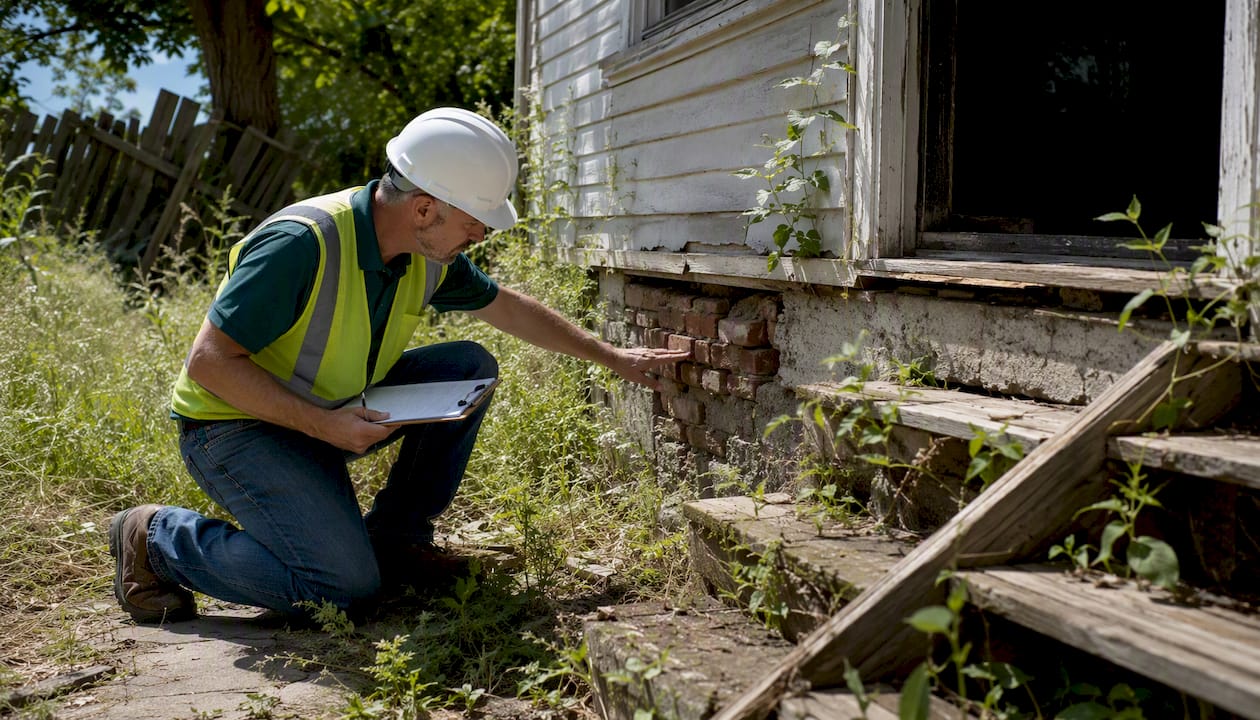
- Complete an exterior visual check. Look for sagging rooflines, leaning walls, broken windows, and signs of water intrusion. Photograph everything.
- Gear up with PPE before entry. Heavy-duty gloves, a respirator mask rated for mold and particulates, safety goggles, steel-toe boots, and long sleeves are mandatory. This full set protects against biohazards and sharp objects, per standard safety guidance.
Two hazards stop work immediately: visible structural collapse signs or active sewage. And the single highest-priority rule? Do not turn on utilities until a licensed professional or your utility provider has inspected them. The EPA and CDC both flag mold and biohazard exposure as serious health risks in long-vacant properties. Ohana Property & Transition Services LLC handles exactly these situations across Central Indiana, and this guide walks you through the same process their crews follow.
Table of Contents
- How do you safely clean an abandoned house before entering?
- How do you plan and prioritize a neglected property cleanout?
- What tools and supplies do you need to clean an abandoned property?
- What is the right order for deep cleaning an empty house?
- Which hazards should you never handle yourself?
- How should you handle disposal, donations, and hazardous waste legally?
- What does a cleanout cost and how long does it take?
- When should you hire a professional cleanout service?
- Key Takeaways
- Ohanapropertyexperts is ready to help you get this done
- Useful sources
How do you safely clean an abandoned house before entering?
Legal access comes first, and it is not optional. If you inherited the property or purchased it, keep that documentation on-site. If you are an estate executor, property manager, or investor working on behalf of an owner, get written authorization before any physical work begins. Local rules vary on permits for large-scale debris removal, so check with your county or municipality before renting a dumpster or hauling bulk waste.
Exterior structural check
Walk the full perimeter before opening any door. You are looking for:
- Sagging or visibly bowed roof sections
- Leaning or cracked exterior walls
- Broken or boarded windows (entry points for pests and weather)
- Pooled water, soil erosion, or foundation cracks suggesting water intrusion
- Obvious signs of fire damage or charring
Take photos of every concern. These images protect you legally and speed up any insurance or estate documentation later.
Utilities: leave them off
Prioritizing system safety over cosmetic cleaning is the single most important sequencing decision you will make. Turning on electricity to a house with corroded wiring or a damaged panel creates fire and electrocution risk. Restoring water pressure to cracked pipes floods the structure. Gas lines need a licensed plumber or your gas utility to inspect for leaks before you touch the shutoff. Call your utility providers and schedule inspections before the cleaning crew arrives.
Required PPE checklist
- Heavy-duty gloves (puncture-resistant)
- A respirator mask rated for mold and particulates
- Safety goggles
- Steel-toe boots
- Long sleeves and coveralls or disposable Tyvek suit
- Hard hat if the ceiling or roof shows instability
Pro Tip: Bring a partner. Never enter a structurally suspect property alone. Tell someone outside the property your plan and expected exit time. Pack a small first-aid kit. If you spot suspected asbestos-containing materials (textured ceiling tiles, pipe wrap, old floor tiles), active sewage, or any sign of structural collapse, stop immediately and call a licensed professional.
How do you plan and prioritize a neglected property cleanout?
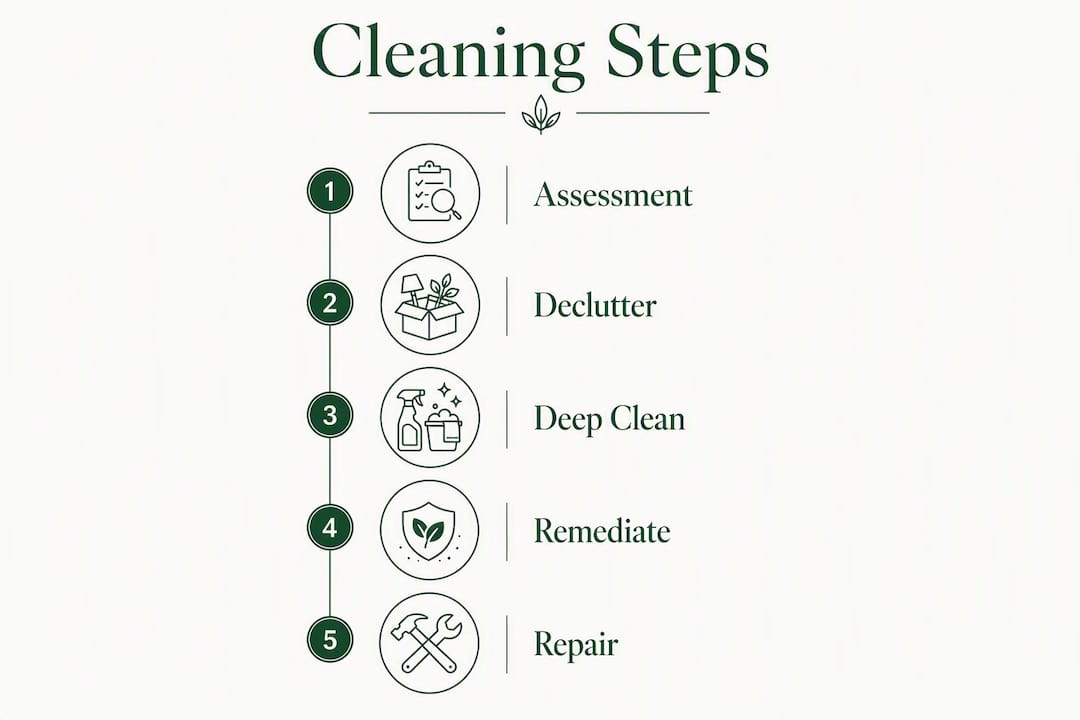
A neglected home cleanout has five phases: assessment, declutter, deep clean, remediate, and repair. Trying to do all five at once is how projects stall. Assign each phase its own day or days, and stick to the sequence.
The four-box method
The four-box method is the fastest way to declutter without second-guessing every item. Label four areas or containers:
- Keep — items the owner or estate is retaining
- Throw away — damaged, unsanitary, or worthless items
- Donate — functional items in reasonable condition
- Sell — items with resale value (furniture, tools, collectibles)
Work through every room with these four destinations in mind before you clean a single surface. Sorting and cleaning simultaneously creates chaos and doubles your time.
Room prioritization
Starting with the worst room — usually the kitchen or a bathroom — delivers two practical benefits. First, you create a functional staging area immediately. Second, the psychological lift of finishing the hardest space keeps the team motivated through the rest of the project.
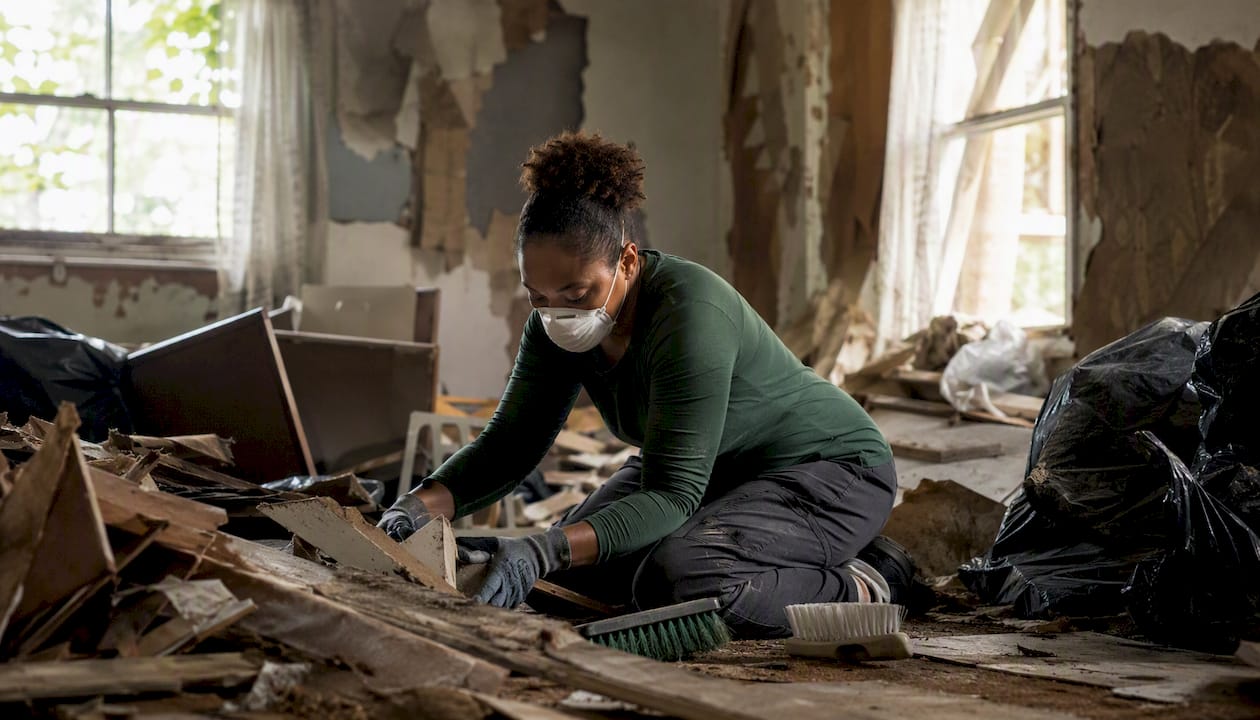
After the kitchen and bathrooms, move to entryways and exterior locks to secure the property. Living areas and bedrooms follow. Attic and basement come last because they are typically storage-heavy and may require remediation decisions.
Timeline planning by property size
- Small property (1–2 bedrooms, light neglect): a few days with a small crew
- Medium property (3 bedrooms, moderate neglect): several days with a moderate crew
- Large property or heavy neglect: over a week, likely requiring professional cleanout support and a roll-off dumpster
Large-volume debris removal almost always requires a dumpster rental or multiple truck loads. Book the dumpster before the first work day so it is on-site when you need it. For multi-day projects, rotate team members to prevent fatigue, and secure the property each night with new locks or boarded entry points.
What tools and supplies do you need to clean an abandoned property?
Arriving without the right equipment turns a two-day job into a week. Here is what to bring and what to rent.
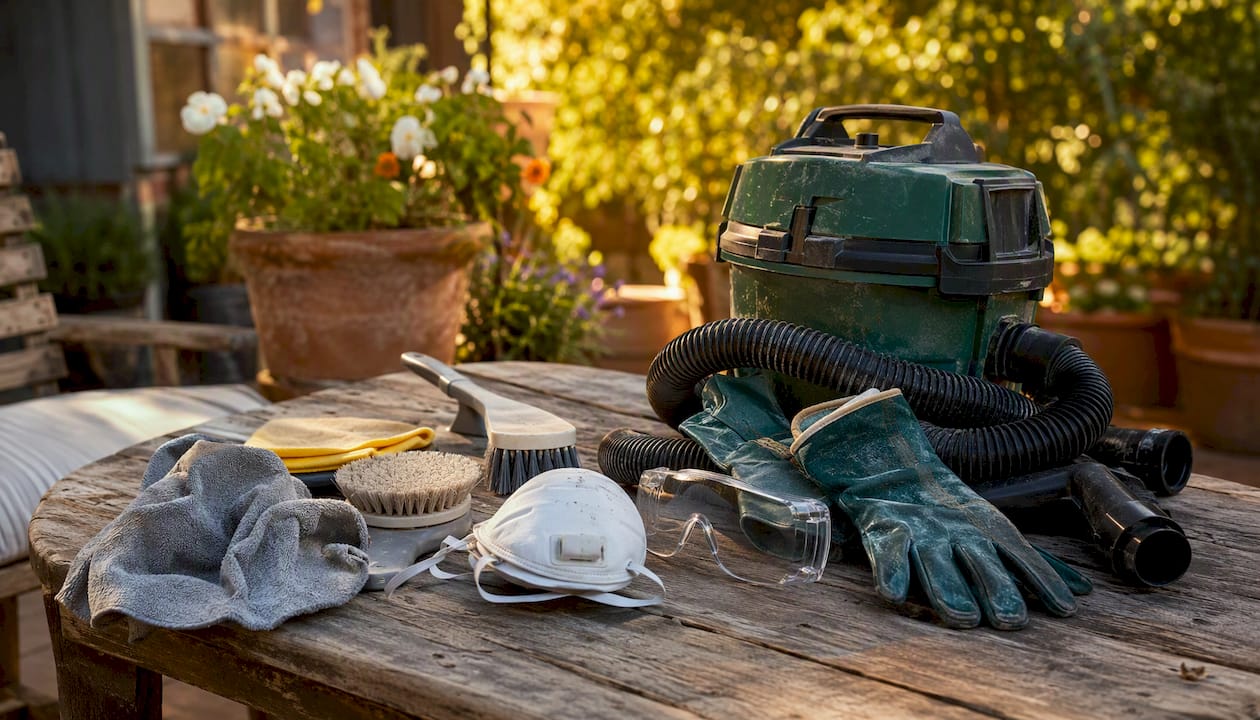
Basic PPE and hand tools
- Heavy-duty puncture-resistant gloves
- N95 or half-face respirator
- Safety goggles and hard hat
- Contractor-grade heavy-duty trash bags (3-mil minimum)
- Scrapers, putty knives, and a pry bar for stuck debris
- Heavy-duty broom and dustpan
Cleaning agents
- Heavy-duty disinfectant (EPA-registered)
- Mold-killing cleaner (check for active mold before choosing a product)
- Degreaser for kitchen surfaces and appliances
- Enzyme cleaner for organic waste and pet contamination
- Multi-surface floor cleaner
- White vinegar and baking soda for light mineral deposits
Large equipment
- HEPA-filter vacuum (critical — standard vacuums recirculate fine particulates)
- Shop vacuum for wet debris
- Dehumidifier and box fans for drying and ventilation
- Pressure washer for exterior surfaces and concrete
- Roll-off dumpster or scheduled haul service
HEPA vacuums and wet-cleaning are the right combination for long-vacant homes because dust in empty houses comes from degrading textiles, insulation fibers, and building materials — not just ordinary household dirt. Standard vacuums push those particles back into the air.
Appliance and furniture removal
- Appliance dolly and furniture straps
- Protective moving blankets
- A second person for anything over 50 lbs
Rent vs. buy: Rent HEPA vacuums, dehumidifiers, and pressure washers for a one-time job. Buy basic hand tools, PPE, and cleaning supplies outright — you will use them throughout the project.
What is the right order for deep cleaning an empty house?
The top-to-bottom, left-to-right rule prevents re-contamination. Clean ceilings and upper shelves first; floors last. Move systematically through each room from left to right so you never clean over an area you have already finished.
Step-by-step room sequence
- Exterior and entry points — clear debris, board or lock all entry points, photograph the full exterior
- Kitchen — remove all food and old appliances, degrease cabinets and surfaces, disinfect counters and sink, check under the sink for mold or pest evidence
- Bathrooms — treat visible mold with a mold-killing cleaner, disinfect all fixtures, check grout and caulk for deterioration
- Living areas and bedrooms — HEPA vacuum all surfaces and floors, remove porous items (old mattresses, upholstered furniture) that cannot be sanitized, wet-clean hard surfaces
- Basement — dry the space first with dehumidifiers and fans, check for standing water and mold, inspect the water heater and HVAC equipment
- Attic — check insulation condition (do not disturb if you suspect asbestos), look for pest nesting, assess roof decking from below
Do-not-do warnings
- Never sand or scrape textured ceiling tiles, old floor tiles, or pipe insulation without asbestos testing first
- Never mix bleach with ammonia-based cleaners
- Never power on a damaged electrical panel
- Never run gas appliances until the gas line has been inspected
Replace vs. deep-clean
Professional-grade treatments including HEPA vacuuming, antimicrobial fogging, and in some cases ozone treatment are often required for deep-set odors and biological contamination that household products cannot reach. As a general rule: metal, glass, and sealed hard surfaces can usually be cleaned. Porous materials — old mattresses, carpet, severely water-damaged drywall, and particle-board furniture — typically need replacement.
After the heavy clean, run dehumidifiers and fans for at least 24–48 hours before assessing whether a second lighter pass is needed. Severely neglected homes almost always benefit from that second pass once the bulk contamination has been removed.
Which hazards should you never handle yourself?
Some conditions in an abandoned property cross the line from DIY cleaning into licensed remediation territory. Crossing that line without credentials puts your health and legal standing at risk.
Hazard indicators that require a professional
- Widespread black or green mold covering more than a small, isolated patch
- Textured “popcorn” ceilings, old floor tiles, pipe wrap, or vermiculite insulation (potential asbestos)
- Peeling paint in a pre-1978 home (potential lead paint)
- Standing sewage or sewage odor inside the structure
- Chemical containers, drums, or unknown liquids
- Hypodermic needles, medical waste, or evidence of a decomposition scene
- Animal carcasses or large-scale pest infestation
Mold: when to DIY and when to call
Surface mold on a small, non-porous area (under 10 square feet, per EPA guidance) can often be addressed with a mold-killing cleaner and proper PPE. Anything larger, anything inside HVAC ductwork, or any situation where the moisture source is unknown requires a licensed mold remediation contractor. Hidden damp behind drywall is common in long-vacant homes and will return if the source is not fixed.
Asbestos and lead: never DIY
Never attempt to remove suspected asbestos, lead, or major mold infestations yourself. Biohazards such as needles, human waste, or animal carcasses also require licensed abatement or remediation professionals for safety and regulatory reasons.
Hire-a-pro checklist
- Verify state license and liability insurance
- Confirm containment plan (negative pressure, HEPA filtration)
- Get a written scope of work with line items
- Request proof of disposal (manifests or receipts)
- Ask for references from similar jobs
How should you handle disposal, donations, and hazardous waste legally?
Disposal is where many cleanouts slow down or create legal exposure. Plan your routing before the first bag hits the floor.
Disposal routing
- Regular trash haulers handle bagged household waste within their weight and volume limits — check your local service for bulk pickup rules and scheduling.
- Municipal bulk pickup is available in many Indiana communities for large items; call your city or county public works department to schedule.
- Roll-off dumpster rental is the most efficient option for large-volume debris. Book it before the project starts and confirm what materials the rental company accepts.
- Transfer stations and landfills accept materials that haulers will not. Know your nearest facility’s hours and accepted materials list.
Hazardous waste: separate it from the start
Paint, solvents, batteries, electronics, fluorescent bulbs, and chemical containers cannot go in regular trash or a standard dumpster. They must go to a designated hazardous-waste facility. Most Indiana counties hold periodic household hazardous waste collection events — check with your county solid waste district for dates and accepted materials.
Donation routing
Local estate cleanout services that offer donation-conscious recovery can route usable furniture, appliances, and household goods directly to charities and furniture banks, which saves you multiple trips and generates donation receipts for estate records. Before donating, photograph items for documentation, assess condition honestly, and confirm the receiving organization accepts the item type. Donation receipts matter for estate accounting and potential tax records.
Documentation checklist
- Photograph the property before any items are removed
- Keep all dumpster rental and haul receipts
- Retain hazardous-waste disposal manifests
- Log donation receipts with item descriptions and estimated values
- Check local permit requirements for large-scale debris removal before you start
Keeping this paper trail protects you during estate settlements, insurance claims, and property sales. For debris removal before listing, thorough documentation also reassures buyers and their agents.
What does a cleanout cost and how long does it take?
Cost and timeline depend on five main factors: property size, degree of neglect, presence of hazardous materials, disposal and dumpster fees, and whether you use professional labor.
Main cost factors
- Property size — square footage directly drives labor hours and disposal volume
- Degree of neglect — light neglect vs. years of accumulation can triple the labor requirement
- Hazardous materials — mold remediation, asbestos abatement, and biohazard cleanup are priced separately and add significant cost
- Dumpster and disposal fees — roll-off rentals, landfill tipping fees, and hazardous-waste disposal all vary by region
- Labor rates — DIY saves labor cost but adds time; professional crews are faster and carry insurance
- Rental equipment — HEPA vacuums, dehumidifiers, and pressure washers add daily rental costs
Sample timeline and crew guide
| Property Size | Neglect Level | Estimated Days | Recommended Crew |
|---|---|---|---|
| Small (1–2 bed) | Light | 2–4 days | 2–3 people |
| Medium (3 bed) | Moderate | 5 days | 3–4 people |
| Large (4+ bed) | Heavy | 10+ days | 4–6 people or pro team |
| Any size | Hazmat present | Add 3 days | Licensed remediation required |
When DIY saves money vs. when pros are worth it
DIY is cost-effective for small properties with light neglect, no hazardous materials, and a flexible timeline. Professional cleanout services become more cost-efficient when the volume is large, hazardous materials are present, the timeline is tight (estate sale deadlines, for example), or when documented proof of disposal is required for legal or insurance purposes.
Getting an accurate estimate starts with photos. Take wide-angle shots of every room, close-ups of any damage or mold, and exterior shots of the full property. A photo-based quote from a professional service can give you a realistic cost range before anyone sets foot on-site.
When should you hire a professional cleanout service?
Some situations call for professional help from the start. Others reach that point partway through. Knowing the threshold saves time, money, and health risk.
Decision criteria: hire a pro when you have
- Confirmed or suspected mold, asbestos, lead, or sewage
- Structural instability that makes interior work unsafe
- Large-volume debris requiring multiple truck loads or a roll-off dumpster
- A hard deadline (estate sale, property listing, court order)
- Need for documented proof of disposal for estate or insurance purposes
- Limited physical capacity or no available crew
What professional cleanout services cover
A full-service property cleanout typically includes:
- Full-property debris and junk removal
- Estate cleanout with item sorting and documentation
- Appliance and furniture removal
- Donation routing with receipts
- Debris hauling and disposal with proof of disposal
- Photo documentation before and after
Questions to ask any contractor
- Are you licensed and insured in Indiana?
- What is your disposal plan, and can you provide manifests?
- Do you offer a photo-based or on-site estimate?
- What is your estimated timeline for this scope?
- Do you handle donation routing and provide receipts?
What Ohanapropertyexperts offers
Ohana Property & Transition Services LLC provides full property cleanouts, estate cleanouts, appliance removal, debris hauling, and donation-conscious recovery across Central Indiana. Free estimates are available, and photo-based quotes mean you can get a realistic number without scheduling an on-site visit first. Their service area covers Columbus, Seymour, North Vernon, Edinburgh, Franklin, Greenwood, Indianapolis, Lafayette, and surrounding communities.
For estate executors specifically, Ohanapropertyexperts provides proof-of-disposal documentation — a detail that matters when heirs, attorneys, or insurers need a paper trail.
Key Takeaways
Cleaning an abandoned house safely requires verified legal access, proper PPE, a room-by-room sequence starting with the kitchen and bathrooms, and a clear line between DIY cleaning and licensed remediation for mold, asbestos, and biohazards.
| Point | Details |
|---|---|
| Safety before entry | Verify legal access, complete an exterior check, and gear up with PPE before stepping inside. |
| Utilities stay off | Do not energize electricity, water, or gas until a licensed professional inspects each system. |
| Four-box declutter first | Sort every item into keep, throw away, donate, or sell before cleaning any surface. |
| Know your hazmat limits | Stop work and call a licensed contractor for suspected asbestos, lead, major mold, sewage, or biohazards. |
| Ohanapropertyexperts | Provides free estimates, photo-based quotes, donation routing, and proof-of-disposal for Central Indiana properties. |
The real cost of skipping the plan
There is a pattern we see regularly in Central Indiana: someone inherits a property, spends a weekend pulling things out without a system, and ends up with a pile of mixed trash, donations, and keep items that nobody can sort through. The project stalls. The property sits another three months. The estate timeline slips.
The four-box method and the room-by-room sequence are not just organizational preferences. They are the difference between a project that finishes and one that doesn’t. Starting with the worst room — usually the kitchen or a bathroom — creates a clean, functional space the crew can use as a base. That one decision changes the energy of the whole job.
What people consistently underestimate is documentation. Photos taken before a single item moves protect you in ways that become clear only later: during insurance claims, estate disputes, or when a buyer’s agent asks what was removed and when. Take more photos than you think you need.
And on the question of when to call a professional: the threshold is lower than most people expect. If you open a door and smell sewage, see widespread mold, or notice the floor flex under your weight, that is the moment to step back. Speed is not worth the risk, and a good cleanout crew will get you further in two days than a cautious DIY team will in two weeks.
Ohanapropertyexperts is ready to help you get this done
When the scope is bigger than a weekend project, or when the property has hazards that require professional handling, Ohanapropertyexperts is the straightforward answer for Central Indiana homeowners, estate executors, landlords, and investors. No guessing at disposal logistics, no renting equipment you have never used, and no liability exposure from improper hazmat handling.
Ohana Property & Transition Services LLC handles full property cleanouts, estate cleanouts, appliance and furniture removal, debris hauling, and donation routing with receipts. The team serves Columbus, Seymour, North Vernon, Edinburgh, Franklin, Greenwood, Indianapolis, Lafayette, and surrounding Central Indiana communities. Every job comes with a free estimate, and photo-based quotes mean you can get a real number fast — just send photos of each room and the exterior.
For estate jobs, Ohanapropertyexperts provides proof-of-disposal documentation so heirs, attorneys, and insurers have the paper trail they need. To get started, call (812) 302-6833 or visit ohanapropertyexperts.com/services to request your free estimate today.
Useful sources
- EPA Mold Resources — guidance on mold health risks, when to remediate, and how to find licensed contractors
- CDC Environmental Health — Mold — public health guidance on mold exposure and biohazard precautions
- How do you deep clean a neglected house? — four-box method and decluttering workflow
- Ohana Property Services — Donation-Conscious Recovery — donation routing, documentation, and proof-of-disposal services
- Ohana Property Services — Full Property Cleanouts — scope and logistics for large-scale cleanouts in Central Indiana
- Ohana Property Services — Estate Cleanouts — estate-specific cleanout services with documentation for heirs and insurers
Recommended
- Property Cleanout Benefits Home Sales: Seller’s Guide | Ohana Property Services
- Why Landlords Need Cleanout Services: 2026 Guide | Ohana Property Services
- What Happens During a Full Cleanout: A Homeowner’s Guide | Ohana Property Services
- I Inherited a Property in Indiana. Now What? | Ohana Property Services