
How to Recommend Cleanout Services to Clients
Learn how to recommend cleanout services to clients effectively. Ensure peace of mind with reliable providers for property transitions.

How to Recommend Cleanout Services to Clients
A property cleanout service is defined as a professional operation that removes unwanted items, debris, and furniture from a home, estate, or rental property to prepare it for sale, rent, or occupancy. When you need to recommend cleanout services to clients going through an estate settlement, relocation, or property transition, the stakes are high. The wrong provider can cause delays, hidden fees, and family disputes. The right one brings order, speed, and genuine peace of mind. This guide covers exactly how to identify, vet, and coordinate the best cleanout services so your clients get reliable results every time.
What credentials should you check when recommending cleanout services to clients?
Licensing and insurance are the two non-negotiable requirements for any cleanout provider you recommend. A reputable company carries general liability insurance and workers’ compensation coverage. Without both, your client assumes financial responsibility if a worker is injured on the property or if items are damaged during removal.

The most direct way to verify coverage is to request a Certificate of Insurance (COI) before any work begins. A COI lists the policy limits, coverage dates, and the insurer’s contact information. If a company hesitates to provide one, that hesitation is itself a warning sign.
Beyond insurance, check for professional affiliations and verifiable reviews. Local realtors and probate attorneys are reliable sources for vetted vendor referrals, since local professional networks consistently surface providers with proven track records. Online reviews on Google and the Better Business Bureau add another layer of confirmation.
When evaluating any provider, look for these credentials:
- Current COI with general liability and workers’ compensation listed
- State or local business license verifiable through your county or state business registry
- Written estimate and contract before any work starts, not after
- Clear disposal policy stating where items go: landfill, donation center, or recycling facility
- Professional affiliations with trade organizations or local business groups
Pro Tip: Ask the company to name you or your client as an “additional insured” on their COI for the duration of the project. This gives your client direct protection under the provider’s policy.
Leading cleanout companies also prioritize donation and recycling for eco-friendly disposal, with some achieving sustainability rates up to 80%. That figure matters because it signals a company with organized processes, not just a truck and a dumpster.
How do you evaluate pricing structures and avoid surprise fees?
Cleanout pricing falls into two main models: flat-rate and hourly. Flat-rate pricing covers the full project for one agreed price. Hourly pricing charges by the crew hour, which can escalate quickly if the job takes longer than estimated.
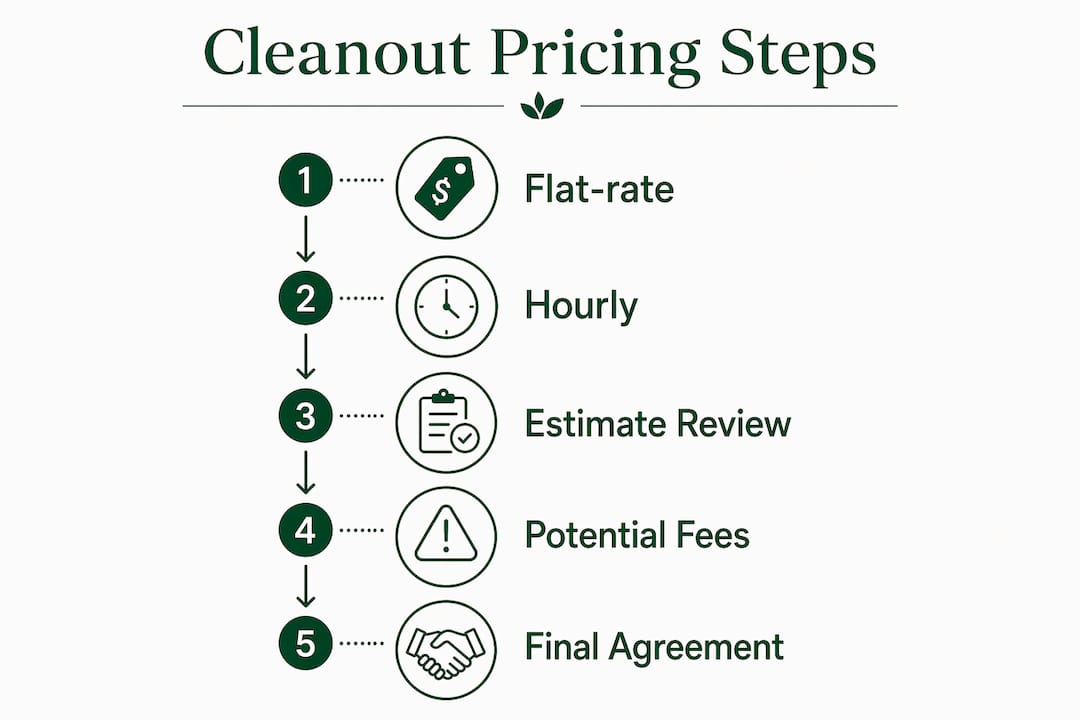
Price quotes vary significantly based on whether dump fees, labor surcharges, and hazardous waste handling are included. A quote that looks affordable can double once those line items appear on the final invoice. Always ask for a total project cost estimate that bundles every potential fee.
Follow these steps to protect your client from billing surprises:
- Request an on-site estimate. Firm, on-site, no-obligation estimates before work begins are far more accurate than phone or virtual quotes. A crew that walks the property can account for volume, access challenges, and special items.
- Ask for an itemized breakdown. The estimate should list labor, disposal fees, fuel surcharges, and any specialty item fees (appliances, hazardous materials, electronics) as separate line items.
- Clarify the change order policy. If the scope grows during the project, how does the company handle additional charges? Get that answer in writing before signing anything.
- Confirm dump fees are included. Some companies quote labor only and bill dump fees separately. This is one of the most common sources of unexpected costs.
- Compare at least two estimates. A single quote gives you no context. Two or three quotes reveal the market rate and expose outliers in either direction.
Pro Tip: Ask each company, “What would cause the final price to exceed this estimate?” Their answer tells you exactly where the risk lies and whether they have clear policies for managing scope changes.
Professional full house cleanouts typically take 1–3 days depending on property size and volume. That timeline helps your client plan around the cleanout and coordinate other services without unnecessary gaps.
How should you coordinate cleanout services with other transition tasks?
Sequencing is the most overlooked factor in a successful property transition. Cleanout success depends on proper sequencing: estate sales first, junk hauling second, then final cleaning. Running these steps out of order wastes money and creates scheduling conflicts.
Coordinating among estate sale companies, junk haulers, and cleaners avoids inflated costs and extended timelines. When each vendor knows the schedule, they can plan their crew size, equipment, and timing accordingly. Poor coordination is the single biggest driver of cost overruns in estate transitions.
Here is how to guide your client through the coordination process:
- Schedule the estate sale first. Everything with resale value should be sold or claimed before the junk hauler arrives. Sending sellable items to a landfill is an avoidable loss.
- Book the cleanout crew immediately after the sale ends. A gap of more than a few days invites last-minute additions to the removal list and delays the property prep timeline.
- Confirm the cleaning crew’s start date before the cleanout begins. The cleanout crew needs to finish completely before the cleaning crew enters. Overlapping these two steps creates confusion and extra charges.
- Share the property timeline with every vendor. A simple one-page schedule with dates and contact names prevents miscommunication between crews.
- Involve the realtor early. Realtors often have preferred vendor lists and can flag property-specific requirements, such as HOA rules about dumpster placement or staging timelines.
For a detailed walkthrough of this process, Ohanapropertyexperts has published a practical guide on coordinating estate sale cleanouts that covers sequencing, vendor communication, and timeline management in depth.
What red flags should you warn clients about when choosing cleanout services?
The most reliable warning signs appear before the work starts. Red flags include refusal to provide a written contract, vague answers about disposal, and cash-only payment requests. Each of these signals a provider operating without the insurance or ethical standards required for estate work.
Choosing the lowest bid without full fee disclosure is one of the most expensive mistakes clients make. A quote missing dump fees, hazardous waste charges, or labor surcharges can easily cost more than a higher, fully transparent bid once the final invoice arrives.
Clients also frequently overlook the need for a documented chain of custody for estate items. Written policies on donations and resale protect against family disagreements about where specific items went. Without documentation, disputes over donated or sold belongings can create legal complications during estate settlement.
Timing is another common mistake. Booking cleanout services at least 2–4 weeks in advance during peak spring and summer seasons protects availability. Late booking leads to scheduling conflicts and, often, higher prices from vendors who know they have leverage.
Watch for these specific red flags before recommending any provider:
- No written contract offered before work begins
- Vague or evasive answers about where items are taken after removal
- Cash-only payment requirements with no receipt or invoice
- No proof of insurance when asked directly
- Unusually low bids with no itemized breakdown of fees
Understanding what a cleanout company actually does on-site also helps clients set realistic expectations. Ohanapropertyexperts has a plain-language resource explaining what cleanout companies do that clients can read before their first consultation.
Key Takeaways
Recommending the right cleanout service requires vetting credentials, understanding pricing, sequencing tasks correctly, and knowing which warning signs to act on before signing any contract.
| Point | Details |
|---|---|
| Verify insurance and licensing | Always request a current COI and confirm state licensing before recommending any provider. |
| Demand a total cost estimate | Ask for all fees bundled upfront, including dump fees, labor surcharges, and hazardous waste handling. |
| Follow the right sequence | Complete estate sales before junk hauling, and finish hauling before the cleaning crew arrives. |
| Book early, especially in peak seasons | Schedule cleanout services at least 2–4 weeks ahead during spring and summer to protect availability. |
| Get disposal policies in writing | A documented chain of custody for donated or resold items prevents disputes among estate inheritors. |
What I have learned from recommending cleanout services over the years
The single most valuable thing I have learned is that clear upfront communication saves clients more stress than any other factor. Families going through estate transitions are often grieving, pressed for time, and unfamiliar with how property cleanouts work. When I walk them through the vetting process before they make a single call, the entire experience goes more smoothly.
I have also seen what happens when cost is the only filter. A family in the middle of an estate settlement chose the lowest bid without asking about disposal fees. The final invoice was nearly double the quote. That experience reinforced something I now tell every client: a transparent, slightly higher estimate is almost always cheaper than a vague, low one.
The coordination piece is where most people underestimate the complexity. Running an estate sale, a junk removal crew, and a cleaning team in the wrong order costs real money and real time. Getting those three vendors on a shared timeline, even a simple one, is the difference between a two-week transition and a six-week one.
My honest recommendation is to treat the cleanout provider selection with the same rigor you would apply to hiring a contractor. Check the insurance, read the contract, and ask the hard questions about disposal. The families who do this consistently report far less stress and far fewer surprises.
— Olga
Ohanapropertyexperts is ready to help your clients move forward
Families and property owners across Central Indiana trust Ohanapropertyexperts for estate cleanouts, full property cleanouts, garage and basement cleanouts, debris removal, and junk hauling. Every project comes with a free on-site estimate, a written scope of work, and a licensed, insured crew that treats your property and your family with respect.
Whether you are settling an estate, preparing a rental property, or clearing a home before a sale, Ohanapropertyexperts delivers fast, transparent service with no hidden fees. Explore the full range of cleanout and transition services or get started with a free consultation by calling (812) 302-6833. For families navigating estate transitions specifically, the estate cleanout services page covers exactly what to expect from start to finish.
FAQ
What credentials should a cleanout company have?
A reputable cleanout company carries general liability insurance and workers’ compensation coverage, both verifiable through a current Certificate of Insurance. State or local business licensing is also required and can be confirmed through your county business registry.
How far in advance should you book a cleanout service?
Book at least 2–4 weeks ahead during peak spring and summer seasons to secure your preferred dates and avoid last-minute price increases.
What is the correct order for estate transition services?
Complete the estate sale first to recover value from sellable items, then bring in the junk hauler, and finish with a cleaning crew. Running these steps in the wrong order creates overlap, extra costs, and scheduling conflicts.
How long does a full property cleanout take?
Professional full house cleanouts typically take 1–3 days depending on the size of the property and the volume of items being removed.
What should a cleanout estimate include?
A complete estimate covers labor, dump fees, fuel surcharges, hazardous waste handling, and any specialty item fees for appliances or electronics. Any fee not listed upfront is a potential surprise on the final invoice.
Recommended
- What Cleanout Companies Do Explained for Homeowners | Ohana Property Services
- What Cleanout Companies Do for Seniors: 2026 Guide | Ohana Property Services
- Property Cleanout Benefits Home Sales: Seller’s Guide | Ohana Property Services
- Why Landlords Need Cleanout Services: 2026 Guide | Ohana Property Services