
Property Transition Services Explained for Homeowners & Agents
Discover how property transition services can simplify your move. Learn key steps to prepare your property for sale or rental efficiently.
Property Transition Services Explained for Homeowners & Agents
Property transition services cover the on-site work that clears a property and makes it market-ready: estate cleanouts, junk and debris hauling, appliance and furniture removal, donation routing, and a final broom-clean sweep before a sale, rental, or move-in. Call a provider once you know a property needs to change hands and the current condition would slow a listing, showing, or lease start.
Before anyone loads a truck, take these three steps:
- Confirm who has legal authority to authorize removals (executor, trustee, owner, or agent with written permission).
- Secure valuables, documents, and anything earmarked for family or sale before crews arrive.
- Schedule an appraisal or estate-sale consult if valuables exist, or a cleanout estimate if the property is simply cluttered.
Pro Tip: Call the listing agent or estate-sale professional before signing any removal contract. Once a crew starts hauling, there’s no getting sale inventory back.
Key Takeaways
Property transitions succeed when authority is confirmed, valuables are protected, sale items are sorted before removal, and every provider commitment is documented in writing.
| Point | Details |
|---|---|
| Confirm authority first | Verify legal authority through the deed, will, or court appointment before any items leave the property. |
| Follow the correct sequence | Protect valuables, hold the estate sale, then remove the remainder, never the reverse order. |
| Get contract terms in writing | Insist on scope, fees, excluded items, and unsold-item handling before signing anything. |
| Budget for regulated items | Hazardous materials like paint, chemicals, and electronics require separate, often paid, disposal. |
| Choose a documented provider | Ohana Property & Transition Services offers photo-based quotes, written scopes, and donation receipts for Central Indiana properties. |
Table of Contents
- What Do Property Transition Services Actually Include?
- Who Needs to Approve Removals Before Work Begins?
- How Long Does a Property Transition Actually Take?
- What Should Be in Writing With Your Cleanout Provider?
- How Do You Safely Handle Hazardous or Regulated Items?
- What Drives the Cost of a Property Cleanout?
- What Questions Should You Ask Before Hiring a Provider?
- Why a Local, Compassionate Approach Matters More Than People Expect
- How Ohana Property & Transition Services Can Help
- Where to Find More Guidance on Property Transitions
- Frequently Asked Questions
- Sources
What Do Property Transition Services Actually Include?
The service mix depends on the job. A typical provider offers:
- Full-property cleanouts, sorted room by room
- Donation pickup and routing to local charities
- Appliance and furniture removal
- Hazardous-material separation and safe handling
- Load-and-haul service to transfer stations or dumpsters
- Broom-clean finishing so the space is ready for photos or a walkthrough
An estate handled after a family sale looks different from a rental turnover or an investor’s rehab flip; for essential insights on handling this process, consider the detailed stages presented in Estate Cleanouts & House Cleanout | Pinky’s. The estate job usually starts with sorting for keepsakes, resale, and donation. A rental turnover moves faster, since the goal is an empty, clean unit by a lease deadline. A flip often needs debris hauling for construction waste on top of the cleanout. That’s the real dividing line between estate cleanout work, which sorts before it disposes, and junk removal, which is built for speed and bulk hauling.
Who Needs to Approve Removals Before Work Begins?
Before a single item leaves the property, confirm who has the legal right to authorize it. Gather these records first:
- Deed or proof of ownership
- Will or trust documentation
- Letters of administration or court appointment (for probate estates)
- Power-of-attorney forms, if someone is acting on an owner’s behalf
- Key inventory and account access information
Check the title, ask the estate attorney, or confirm with the probate court if there’s any doubt about who’s authorized to act. If two heirs disagree about what stays or goes, pause the job until it’s resolved in writing.
Disputed authority is the single fastest way a routine cleanout turns into a legal headache. If ownership or executor status isn’t crystal clear, hold everything until you have written permission from every party with a claim.
How Long Does a Property Transition Actually Take?
Most property transitions run three to six months from initial planning to the final sweep, with milestones set around the sale or lease schedule. Here’s a practical sequence:
- Planning and authority check (week one): confirm decision-makers, gather documents, and walk the property.
- Appraisal and estate-sale scheduling (weeks two through four): estate sale companies typically need two to three weeks to prepare and market a sale, which usually runs two to three days once it opens.
- Sale or listing date: coordinate with the agent so showings and photos aren’t scheduled around a house full of furniture.
- Post-sale cleanout: bring in the removal crew once valuables and sale items are gone.
- Repairs, cleaning, and final prep: address anything the cleanout exposed, like scuffed floors or a musty basement.
- Closing or lease start: final walkthrough and keys transferred.
Your working checklist should include a photo inventory of the property before anyone touches it, a protected-items list for documents and valuables, interviews with at least two or three vendors, a donation routing plan, a plan for regulated items, firm removal deadlines, and a folder for every receipt.
Recommended sequencing follows a four-step order practitioners use: identify the decision-makers, walk the property to flag priority items, run the estate sale or liquidation, then remove what’s left. Getting this order backward is how families lose grandma’s jewelry to a dumpster.
Pro Tip: Loop in the listing agent and estate-sale company before you schedule the removal crew. Cleaning and repairs should happen after the cleanout, not before, so crews aren’t tracking dirt through a freshly cleaned space. For a closer look at sequencing multiple vendors, this guide to coordinating an estate sale cleanout walks through the timing in more detail.
What Should Be in Writing With Your Cleanout Provider?
A reliable provider will do a walkthrough before quoting, and typically offers a mix of services:
- On-site sorting and item-by-item review
- Donation pickup with documented routing
- Buy-out offers for the full contents at once
- Load-and-haul removal
- Hazardous-material disposal
- Broom-clean finish, with deep cleaning available as an add-on
Before you sign anything, insist on these items in writing:
- Full scope of work and specific removal dates
- Fees and payment timing, including deposit terms
- Excluded items the crew won’t touch
- What happens to unsold or unwanted items
- Donation routing and receipts for estate accounting
- Special-handling fees (pianos, safes, hot tubs)
- Cancellation terms and proof of liability insurance
A buy-out cleanout makes sense when the contents have modest value and speed matters more than maximizing dollars. If there’s real value in the estate (antiques, collectibles, a decent furniture set), insist on an estate sale first. Ask providers directly: “What happens to items that don’t sell or aren’t donated?” Their answer tells you a lot. Full-property cleanout details, including what’s typically bundled into a quote, are outlined on Ohana’s full property cleanout page.
How Do You Safely Handle Hazardous or Regulated Items?
Some items can’t just go in a dumpster. Watch for:
- Controlled medicines
- Electronics and e-waste
- Chemicals, paint, and solvents
- Asbestos-containing materials
- Propane tanks
- Sharps and needles
- Firearms
Handle these correctly:
- Contact your local health department or solid-waste agency for disposal rules specific to your area.
- Use manufacturer or retailer take-back programs for electronics and batteries.
- Arrange licensed transport for chemicals, asbestos, or other regulated waste.
- Keep documentation, disposal manifests, and donation receipts for every regulated item you clear.
Expect additional fees here, and don’t hesitate to call a licensed hazmat specialist when materials fall outside what a general cleanout crew can legally handle.
What Drives the Cost of a Property Cleanout?
Pricing swings on a handful of predictable factors:
- Total volume of items and square footage
- Access issues (stairs, narrow hallways, no elevator)
- Special-handling items like pianos, gun safes, or hot tubs
- Hazardous materials requiring separate disposal
- Travel distance to the property
- Local disposal or transfer-station fees
- Whether the provider offers donation credits or a buy-out to offset the cost
Ask each provider the same set of questions so quotes are actually comparable: What’s included in the price? Are truck fees and labor separate? Is disposal and donation handling part of the quote? A photo-based estimate speeds this up and usually gets you a tighter, more accurate number before anyone sets foot on the property.
Pro Tip: Get at least three quotes and read the fine print on what’s bundled. A low number that excludes disposal fees isn’t actually the low number.
What Questions Should You Ask Before Hiring a Provider?
Ask every provider you’re considering:
- Can you show proof of insurance?
- Will I get a written estimate and contract?
- Do you have references from estate or rental cleanout work?
- What’s your donation and recycling process?
- What’s your realistic timeline for this job?
- What happens to items that don’t sell or aren’t claimed?
Watch for red flags: no walkthrough before quoting, vague answers about unsold items, pressure to start before a written scope exists, no proof of insurance, or refusal to separate hazardous materials from general debris.
Trust signals look different: photo-based quotes, a documented inventory and receipts, clear donation routing, straightforward buy-out terms, and references from real-estate agents or estate attorneys who’ve used the provider before. If a company won’t put a walkthrough on the calendar before quoting your job, that’s usually all you need to know.
Pro Tip: A provider who insists on documenting everything, from the initial photo inventory to the final donation receipt, is protecting you as much as themselves.
Why a Local, Compassionate Approach Matters More Than People Expect
Cleanouts often happen during a hard stretch, a death in the family, a foreclosure, a divorce. A provider who knows the local donation network, the area’s disposal rules, and how to move quickly without rushing grieving families through decisions makes the whole process feel less brutal. Documentation isn’t just paperwork. It’s what keeps siblings from fighting over what happened to mom’s china cabinet six months later.

Pro Tip: Photograph everything before removal starts. A simple photo inventory settles more family disputes than any conversation ever will.
How Ohana Property & Transition Services Can Help
Ohana Property & Transition Services is a family-owned company serving Columbus, Indiana and the surrounding Central Indiana communities, and we built our process around exactly the steps this article walks through. We handle estate cleanouts, full property cleanouts, debris removal, appliance and furniture removal, and donation-conscious routing, backed by photo-based quotes so you get an accurate number before we ever step onsite.
Whether you’re an executor preparing an estate for sale, a landlord facing a rental turnover, or an investor clearing a property for a flip, our estate cleanout and full property cleanout services match the exact scenarios covered above, complete with donation receipts and a written scope for every job. We also work directly with agents and investors on recurring cleanout needs through our real estate partner program. Call (812) 302-6833 or request a free photo-based estimate through our full services overview to get a real number on your timeline, not a guess.
Where to Find More Guidance on Property Transitions
- NAR’s practical guide to estate and probate cleanouts
- Senior Move Guide’s estate clearance overview
- Modern Aging Directory’s estate cleanout services guide
Contact your local solid-waste or health department for hazardous-item rules, and keep every donation receipt, disposal manifest, and signed contract page in one folder.
Frequently Asked Questions
What are property transition services? Property transition services are on-site cleanout and hauling services, including estate cleanouts, junk removal, debris hauling, and appliance or furniture removal, used to prepare a property for sale, rent, or occupancy.
How do I choose the right property transition service? Interview at least two or three providers, ask for proof of insurance and a written estimate, check references from estate or rental work, and confirm their donation and unsold-item policies before signing anything.
How is an estate cleanout different from junk removal? An estate cleanout sorts items first for donation, resale, or family keepsakes before disposing of the rest, while junk removal is built for fast, bulk hauling with less sorting involved.
What documents do I need before starting a property transition? Secure the deed or ownership proof, will or trust paperwork, letters of administration if it’s a probate estate, and any power-of-attorney forms before authorizing removals.
How much does a property cleanout typically cost? Cost depends on volume, access, special-handling items, hazardous materials, and disposal fees. Photo-based estimates from at least three providers give you the clearest comparison.
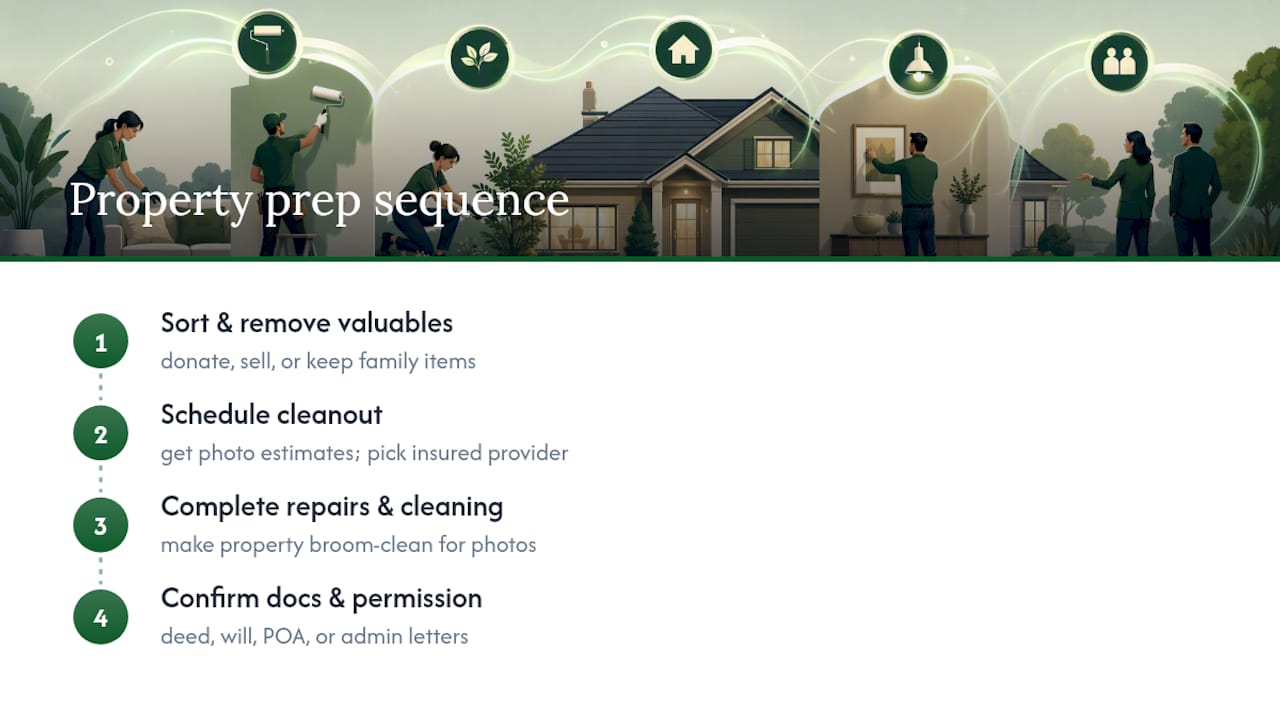
When should I schedule the cleanout relative to a home sale? Schedule the cleanout after the estate sale or valuables have been sorted and removed, then handle repairs and cleaning, so the property is broom-clean before listing photos and showings.
Sources
- Managing an Estate or Probate Cleanout: A Practical Guide for REALTORS®
- Estate clearance before selling a house | Senior Move Guide
- Estate Cleanout Services: Costs, Process & How to Find One