
How to Sort Deceased Belongings Legally in Indiana
Learn how to sort deceased belongings legally in Indiana. Secure property, document assets, and avoid personal liability as an executor.

How to Sort Deceased Belongings Legally in Indiana
As executor in Indiana, you may secure and begin documenting a decedent’s belongings immediately after death, but you must not distribute any assets until your inventory is complete and probate requirements are met. That single rule protects you from personal liability and keeps the estate legally defensible from day one.
Three actions to take right now:
- Secure the home. Change the locks promptly after securing the property. Executor guidance is clear: unauthorized removal of items before inventory is one of the most common sources of family conflict and executor liability.
- Begin a timestamped photo inventory. Walk every room and photograph items in place before anything moves. Reference Indiana Code 29-1-13-1, which requires the personal representative to take possession of and protect the decedent’s property.
- Pause all distribution. Nothing leaves the property until the inventory is shared and court requirements under your county’s probate rules are satisfied. Ohana Property & Transition Services LLC works alongside Central Indiana executors at exactly this stage, helping document and clear properties in a legally traceable way.
Table of Contents
- What should you do first as an executor? A 30–90 day checklist
- What can you legally do as an executor in Indiana before and after probate?
- How do you document an inventory that holds up legally?
- How do you handle disputed items without making things worse?
- What is the most efficient way to sort through a home?
- How do you value belongings and dispose of them lawfully?
- When should you hire professionals, and what should you expect?
- Key Takeaways
- What executors often get wrong about sorting belongings
- Ohanapropertyexperts is ready to help Central Indiana executors
- Useful sources for Indiana executors
What should you do first as an executor? A 30–90 day checklist
First 48 hours
- Change locks and secure all entry points.
- Locate the will, deed, insurance policies, financial account statements, and any transfer-on-death (TOD) documents. TOD deeds and vehicle registrations pass outside probate and should be identified immediately so they are not accidentally inventoried as probate assets.
- Open a separate estate bank account. Never mix estate funds with personal funds.
- Notify immediate family and beneficiaries that distribution is paused pending inventory.
First two weeks
- File the will with the probate court in the county where the decedent lived.
- Apply for an employer identification number (EIN) for the estate through the IRS.
- Publish the required notice to creditors in a local newspaper per Indiana law.
- Check whether a surviving spouse or dependent children are entitled to a personal property allowance under Indiana law. That allowance must be addressed before any general distributions.
- Contact your county clerk for local probate forms. Hamilton County, for example, uses specific local petition and inventory forms that differ from state defaults.
First 60–90 days
- File the verified inventory with the court. Many Indiana counties require this within 60 days of appointment. Costs for a professional personal property appraisal typically run a few hundred dollars and are a legitimate estate expense.
- Obtain written estimates from estate cleanout professionals before any clearing begins. Those estimates become part of the estate accounting record.
- Evaluate whether a small estate affidavit applies. If the probate estate falls below Indiana’s statutory threshold, that procedure can shorten the process considerably. Confirm the current threshold with an Indiana estate attorney, as it is subject to legislative change.
Pro Tip: Check your specific county clerk’s website before filing anything. Local filing practices vary, and using the wrong form can delay your appointment as personal representative.
What can you legally do as an executor in Indiana before and after probate?
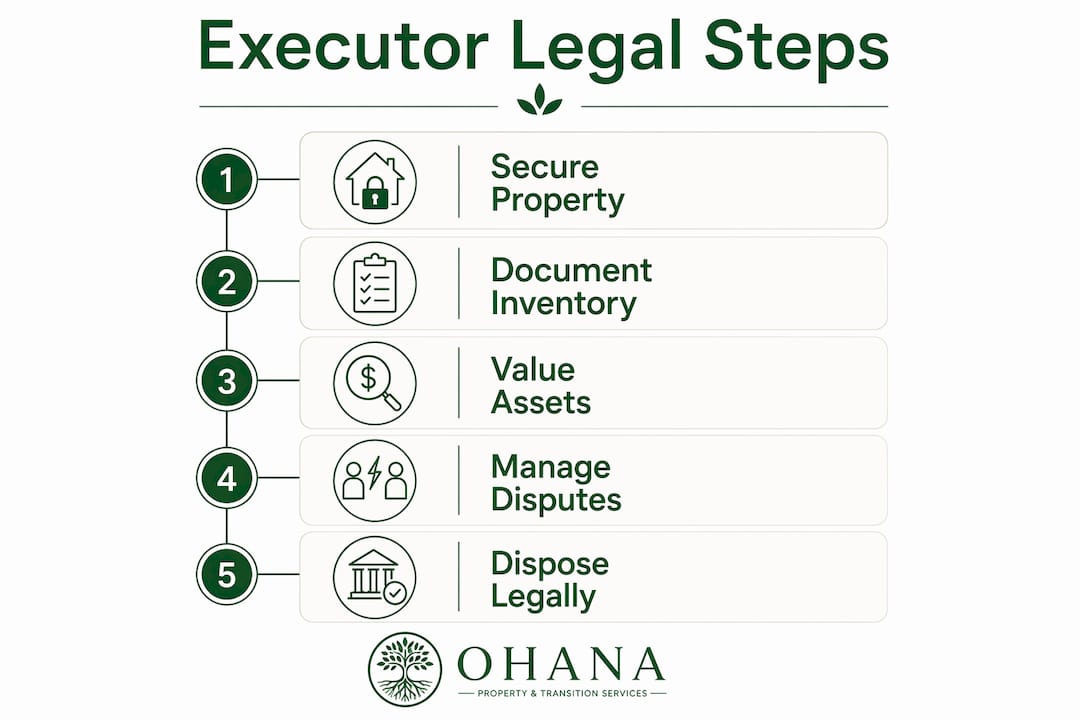
Indiana Code 29-1-13-1 gives the personal representative authority to take possession of the decedent’s real and personal property and to keep buildings in tenantable repair. That authority begins at appointment, not at the close of probate.
What that means in practice: you may secure the home, photograph and inventory contents, pay urgent maintenance costs, and maintain insurance coverage. You may not sell, donate, or distribute items to beneficiaries until the inventory is filed and, in a supervised estate, until the court approves.
Supervised vs. unsupervised administration. Indiana allows both. In a supervised estate, the court reviews major actions before they happen. In an unsupervised estate, you have more flexibility, but you must still send formal notice to all interested persons and file required documents. Skipping that notice step can cost you the right to continue as personal representative.
Executors face personal liability for breach of fiduciary duty. Courts can remove a personal representative and hold them financially responsible for losses. That risk is why pausing distribution until the inventory is complete is not just good practice; it is legally necessary.
When to call an attorney: contested wills, unclear title to real estate, high-value assets with disputed ownership, or any allegation of executor misconduct. Do not try to broker those situations yourself.
How do you document an inventory that holds up legally?
An airtight inventory with timestamped photos is your primary defense against future claims. Build it before anything is moved, and maintain it throughout the administration period.
Inventory template fields
| Field | What to Record |
|---|---|
| Item ID | Sequential number (e.g., 001) |
| Description | Make, model, color, distinguishing marks |
| Room/Location | Exact room and position in room |
| Condition | Excellent / Good / Fair / Poor |
| Date Found | Date photographed and logged |
| Estimated Value | Your estimate or appraiser’s figure |
| Recipient | Name of beneficiary or disposition path |
| Receipt/Acknowledgment | Signed receipt or email confirmation |
Photo evidence protocol: photograph each item in place before moving it, use a device that embeds a timestamp in the file metadata, and back up images immediately to a cloud folder organized by room. Print a physical copy for court filings.
Signed transfer receipts should capture the item ID, agreed value, recipient’s full name, date of transfer, and a signature or email confirmation. Store originals with the estate file.
Pro Tip: Label high-value items with a numbered tag that matches your inventory log, then secure them in a locked room or off-site storage. Keep a digital log and a printed copy. Courts appreciate organized paper trails, and beneficiaries are less likely to dispute a documented record.
How do you handle disputed items without making things worse?
Family fallout more often stems from disputed tangible possessions than from the will itself. The executor’s job is to treat personal property distribution as an administrative task, not a mediation session.
- Secure the item immediately. Move it to a locked room or neutral storage. Do not allow anyone to take it pending resolution.
- Request written documentation. Ask the claimant to submit their claim in writing, including any evidence of ownership (receipts, photos, letters, prior agreements).
- Hold and document. Log the dispute in the estate file with dates, names, and the nature of the claim.
- Propose mediated resolution. A neutral mediator can resolve most family disputes faster and cheaper than court. If the dispute involves allegations of executor misconduct or contested heirship, involve an attorney.
- Request court guidance if the parties cannot agree. A judge’s order protects you from liability regardless of the outcome.
Pro Tip: Keep all dispute communications in writing, whether by email or certified letter. Verbal promises made under emotional pressure are the single biggest source of executor liability. If you said it, write it down immediately after.
For guidance on managing family disputes over belongings, Ohanapropertyexperts has practical resources built specifically for Indiana families.
What is the most efficient way to sort through a home?
Follow a room-by-room, top-down, outside-in sequence. Professional organizers and move managers recommend this approach because it minimizes backtracking and keeps emotional fatigue manageable.

Recommended sequence: bathrooms and linen closets → kitchen → living areas → bedrooms → attic, basement, and outbuildings.
Start with lower-emotion spaces first. Bathrooms and linen closets contain few sentimental items and let you build momentum before reaching bedrooms and personal spaces.
Bin system: use five color-coded bins or labels: Keep, Sell, Donate, Trash, and Hold for Claim. The “Hold for Claim” bin is for any item with a pending dispute or unclear ownership. Nothing in that bin moves until the dispute is resolved.
Time management: assign 90-minute sessions with a defined room goal. Rotate family members through tasks so no one person carries the emotional weight all day. A systematic approach also makes it easier to hand off to a professional cleanout crew when the sorting phase is done.
Security rule: valuables and documents come out first, before general sorting begins. No family member removes any item unsupervised until the inventory is complete and distribution is authorized.
How do you value belongings and dispose of them lawfully?
Get a documented valuation for any item that could materially affect estate value before choosing a disposition path. Triggers for a formal appraisal include antiques, jewelry, art, firearms, collectibles, and any item a beneficiary disputes.
| Disposition Option | Legal/Operational Notes |
|---|---|
| Estate sale | Proceeds go to the estate account; retain itemized sale records for court accounting |
| Consignment | Use a written consignment agreement; track proceeds by item |
| Donation | Obtain a dated receipt from the charity; record fair market value for estate accounting |
| Recycling/disposal | Document what was disposed of and when; retain hauler receipts |
| Hazardous disposal | Prescription meds: use DEA-authorized collection sites. Needles/sharps: use approved sharps containers. Chemicals: contact your county hazardous waste program. Firearms: transfer through a licensed dealer (FFL) or surrender to local law enforcement per Indiana law |
Donated-item receipts and sale proceeds both belong in the estate accounting file. The IRS requires executors to report estate income on Form 1041, and clean records make that filing straightforward.
When should you hire professionals, and what should you expect?
Hire professionals when scale, time, legal risk, or family conflict exceed your capacity. That threshold arrives sooner than most executors expect.
Estate cleanout service (such as Ohanapropertyexperts): handles full-property clearing, furniture and appliance removal, debris hauling, and donation-conscious recovery. Pricing is typically by load or by project scope. Expect a written estimate, a signed job receipt, and documentation you can submit for estate accounting. For a look at what estate cleanout services cover in Central Indiana, Ohanapropertyexperts offers free estimates with a written scope of work.
Certified appraiser: provides an itemized, defensible valuation for high-value assets. Fees vary by item type and volume. The appraisal report becomes part of the estate inventory.
Mediator: resolves family disputes outside court. Faster and less expensive than litigation for most personal property conflicts.
Estate attorney: necessary for contested wills, complex probate, unclear title, or any situation where executor liability is at risk. Riley & Ahler P.C. and similar Indiana probate firms handle these matters locally.
For complex or large-scale cleanouts, difficult estate situations often benefit from a professional crew that understands both the physical and emotional weight of the work.
Key Takeaways
Sorting a deceased person’s belongings legally in Indiana requires securing the property first, completing a documented inventory before any distribution, and following county-specific probate filing deadlines.
| Point | Details |
|---|---|
| Secure property within 48 hours | Change locks immediately to prevent unauthorized removal and limit executor liability. |
| Complete inventory before distributing | File a verified inventory with the court; many Indiana counties require this shortly after appointment, so check your county’s specific deadline. |
| Identify non-probate assets early | TOD deeds and vehicle registrations pass outside probate and must be separated from the estate inventory. |
| Pause and document disputed items | Secure disputed belongings, request written claims, and hold items until mediated or court-ordered resolution. |
| Ohanapropertyexperts for Central Indiana cleanouts | Provides free estimates, written scopes, and signed job receipts that support estate accounting for Indiana executors. |
What executors often get wrong about sorting belongings
Most executors focus on the legal paperwork and underestimate how much the physical sorting process can derail an otherwise clean probate. A missed item in a back bedroom, an appliance removed before inventory, or a verbal promise made during an emotional afternoon can create disputes that outlast the estate itself.
The families I work with in Central Indiana most often struggle not with the legal steps but with the sheer volume of belongings and the pressure from other family members to move quickly. Slowing down in the first week, securing the property, and building a real paper trail is almost always the right call, even when it feels like it is holding things up. The executor who documents everything and distributes nothing prematurely is the one who closes the estate without a lawsuit.
Professional help is not a sign that the family cannot handle things. It is a practical decision that protects everyone, including the beneficiaries who are watching closely.
Ohanapropertyexperts is ready to help Central Indiana executors
When the sorting is done and it is time to clear the property, Ohanapropertyexperts delivers the boots-on-the-ground support Indiana executors need. We handle full estate cleanouts, furniture and appliance removal, debris hauling, and donation-conscious recovery, all with the documentation executors need for court accounting.

Every job starts with a free estimate and a written scope of work. Our insured crew works efficiently and respectfully, and we provide signed job receipts you can submit directly to the probate court or your estate attorney. We serve Columbus, Seymour, Franklin, Greenwood, Indianapolis, and surrounding Central Indiana communities.
Ready to move forward? Call us at (812) 302-6833 or visit our services page to request your free estimate today.
Useful sources for Indiana executors
- Indiana Code 29-1-13-1: Possession of property; duties of personal representative
- Hamilton County Instructions to Personal Representative (Supervised Estate)
- Hamilton County Instructions to Personal Representative (Unsupervised Estate)
- HeirPortal: Indiana Executor Checklist
- Fritchlaw: Executor Duties in Indiana Probate
- IRS Publication 559: Survivors, Executors, and Administrators
- ExecutorChecklists.com: Distributing Personal Property as Executor
- Senior Move Guide: How to Sort Through Deceased Parents’ Belongings
This article provides general information for educational purposes and does not constitute legal advice. Confirm current Indiana probate rules, filing deadlines, and statutory thresholds with a qualified Indiana estate attorney or your county probate court.