
Cubic Yard Truckload Pricing: What Homeowners and Executors Pay
Understand how cubic-yard volume, access, and local disposal fees shape residential truckload costs—typically $500–$800. Send photos for a fast, free...

Cubic Yard Truckload Pricing: What Homeowners and Executors Pay
Truckload pricing works by charging you for how much space your items take up in the truck, not just what those items weigh or how many pieces you have. A typical full truckload for a residential cleanout runs between $500 and $800, with premium markets pushing closer to $1,000. Your final number depends on volume, plus any surcharges for stairs, heavy materials, or extra labor that get confirmed once a crew actually sees the job.
TL;DR:
- Truckload prices for residential cleanouts typically range from $500 to $800, with premium markets pushing closer to $1,000, depending on volume and surcharges.
- Pricing tiers are based on cubic yards, with smaller loads costing more per yard due to fixed crew and operational costs, and full trucks often requiring multiple hours of labor.
- Extra fees are common for stairs, heavy or hazardous materials, and additional labor, all of which should be disclosed by the company upfront before loading begins.
- Providing detailed photos and measurements helps estimate costs accurately before the crew arrives, with on-site walkthrough confirming the final price.
- Local disposal fees and seasonal demand fluctuations can significantly impact the final quote, especially in high-cost cities or busy times in spring and summer.
Table of Contents
- How Truckload Pricing Works: Volume, Cubic Yards, and Load Tiers
- What a Truckload Actually Costs: Real Price Ranges
- Common Extra Fees and When They’re Legitimate
- Getting an Accurate Quote: Phone, Photos, and On-Site Walkthroughs
- Junk Removal vs. Dumpster Rental: Which Fits Your Job?
- Cancellation and Rescheduling: What to Expect
- How Long It Takes From Booking to Completion
- Fuel Surcharges and Their Effect on Your Total
- Phone Quotes vs. Photo Quotes vs. On-Site Estimates
- Why Prices Shift by Region and Demand
- Seasonal Swings in Truckload Pricing
- Minimum Charges and Volume Thresholds
- Ohana’s Approach to Transparent Truckload Pricing
- Get a Free Estimate for Your Next Truckload Job
- Sources
How Truckload Pricing Works: Volume, Cubic Yards, and Load Tiers
Junk removal companies measure your job in cubic yards, not pounds. A cubic yard is a cube 3 feet on each side, roughly the size of a large washing machine. Trucks used for residential cleanouts typically hold 10 to 15 cubic yards, with some models closer to 15. If you’re trying to picture that, a moving truck size guide can help you translate cubic footage into something you can actually visualize in your garage or basement.
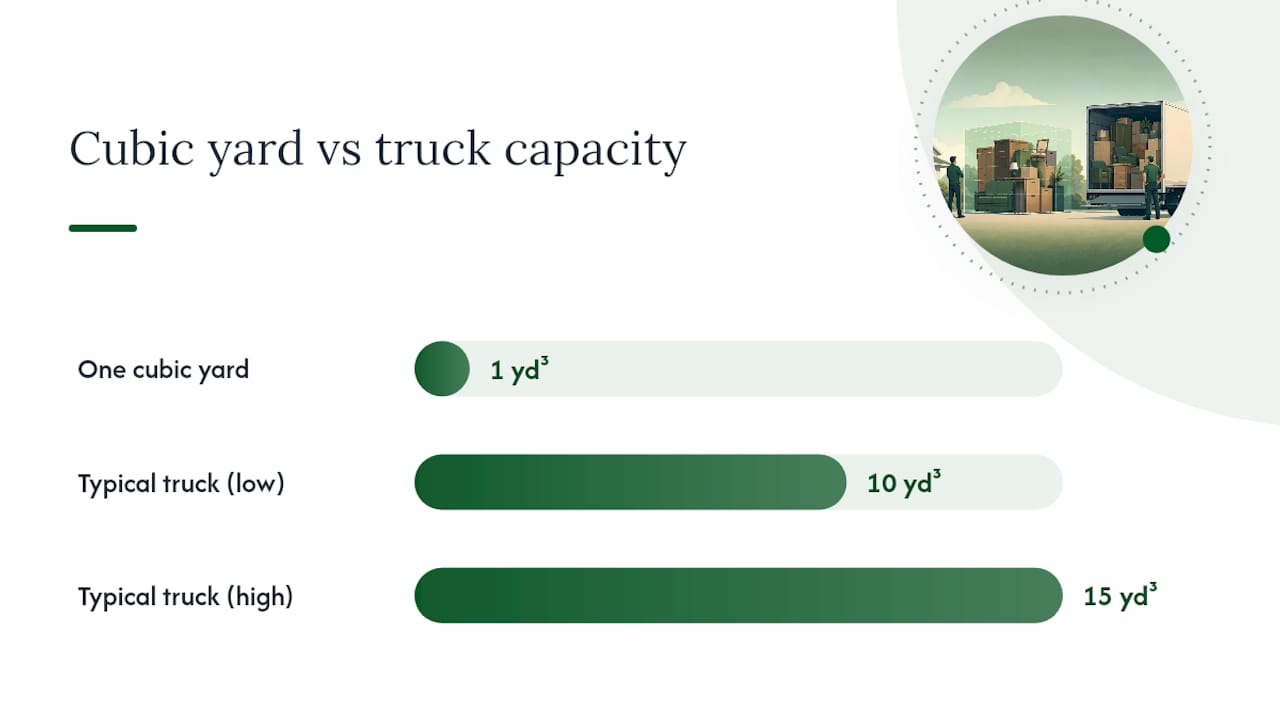
Companies quote in tiers rather than a straight per-yard rate: minimum load, an eighth of a truck, a quarter, a half, three-quarters, and full. That structure isn’t arbitrary. Pricing tends to be non-linear, meaning smaller loads cost more per cubic yard than larger ones because a crew’s drive time, fuel, and dump run cost the same whether the truck is a quarter full or packed to the roof. One pricing model breaks tiers down into eighths and sixths specifically so quotes feel more precise to the customer, even though the underlying curve still rewards bigger loads.
A few quick ways to eyeball your own load before calling anyone:
- A single-car garage full of boxes and furniture usually fills a quarter to a half truck.
- A cleared-out bedroom with a bed, dresser, and boxes lands around an eighth to a quarter truck.
- A hoarding situation or full basement plus garage often hits three-quarters to a full truck.
- Appliances and large furniture eat more volume per item than their weight suggests.
What a Truckload Actually Costs: Real Price Ranges
Here’s where the cubic-yard math turns into dollars. National data on junk removal pricing puts a minimum or small pickup load around $100 to $200, with a full truck typically landing between $500 and $800 for most markets, and closer to $1,000 in higher-cost cities.
Pro Tip: Ask for the company’s tier breakdown, not just a single “full truck” number. Seeing the jump from a quarter load to a half load shows you exactly where your job sits and whether it’s worth consolidating items to drop a tier.
Three quick examples show why the same room can land in different price bands:
- Half load, single bedroom set: Bed frame, mattress, two dressers, boxes. Straightforward carry, no stairs, moderate weight. This sits comfortably mid-range for a half truck.
- Three-quarter load, garage cleanout: Old paint cans, a broken lawn mower, scrap wood, and boxes. The mix of weight and awkward shapes pushes this toward the higher end of its tier even though it’s not a full truck.
- Full load, estate cleanout: Furniture from multiple rooms, appliances, and years of accumulated belongings. This is where dump fees and labor time both climb, since a full truck usually means a full crew-hour on-site plus a heavier disposal bill.
Local dump or tipping fees swing these numbers more than people expect. A transfer station might charge $60 to $120 per ton for standard debris, and that cost gets baked into your quote before labor is even factored in.
Common Extra Fees and When They’re Legitimate
A quote that looks great on the phone can grow once a crew sees stairs, a stuffed shed, or a refrigerator full of coolant. Knowing which surcharges are standard helps you tell a fair add-on from a padded invoice.
- Stairs and long carries. Crews typically add a per-flight or per-distance charge when they have to haul items down multiple flights or across a long yard to the truck. This reflects extra time and labor, not a markup.
- Heavy or dense materials. Concrete, dirt, tile, and roofing shingles take up little truck space but weigh far more than furniture. Many companies switch to a weight-based rate or add a heavy-material surcharge for these loads, since disposal facilities often charge by the ton.
- Hazardous or regulated items. Paint, chemicals, and appliances with refrigerant (fridges, freezers, some AC units) require special handling under EPA rules, which usually means a flat add-on fee per item.
- Extra labor. Disassembling furniture, bagging loose debris, or working in unsanitary conditions takes crew time beyond what’s built into the base quote, so expect an hourly labor charge past an included allowance.
The best operators disclose these possibilities before the truck ever gets loaded, not after.
Getting an Accurate Quote: Phone, Photos, and On-Site Walkthroughs
You can get remarkably close to your real price before a crew ever shows up, if you give them the right information. Start by estimating cubic yards yourself: measure the general footprint of your pile and its height, then compare it to the garage or bedroom benchmarks above.
Photos matter more than most homeowners realize. A good photo set includes a wide shot of the full pile, close-ups of anything heavy or hazardous, and a shot of stairs or hallways the crew will need to navigate. Mention anything the camera can’t show, like a broken elevator or a narrow gate.
On a phone call, ask these questions before you accept a range:
- What size truck are you quoting against, and how many cubic yards is that?
- How much labor time is included before extra charges kick in?
- Are stairs, heavy items, or hazardous materials in my job likely to trigger surcharges?
- What’s your dump or tipping fee policy, and is it already factored into the quote?
A phone or photo estimate gives you a range, but an on-site walkthrough is what locks in the real number. Reputable companies use that walkthrough to confirm volume and flag anything the photos missed, ideally before loading starts rather than after.
| Question to Ask | Why It Matters |
|---|---|
| What truck size is this quote based on? | Ties your price directly to cubic-yard capacity |
| Is labor time included? | Prevents surprise hourly charges |
| Any suspected surcharges? | Flags stairs, weight, or hazardous items early |
| How is the on-site price finalized? | Shows whether the company overestimates or underestimates upfront |
Junk Removal vs. Dumpster Rental: Which Fits Your Job?
Junk removal wins when your items are scattered across multiple rooms, when a walkway or staircase makes DIY hauling painful, or when you simply don’t want to lift anything. A crew handles the loading, which matters most for estate cleanouts where family members may not be physically able to haul heavy furniture themselves.
A dumpster rental tends to make more sense for a different situation:
- Multi-day renovation or demolition projects generating continuous debris.
- Jobs where you’re comfortable doing your own loading over several days.
- High-volume situations where a container sitting in the driveway is more convenient than scheduling multiple truck visits.
Permits matter too. Dumpsters often need street placement permits in dense neighborhoods, while a junk removal truck typically just needs a driveway or curb access for a few hours. If your timeline is tight and your load is a one-time pull, a truckload service usually gets the property cleared faster.
Cancellation and Rescheduling: What to Expect
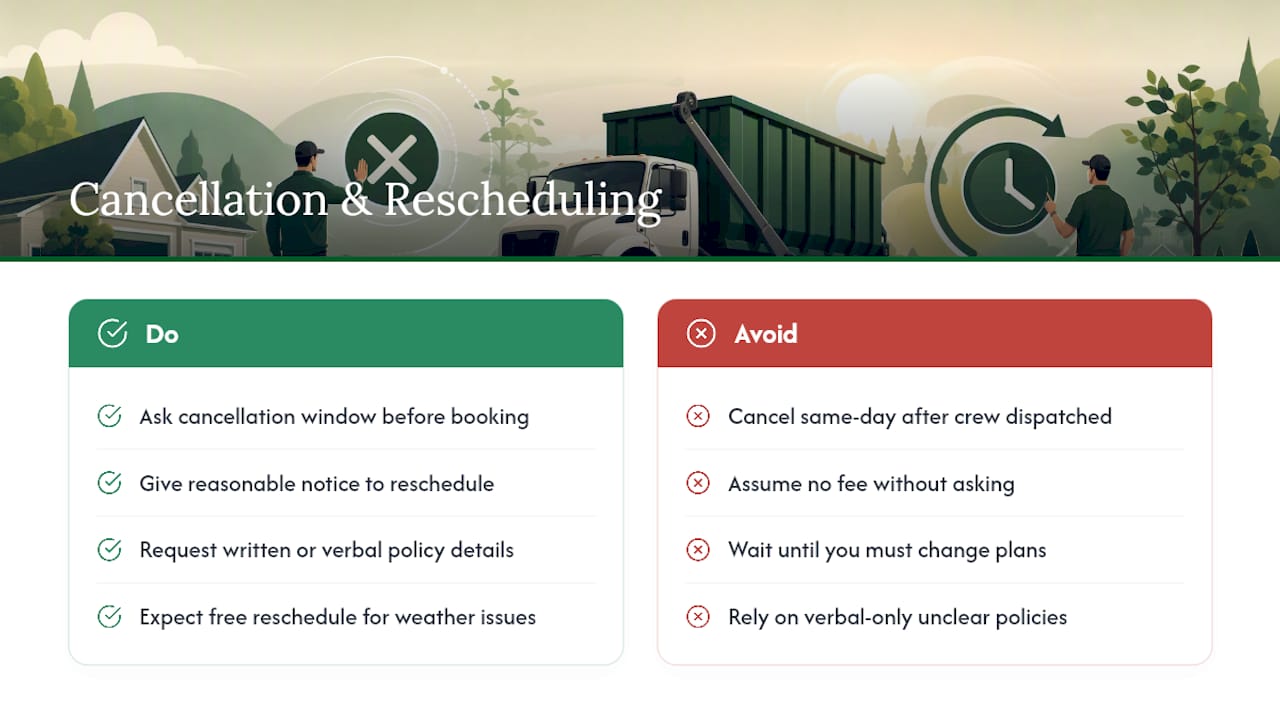
Most local junk removal and cleanout companies build some flexibility into their booking policies, but the details vary by provider. A same-day cancellation, especially after a crew has already been dispatched or a truck route has been planned around your job, is more likely to carry a fee than a cancellation made a day or two in advance.
Rescheduling is usually easier than canceling outright. Companies would rather move your appointment to a new slot than lose the job entirely, so most will accommodate a reschedule request with little or no penalty if you give reasonable notice. Weather delays are a common example. A crew that can’t safely access a property because of ice or flooding will typically offer a free reschedule rather than charging you for something outside your control.
The safest approach is to ask about the cancellation window before you book, not after you need to change plans. A company that clearly states its policy upfront, in writing or verbally on the booking call, is generally the one that handles changes fairly when life gets in the way. Estate executors juggling multiple appointments (probate deadlines, realtor walkthroughs, family visits) benefit especially from this clarity, since a cleanout date often has to move around other people’s schedules.
How Long It Takes From Booking to Completion
Turnaround time depends heavily on job size and how far out you book, but most residential cleanouts move faster than people expect. A single-load pickup, like a quarter or half truck of furniture and boxes, can often be scheduled within a day or two of the initial call, especially if you’ve already sent photos for a quote.
Larger jobs take more coordination. A full property or estate cleanout involving multiple trucks, donation sorting, and possibly multiple visits can stretch to a week or more once you factor in scheduling around family availability, realtor deadlines, or probate timelines. The actual on-site work, once a crew arrives, is usually finished in a few hours to a full day depending on volume.
Booking earlier in the week tends to open more scheduling flexibility than trying to book a weekend slot last minute, since weekends are typically the busiest days for local crews.
Fuel Surcharges and Their Effect on Your Total
Fuel costs are one of the three real expenses behind every truckload quote, alongside labor and disposal fees. When gas or diesel prices spike, some companies pass a portion of that increase along as a separate line item rather than folding it quietly into the base rate.
Not every company charges a fuel surcharge, and it’s rarely a huge portion of your total bill on a standard local job. It matters more for jobs that require a longer drive to the property or an extended trip to a distant disposal facility. If you’re comparing quotes and one includes a fuel line item while another doesn’t, ask whether the second company has simply built that cost into its base tier pricing instead of listing it separately. The total matters more than how it’s itemized.
Phone Quotes vs. Photo Quotes vs. On-Site Estimates
A phone quote, based only on your description, is the roughest estimate you’ll get. It gives you a ballpark range but leaves the company guessing at volume, weight, and access conditions.
A photo quote closes much of that gap. Sending clear pictures lets an estimator judge cubic yardage and spot potential surcharge triggers, like a mattress, an old TV, or a stack of concrete pavers, before a truck ever leaves the lot. This is why photo-based quoting has become standard practice for companies that want to give accurate numbers without a home visit.
An on-site walkthrough remains the most reliable option, and it’s the point where companies typically confirm the firm price rather than a range. A crew can see things a photo can’t: how steep the stairs actually are, whether an item is bolted down, or whether hidden debris is buried under what’s visible. For estate cleanouts especially, where sight-unseen surprises are common in attics and storage areas, an on-site estimate protects both you and the company from a mismatched quote.
Why Prices Shift by Region and Demand
Local market conditions move truckload pricing more than most homeowners assume. Dense metro areas with higher labor costs and pricier landfill or transfer station fees push quotes toward the upper end of national ranges, while smaller markets with lower overhead tend to land closer to the low end.
Demand plays a role too. A company juggling a full schedule during a busy season has less incentive to discount, while a slower week might bring more flexibility on price, especially for jobs that can be scheduled on short notice. Real estate turnover cycles matter here directly: markets with heavy seasonal home sales often see cleanout demand spike right alongside listing activity, tightening availability and nudging prices up during those windows.
Disposal costs are the biggest regional variable behind the surface number. Since dump and transfer station fees vary widely by county and facility, two towns 30 minutes apart can have noticeably different truckload rates simply because their nearest landfill charges differently per ton. If you’re comparing quotes across service areas, ask directly whether local disposal fees are already built into the number you’re seeing.
Seasonal Swings in Truckload Pricing
Spring and early summer tend to be the busiest stretch for cleanouts, driven by home sales, estate settlements, and general decluttering after winter. That demand surge can mean less flexibility on price and longer lead times to get on a crew’s schedule.
Late fall and winter often bring a quieter calendar for most local operators, which can translate into more scheduling flexibility and occasionally softer pricing, particularly for jobs that aren’t time-sensitive. Weather adds its own wrinkle: icy driveways or snow-packed access points can slow a job down or add safety-related labor time, which some crews factor into a quote for winter appointments.
Estate cleanouts don’t always follow this seasonal pattern, since probate and family timelines drive the schedule more than the calendar does. If your job isn’t tied to a specific season, asking about slower months on the local schedule is a reasonable way to find more flexibility.
Minimum Charges and Volume Thresholds
Nearly every truckload pricing structure has a floor. Companies set a minimum charge, often in the $100 to $200 range, to cover the fixed cost of sending a truck and crew to your property regardless of how little you’re actually having removed.
This minimum threshold matters most for small jobs, like a single mattress or one broken appliance. If your load falls under an eighth of a truck, you’re likely paying closer to the minimum rate than a true per-cubic-yard price, since the crew’s drive time and dump run cost the same as they would for a slightly larger pickup.
It’s worth asking where that minimum threshold sits before booking a small job, since some companies price a single large item differently from a mixed pile of smaller debris that technically takes up the same space. Combining a small job with a neighbor’s pickup, when that’s an option, is one practical way to get more value out of a minimum charge.
Ohana’s Approach to Transparent Truckload Pricing
Ohana Property & Transition Services LLC is a family-owned company serving Columbus, Indiana and the surrounding Central Indiana communities, and transparency around volume tiers is something we build into every estimate. We walk clients through where their job sits, quarter truck, half truck, full load, before any work begins, and we flag likely weight surcharges upfront rather than letting them surface on an invoice.
Free estimates, whether by phone, photo, or an on-site visit, can be standard practice because a guess without a walkthrough helps no one. Clients trying to trim costs are sometimes recommended to donate usable furniture and appliances before the crew arrives, consolidate small piles into one area so volume is easier to judge, and schedule contiguous rooms or floors together so labor time isn’t wasted moving between disconnected areas of a property.
Estate executors and landlords juggling tight timelines may value that clarity, since a surprise fee on a probate deadline is the last thing anyone needs.
— Olga
Get a Free Estimate for Your Next Truckload Job
If you’ve read this far, you already know that the real cost of a cleanout comes down to volume, access, and what’s actually in the pile, not a flat number a website can promise you sight unseen. Ohanapropertyexperts turns that uncertainty into a firm answer fast: send us photos of your space and we’ll return a real price range before a truck ever leaves the lot, then confirm it on-site with no pressure to accept surprise add-ons.

We handle the jobs this guide walks through, full property cleanouts, estate cleanouts for executors managing probate timelines, and straightforward appliance or furniture removal for landlords turning over a rental. Every estimate is free, and our crews serve Columbus, Seymour, North Vernon, Edinburgh, Franklin, Greenwood, Indianapolis, Lafayette, and the rest of Central Indiana. Ready to see where your job lands on the truckload scale? Visit our services page to request your free photo quote or schedule an on-site estimate, and call (812) 302-6833 to talk through your timeline directly.
Sources
- How Much Does Junk Removal Cost? Real Prices | Autopilot
- How To Price Junk Removal Jobs: Volume vs. Weight | DoorstepHQ
- How to Price Junk Removal Services for Real Profit | GreenRoute
- How To Set Your Junk Removal Pricing | Junk Removal Authority Blog