
How to Dispose Estate Items Responsibly After a Loss
Learn how to dispose of estate items responsibly after a loss with effective steps to inventory, appraise, and donate valuable goods.

How to Dispose Estate Items Responsibly After a Loss
Inventory and document everything first. Prioritize appraisals for anything that looks valuable, donate usable goods to charities that will give you a receipt, recycle hazardous materials through proper channels, and bring in a professional cleanout crew when the volume or timeline is too much for family to manage alone. That is the whole framework, and the steps below fill in the specifics.
Before you touch a single box, do three things:
- Secure the property. Change locks if needed and confirm who has access.
- Start a room-by-room inventory with photos before anything moves.
- Notify the executor and beneficiaries so nobody removes items informally.
Keep every receipt, appraisal, and photo. Estate accounting and probate courts both expect a paper trail, and you cannot rebuild one after the fact.
Key Takeaways
Responsible estate disposal works because it pairs a documented inventory with the right channel, sale, donation, recycling, or professional haul, for each category of item.
| Point | Details |
|---|---|
| Inventory before anything moves | Photograph and log every room before items are sold, donated, or discarded. |
| Match items to the right channel | Send valuables to appraisal or auction, household goods to donation, debris to junk removal. |
| Get receipts for everything | Donation and sale receipts are required for estate accounting and possible tax deductions. |
| Handle special items separately | Medications, firearms, and hazardous materials each require their own legal disposal channel. |
| Hire help when scope demands it | Ohana Property & Transition Services offers photo-based estimates, donation routing, and documented disposal for Central Indiana estates. |
Table of Contents
- How Do You Create an Inventory Executors Can Trust?
- Should You Sell, Donate, Recycle, or Haul It Away?
- What About Medications, Firearms, and Hazardous Materials?
- How Do You Turn Donations Into Documented, Deductible Records?
- When Should You Hire a Professional Estate Cleanout?
- What Legal and Timing Rules Should Executors Follow?
- What Does a Week-by-Week Action Plan Look Like?
- What Most Estate Guides Get Wrong About Disposal
- Get a Free Estimate for a Compassionate, Documented Cleanout
- Frequently Asked Questions
- Sources
How Do You Create an Inventory Executors Can Trust?
Start with the room that holds the most financial risk (usually the primary bedroom, home office, or a locked cabinet) and work outward from there. Don’t skip storage units, garages, safe deposit boxes, or that one closet nobody’s opened in years. Estate liquidation checklists consistently point to the same method: room-by-room inventory, photographed items, and a spreadsheet that survives scrutiny.
- Photograph before you move anything. Wide shots of each room, then close-ups of individual pieces.
- Log item, location, condition, and estimated value in a shared spreadsheet.
- Note disposition (keep, sell, donate, discard) and who has custody of it right now.
- Flag anything unusual for appraisal, jewelry, art, coins, firearms, signed items.
Comprehensive photo and video documentation protects heirs and supports appraisals later, and it’s the single easiest step families skip when emotions are running high.
Get professional appraisals for anything you genuinely can’t value from a phone search. A generalist appraiser can usually flag whether something needs a specialist.
Pro Tip: Set a firm deadline for family claims, in writing, before you distribute anything. Require a signed receipt for every item a relative takes. It sounds bureaucratic, but it’s the only thing that prevents “I thought Mom wanted me to have that” disputes six months later.
Should You Sell, Donate, Recycle, or Haul It Away?
Match the item to the channel, not the other way around. A signed painting belongs at auction. A working dishwasher belongs at a donation center. A stained mattress belongs in recycling, not the living room floor at an estate sale.
- Estate sale or auction: Best for furniture, collectibles, and specialty items with real resale value. Estate sale companies typically charge 25 to 40 percent of gross sales in exchange for pricing, staffing, and advertising, which is worth it if the volume justifies the fee.
- Online resale: Good for smaller, higher-value items when you have time to photograph, list, and manage buyers yourself.
- Donation: The fastest path for usable household goods, clothing, and working appliances, and it comes with a tax and accounting benefit that resale doesn’t.
- Recycling: The correct home for electronics, old appliances, and mattresses, most municipalities run dedicated programs for these.
- Junk removal or dumpster rental: The right call for genuinely unsellable debris, damaged furniture, and anything that’s just taking up space.
A combined approach usually works best: specialist items go to auction houses, everyday household goods go to estate sales or donation, and the leftover debris goes to junk removal. Trying to force every item through one channel wastes time and often loses money.
Cost drivers to expect: Cleanout costs commonly range from a few thousand dollars for a small home to over several thousand dollars for a large, heavily accumulated property., depending on volume, labor, and disposal fees. Knowing that range up front helps you budget before you commit to a full cleanout.
What About Medications, Firearms, and Hazardous Materials?
Some items carry legal risk if you dispose of them the wrong way, and this is where families most often stumble without realizing it.
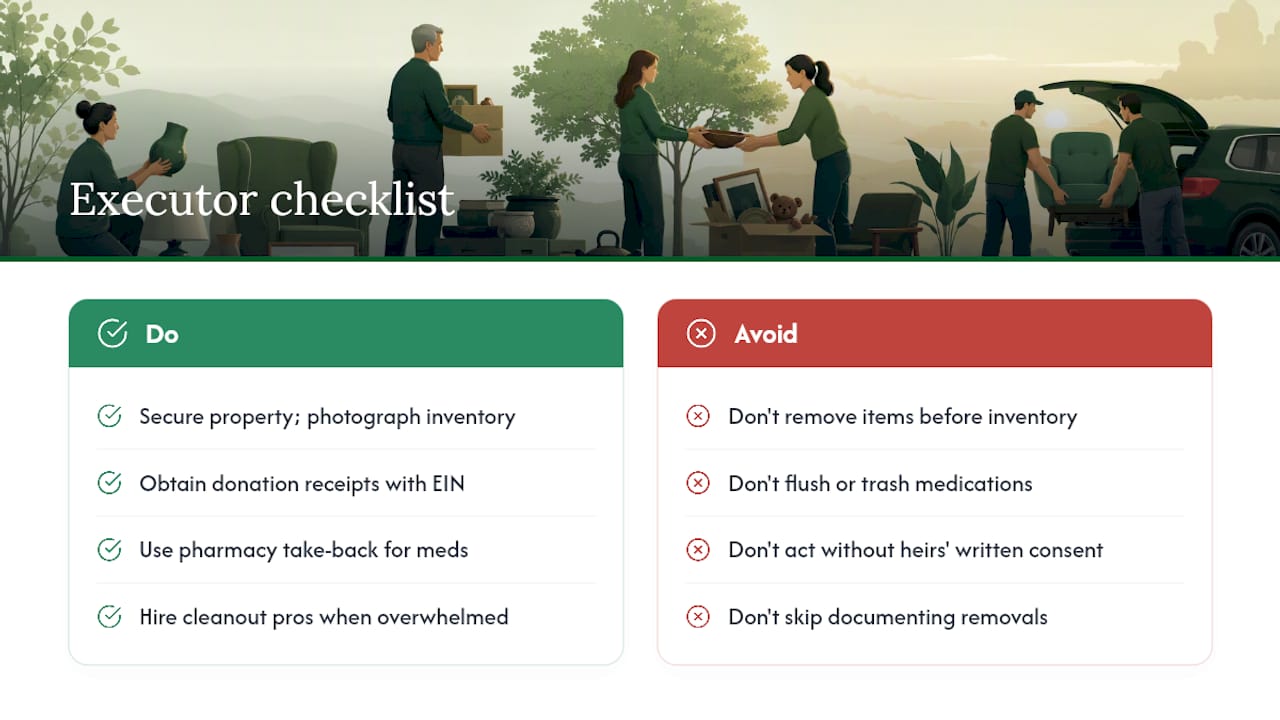
- Medications: Never flush them or toss them in household trash. Use a pharmacy take-back program or a local law enforcement drop-off event.
- Firearms: Transfers must comply with state law. Work with a licensed dealer or an estate attorney rather than moving a firearm yourself, even temporarily.
- Hazardous materials (paint, batteries, refrigerants, propane tanks): Route these through a municipal household hazardous waste program rather than the regular trash or a standard junk haul.
- Fragile antiques and heirlooms: Don’t attempt DIY cleaning, refinishing, or repair. A well-meaning polish job can strip decades of value off a piece that needed a conservator, not a rag.
Pro Tip: Call your county’s solid waste department before cleanout day. Most run scheduled hazardous waste drop-off events, and knowing the next date can save you from storing paint cans and old batteries for weeks.
How Do You Turn Donations Into Documented, Deductible Records?
Donation only counts as “responsible” disposal if you can prove it happened. That means treating every drop-off like a small transaction, not a favor to a charity.
- Call ahead. Organizations like Habitat for Humanity ReStore, Goodwill, and the Salvation Army all have specific rules about what they’ll accept, and some won’t take mattresses, upholstered furniture, or certain electronics.
- Ask about pickup versus drop-off. Large furniture and appliances often qualify for a scheduled pickup, saving you a truck rental.
- Get a written receipt with the organization’s name, its EIN, the date, and an item description. Executor guides are direct about this: estate accounting depends on it, and so does any tax deduction the estate wants to claim.
- Check municipal e-waste and hazardous waste calendars for anything charities won’t accept.
- Route large appliances and furniture to donation first, before junk removal, since every item diverted from a landfill is one less line item on the disposal invoice.
When Should You Hire a Professional Estate Cleanout?
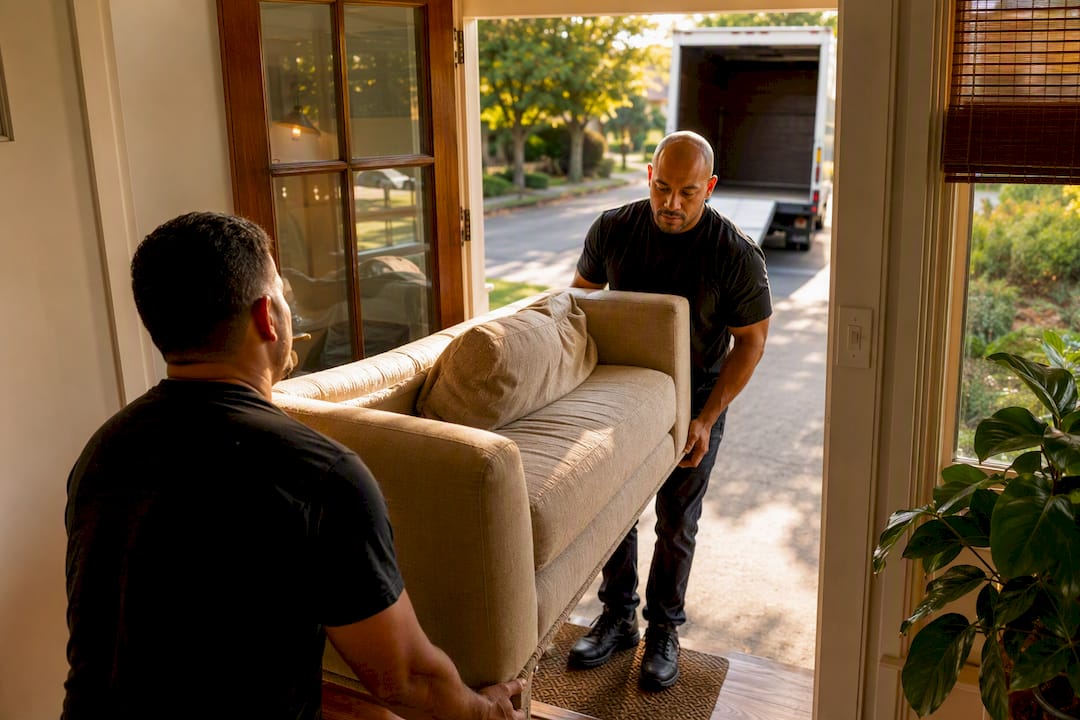
Hire help when the math stops making sense for a family to do it alone: an out-of-state executor, a hard closing date from a buyer or landlord, a house packed with decades of accumulation, or items that require careful, respectful handling rather than a weekend of trash bags.
- Remote executors dealing with a property hours or states away.
- Time pressure from a pending sale, lease deadline, or probate court date.
- Large volume that would take a family multiple weekends to sort through.
- Emotionally difficult sorting, where having a compassionate third party handle logistics actually helps grief, not just workload.
A reputable provider does more than haul boxes. Look for inventory assistance, donation routing to real charities, safe disposal of hazardous items, upfront photo-based estimates, and documented receipts you can hand to the estate’s accountant. Ohana Property & Transition Services built its process around exactly that combination, since family-owned crews working Central Indiana estate cleanouts see the same documentation gaps come up again and again.
Pro Tip: Before hiring anyone, ask three questions: Are you insured? Can you provide a written estimate before the crew arrives? Do you document donations and disposal separately? A provider who hesitates on any of those isn’t the right fit. For real examples of how scope and cost vary, these inherited property cleanout scenarios show the range firsthand.
What Legal and Timing Rules Should Executors Follow?
Executors carry personal liability if they distribute or dispose of property incorrectly, and the mistakes are almost always about timing, not intent.
- Secure the property first. Don’t let anyone, including family, remove items before the inventory is complete.
- Document any early removals in writing, with a signature, even for small items.
- Watch probate timelines. Courts may require approval before major sales or distributions, and skipping that step can create liability for creditor claims later.
- Keep every record: sales receipts, donation receipts, appraisals, and signed beneficiary acknowledgments.
- Call an estate attorney the moment assets get complex, contested, or legally ambiguous. It’s cheaper than fixing a mistake after the fact.
What Does a Week-by-Week Action Plan Look Like?
Most families do better with a calendar than a to-do list, since grief makes open-ended tasks feel impossible to start.
- Days 1 to 3: Secure the property, notify heirs and the executor, start photographing rooms, and flag anything that looks valuable.
- Week 1 to 2: Schedule appraisals for flagged items, contact charities and recyclers to confirm what they’ll take, and set a firm deadline for family claims.
- Week 2 to 4: Book the estate sale or auction, coordinate the cleanout schedule around it, arrange donation pickups, and line up junk removal for whatever’s left.
- Closing: Reconcile every receipt against the estate accounting ledger, deposit sale proceeds into the estate account, and file the paperwork where probate can find it.
This order matters more than it looks. Skipping straight to a cleanout crew before the inventory is done is the single most common mistake families make, and it’s the hardest one to undo.
What Most Estate Guides Get Wrong About Disposal
Most advice on this topic treats “dispose of it responsibly” as a single decision, when it’s actually five or six smaller decisions stacked on top of each other. The checklist approach works, but only if you resist the urge to shortcut the documentation step because it feels tedious compared to the sorting itself. Families rarely regret being too thorough with photos and receipts. They regret it constantly when a sibling questions where Dad’s watch went, or when the estate’s accountant asks for a donation receipt that never got requested.
The conventional wisdom also underestimates how often a mixed strategy beats a single one. Sending everything to one estate sale company, or trying to sell every item online, or donating things that actually had resale value, all waste either time or money. The families who come out ahead are the ones who sort ruthlessly by category first, then match each category to the channel built for it.
If there’s one place to spend real effort, it’s the first 72 hours: inventory, photos, and flagging anything unusual. Everything downstream gets easier once that foundation exists, and everything downstream gets harder if it doesn’t.
Get a Free Estimate for a Compassionate, Documented Cleanout
Ohana Property & Transition Services is the alternative to sorting a loved one’s home alone over a string of exhausting weekends. We combine estate cleanouts, donation routing, appliance and furniture removal, and debris hauling into one photo-based estimate, so you know the cost before a single box gets moved.

What sets our process apart for families and executors is the documentation. Every donation gets routed to a partner charity with a receipt, every disposal gets logged, and you get records your estate’s accountant or attorney can actually use. That’s the difference between a cleanout that just clears a house and one that protects an estate.
We serve Columbus, Seymour, North Vernon, Edinburgh, Franklin, Greenwood, Indianapolis, Lafayette, and the surrounding Central Indiana communities. If you’re facing a property that needs to be cleared for sale, rent, or occupancy, request a free estimate through our estate cleanouts page and we’ll walk you through exactly what the process looks like for your situation.
Frequently Asked Questions
What is the first step to dispose estate items responsibly? Secure the property and complete a photographed, room-by-room inventory before anyone removes or sells anything. This protects the executor legally and gives every later decision, sale, donation, or disposal, a documented starting point.
Do I need receipts for donated estate items? Yes. A written receipt with the organization’s name, EIN, date, and item description is necessary for estate accounting and any potential tax deduction the estate wants to claim.
How do I dispose of a deceased relative’s medications safely? Use a pharmacy take-back program or a local law enforcement drop-off event. Never flush medications or throw them in household trash.
When should an executor hire a professional cleanout service? Hire professional help when the executor lives out of state, a sale or lease deadline is approaching, the property holds a large volume of belongings, or sorting through items is emotionally overwhelming for the family.
What happens if items are removed before the estate inventory is complete? Removing items early can create personal liability for the executor and may require court approval or written consent from heirs. Document any early removals in writing with signatures to protect everyone involved.
Sources
- Estate Liquidation Checklist for Executors (2026)
- How to Run an Estate Sale: Personal Property Liquidation Guide for Executors | ProbatePedia
- The Complete Guide to Estate Cleanouts | Ultimate Dumpsters
Recommended
- How to Sort Deceased Belongings Legally in Indiana | Ohana Property Services
- How to Identify Valuable Estate Items: A Step-by-Step Guide | Ohana Property Services
- How to Coordinate an Estate Sale Cleanout Efficiently | Ohana Property Services
- Sort Lifetime Belongings Guide for Downsizing | Ohana Property Services