
How to Identify Valuable Estate Items: A Step-by-Step Guide
Learn how to identify valuable estate items with our step-by-step guide. Secure key documents and valuables to protect your assets effectively.
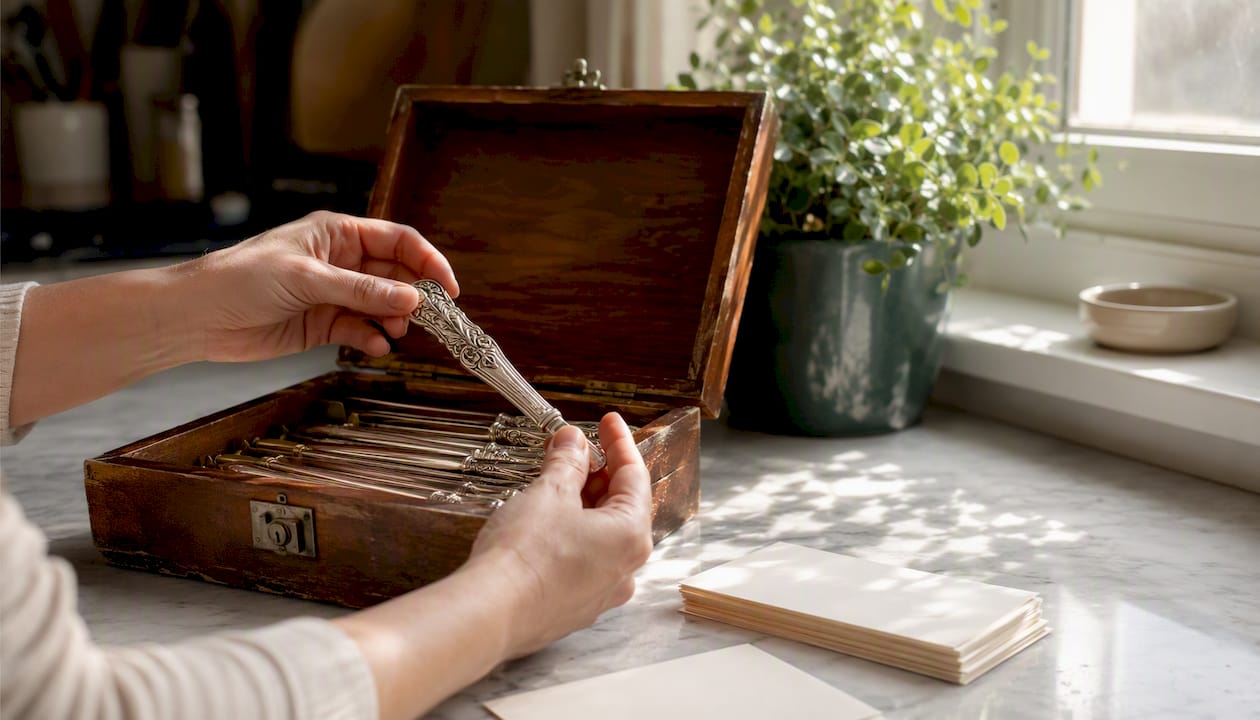
How to Identify Valuable Estate Items: A Step-by-Step Guide
The fastest way to protect value in any estate is to follow one clear sequence: secure documents and small valuables immediately, photograph every room before anything moves, sort every object once into keep, sell, donate, or dispose, research or appraise anything uncertain, then engage vendors in the right order. That order matters more than almost anything else.
Secure these items first, before anyone else enters the property:
- Original will, deeds, and trust documents
- Cash, checkbooks, and financial account statements
- Prescription medications and controlled substances
- Small jewelry, watches, and loose gemstones
- Car titles, Social Security cards, and passports
- Safe combinations, keys, and lockbox contents
Pro Tip: Never call a junk hauler before an estate buyer or appraiser. Haulers clear fast and ask questions later. Items that could have paid you will instead cost you a disposal fee.
Key Takeaways
Securing documents and small valuables before anyone else enters the property is the single action that prevents the most loss in an estate cleanout.
| Point | Details |
|---|---|
| Secure first | Lock down documents, cash, medications, and small jewelry before sorting begins. |
| Photograph everything | Capture every room and open drawer before items move to establish chain of custody. |
| Four-box sort, no maybe pile | Assign every item to keep, sell, donate, or dispose in one pass to prevent decision fatigue. |
| Research before you price | Use eBay sold listings, LiveAuctioneers, Replacements.com, and JM Bullion for realistic value checks. |
| Sequence vendors correctly | Call an estate buyer or appraiser before a hauler; Ohanapropertyexperts handles the final cleanout after value is recovered. |
Table of Contents
- What should you do in the first 24–72 hours?
- How the four-box sorting method works for estates
- Room-by-room hotspots and what to look for
- How do you research and appraise estate items?
- Where should each pile go, and in what order?
- How to handle documents, legal items, and final records
- Which professionals should you hire, and how do you vet them?
- What we have learned from doing this work in Central Indiana
- Ohana Property & Transition Services is ready to help
- Tools and resources to research values and find help
- Sources
What should you do in the first 24–72 hours?
Start by physically securing the property. Change the locks or rekey them if multiple family members or contractors will have access. Assign one person to sign for any items that leave the house during this window.
Walk every room with your phone camera before touching anything. Open drawers, photograph the contents, lift lids, and capture any item that looks unusual or unfamiliar. These photos serve as your chain-of-custody record if ownership questions arise later. A simple spreadsheet or a free app like Sortly works well as an inventory log.
Call an estate buyer or certified appraiser before you call anyone else. Do not donate, throw away, or move anything until at least one professional has walked the property. That single step has saved families thousands of dollars.
A few safety notes: medications must be disposed of through an authorized DEA take-back program, not the trash. Firearms require legal transfer through a licensed dealer or law enforcement. Paint, batteries, and household chemicals are hazardous waste and cannot go in a standard dumpster. Contact your county’s solid waste office for local collection dates.
How the four-box sorting method works for estates
The four-box method is the most reliable operational protocol for estate sorting. Every item goes into one of four categories: keep, sell, donate, or dispose. The rule is to touch each item only once and make a decision on the spot. No “maybe” pile. Professional estate liquidators consistently recommend this approach because a maybe pile grows until it becomes the whole house.
Here is how to run it room by room:
- Set up your four zones before you start. Use colored bins, labeled boxes, or colored tape on the floor. Green for keep, yellow for sell, blue for donate, red for dispose.
- Start with the lowest-stakes room — a bathroom or laundry room — to build decision momentum before tackling bedrooms or offices.
- Pick up each item and ask one question: “Would I pay money for this today?” If yes, it goes to sell. If it has sentimental value to a family member, it goes to keep. If it works but nobody wants it, donate. If it is broken, expired, or unsanitary, dispose.
- Tag items as you go. Numbered stickers on sell items let you build a quick inventory. Photograph each tagged item before it moves.
- Time-box each session to 90 minutes. Decision fatigue sets in fast, and tired sorters create a maybe pile without realizing it.
- Involve key family decision-makers in the keep pile only. Letting everyone weigh in on every item stalls the process. Assign one person per room as the decision lead.
Room-by-room hotspots and what to look for
Certain rooms consistently yield the most valuable items in inheritances. Knowing where to look saves hours of sorting.
| Room | Likely Valuable Items | Quick Identification Check |
|---|---|---|
| Master bedroom / dresser | Jewelry, watches, loose gems | Look for 925, 14K, 18K stamps; check watch case backs for brand engravings |
| Living room | Mid-century furniture, art, silver | Check undersides for maker labels; look for artist signatures on art |
| Kitchen / china cabinet | Sterling flatware, crystal, pottery | Look for “Sterling” on flatware; check pottery bases for maker marks |
| Garage / workshop | Hand tools, vintage power tools | Brand names (Snap-on, Craftsman) and condition drive value |
| Attic / basement | Coins, records, toys, military items | Original packaging multiplies toy value; coins need date and mint mark |
| Home office | First-edition books, stamps, documents | Check copyright page for “First Edition” or matching first printing date |
| Closets | Designer clothing, vintage linens | Look for maker labels; vintage garments with original tags carry collector value |
Inspect undersides, backs, and interior lids for hallmarks, signatures, serial numbers, and maker labels. These hidden markings frequently reveal value that a quick visual sweep misses entirely. Flip furniture, turn porcelain upside down, and open every lid before you decide something is worthless.
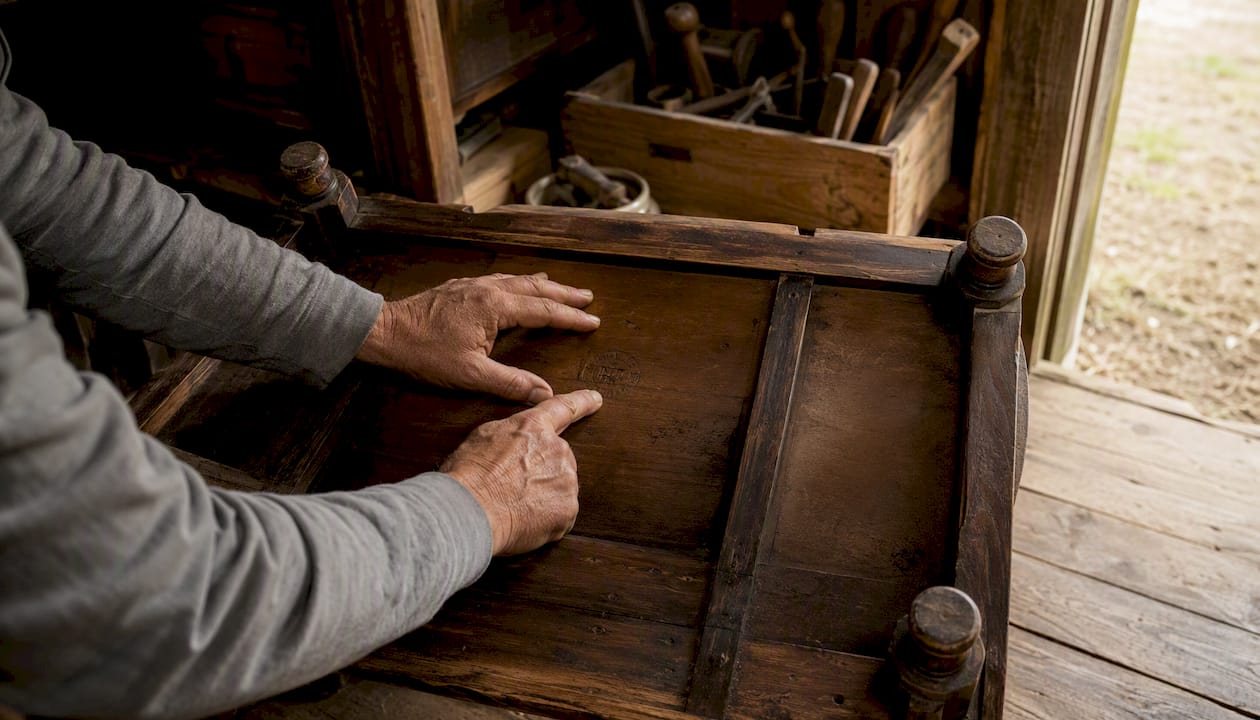
Sterling silver sets, vintage watches, coins, and branded mid-century furniture are among the highest-yield categories in estate cleanouts and often justify specialist attention or a separate listing strategy.
How do you research and appraise estate items?
For a quick price check, use the sold listings filter on eBay rather than active asking prices. Active prices reflect seller hope; sold prices reflect what buyers actually paid. LiveAuctioneers provides auction records for antiques and collectibles. For china and dinnerware patterns, Replacements.com shows current retail and buyback prices. For gold and silver coins or bullion, JM Bullion publishes live spot prices you can use as a floor.
Use the median of several recent sold comparables, not a single sale. One outlier result in either direction will mislead you.
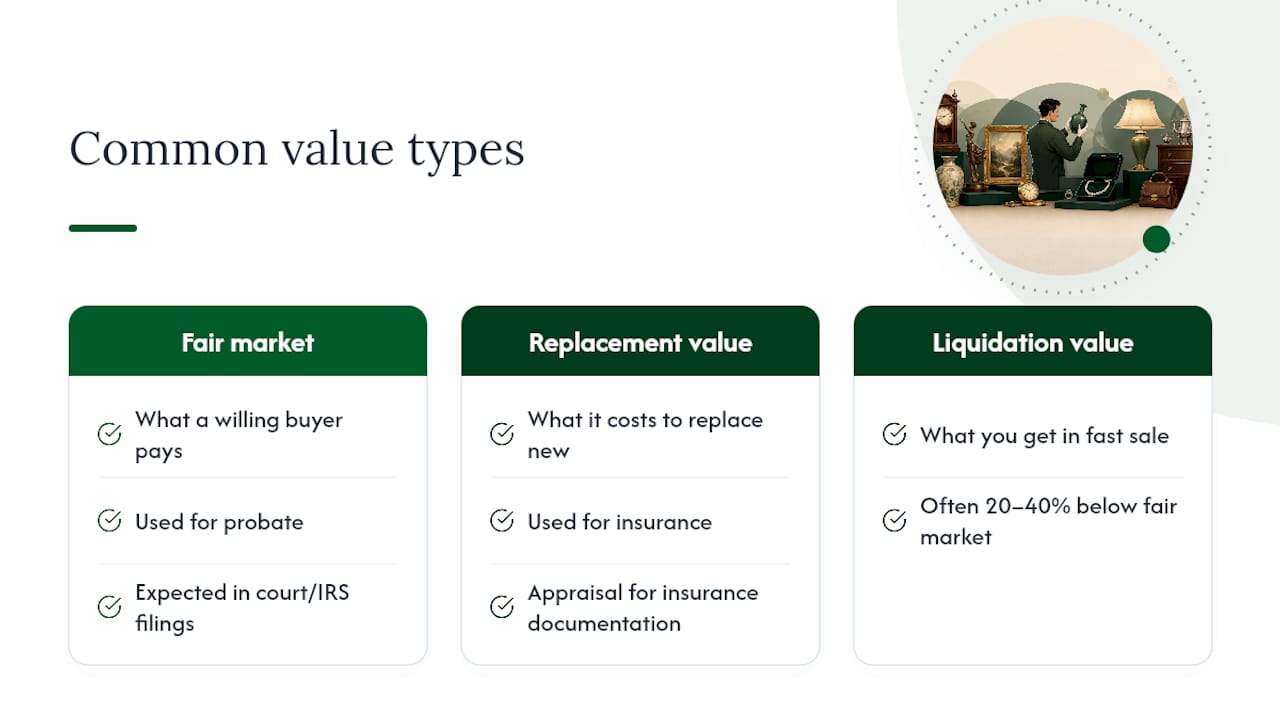
Understanding which value type you need matters as much as the number itself. There are three common measures: fair market value (what a willing buyer pays a willing seller, used for probate), replacement value (what it costs to replace the item new, used for insurance), and liquidation value (what you get in a fast sale, often 20–40% below fair market). Using the wrong type for the wrong purpose creates real legal and financial problems.
When is a formal appraisal required? Get one when the law requires it, when you need documentation for insurance, or when you are donating items or a group of items worth $5,000 or more. A certified appraiser provides a written report and must not act as a buyer for items they appraise. For probate or tax filings, courts and the IRS expect appraisals from credentialed professionals, typically those holding ASA (American Society of Appraisers) or ISA (International Society of Appraisers) credentials.
Where should each pile go, and in what order?
Call an estate buyer or appraiser before a junk hauler. Haulers will clear a house fast but routinely remove sellable furniture and valuables. The right sequence turns a disposal cost into a potential payout.
Recommended disposition sequence:
- Estate buyer or appraiser first. An estate buyer evaluates and may pay cash for valuables and remove them. This can convert items you would have paid to haul into items that pay you.
- Estate sale or consignment for mid-tier items. Estate sale companies run on-site sales and typically take 30–50% commission. Confirm in writing what happens to unsold items. Many companies offer post-sale cleanout and will haul or donate leftovers for a fee.
- Auction house or online marketplace for high-value singles. Pieces worth $500 or more often do better at auction or listed individually on eBay than in a general estate sale.
- Donation for usable but unsellable items. Habitat for Humanity ReStore accepts furniture, appliances, and building materials. Goodwill and Salvation Army take clothing, housewares, and small furniture. Always get a dated receipt for tax purposes.
- Junk removal last. Once buyers, auction, and donation have cleared what they can, call a junk removal crew for the remainder.
Red flags to watch for with any buyer or hauler:
- Any buyer who asks you to pay them upfront
- Verbal-only offers with no written documentation
- Refusal to provide references or proof of insurance
- Pressure to accept an offer the same day without time to compare
- No clear answer on what happens to items they do not want
How to handle documents, legal items, and final records
Secure and log these documents before anything else leaves the property: original will and any codicils, property deeds, vehicle titles, life insurance policies, Social Security cards, passports, and financial account information. Store them in a locked box or with the estate attorney.
For charitable donations, the IRS requires a qualified written appraisal for any single item or group of similar items donated with a claimed value of $5,000 or more. Without it, the deduction can be disallowed. Collect a dated receipt from every donation center, noting the items and their estimated condition.
Photograph every item before it leaves the house. Keep a running inventory sheet with item description, condition, disposition channel, and date. These records protect you in probate, resolve family disputes, and satisfy IRS documentation requirements. Store copies in cloud storage and with the estate attorney.
Which professionals should you hire, and how do you vet them?
Match the task to the right provider type:
- Certified appraiser (ASA or ISA credential): For formal written valuations needed in probate, insurance claims, or charitable donations over $5,000. Ask for their credential number and verify it on the ASA or ISA directory.
- Estate buyer: For fast cash offers and removal of valuable items. Ask for a written offer, confirm what they will and will not take, and get their removal timeline in writing.
- Estate sale company: For maximizing on-site sales of mid-tier household contents. Ask about their commission rate, advertising plan, staffing, and what happens to unsold items after the sale.
- Cleanout or junk removal crew: For final disposal after buyers, auction, and donation have cleared everything of value. Ask for a written estimate, proof of insurance, and confirmation of where items go.
A realistic timeline for a standard estate runs 2–6 weeks. Week one covers securing, photographing, and sorting. Weeks two and three cover appraisals, estate buyer visits, and sale planning. Weeks four through six cover the estate sale or auction, donation pickups, and final cleanout. Rushing any step, especially calling the junk removal crew too early, is the most common and most expensive mistake families make.
What we have learned from doing this work in Central Indiana
The sequence is everything. We have walked properties where a family called a dumpster company first and lost furniture, tools, and silver that would have covered the entire cost of a professional cleanout. We have also seen the opposite: families who took 48 hours to secure, photograph, and sort before calling anyone, and who walked away with money in hand instead of a bill.
The items that surprise people most are the ones hiding in plain sight. A set of flatware in the back of a kitchen drawer. A watch in a nightstand. A box of coins in the basement. None of those look like much until you flip them over and read the hallmarks.
If you are managing an estate in Central Indiana and are not sure where to start, a walkthrough costs nothing. We are happy to help you sort before we haul.
Ohana Property & Transition Services is ready to help
When you are ready to move from sorting to clearing, Ohanapropertyexperts handles the physical work so you can focus on the decisions that matter. Our estate cleanout services cover the full sequence: we work around your appraisal and sale timeline, route usable items to donation partners, handle appliance removal, and clear the remainder with care and speed.
We serve Columbus, Seymour, Indianapolis, Greenwood, Franklin, and surrounding Central Indiana communities. Every job starts with a free, photo-based quote so you know exactly what to expect before we arrive. Call us at (812) 302-6833 or request a free estimate online. Compassionate, insured, and ready when you are.
Tools and resources to research values and find help
Price research and auction records:
- eBay Sold Items (ebay.com) — filter by “Sold” to see actual transaction prices, not asking prices
- LiveAuctioneers (liveauctioneers.com) — searchable auction records for antiques, art, and collectibles
- Replacements.com — china, crystal, and flatware pattern lookup with current buy and sell prices
- JM Bullion (jmbullion.com) — live spot prices for gold, silver, and coin bullion
Appraiser credentials:
- ASA (American Society of Appraisers) — appraisers.org, searchable directory by specialty and location
- ISA (International Society of Appraisers) — isa-appraisers.org, credential verification and member search
Donation and pickup:
- Habitat for Humanity ReStore — accepts furniture, appliances, and building materials; free pickup available in many areas
- Goodwill — clothing, housewares, and small furniture; locations accept drop-offs and issue tax receipts
- Salvation Army — furniture and household goods; free large-item pickup scheduling available online
Hazardous waste:
- Contact your county solid waste district for local collection dates for paint, batteries, chemicals, and electronics
Local cleanout help:
- Ohanapropertyexperts estate cleanout services — free estimates, donation-conscious recovery, and full-service clearing in Central Indiana
This article is general information, not a substitute for advice from a qualified financial advisor. Consult a qualified financial professional about your own circumstances before acting on anything here.
Sources
- Estate Clearance Before Selling a House: The Right Order (and What People Miss)
- How to Value an Estate: Room by Room Guide | Busby Antiques FL
- Do I Need To Get An Appraisal Before Selling My Stuff? - Orion’s Attic
- Cleaning Out a Parent’s House? | 15 Items That Could Be Worth Money | Estimonia
- What’s worth appraising? Estate item triage checklist | Appraisily
Recommended
- How to Sort Deceased Belongings Legally in Indiana | Ohana Property Services
- What to Do With a Parent’s Belongings After They Pass | Ohana Property Services
- How to Coordinate an Estate Sale Cleanout Efficiently | Ohana Property Services
- What Estate Realtors Handle Post-Death: A Family Guide | Ohana Property Services