
Why Inherited Homes Need Fast Cleanouts: 2026 Guide
Learn why inherited homes need fast cleanouts to save money and secure family assets. This guide shows practical steps for a quick process.

Why Inherited Homes Need Fast Cleanouts: 2026 Guide
An inherited home cleanout is the process of clearing a deceased person’s belongings from a property to prepare it for sale, rental, or occupancy. The reason why inherited homes need fast cleanouts comes down to three hard costs: accumulating carrying expenses, rising security risks, and shrinking buyer appeal. Every week a home sits full of furniture and clutter, it costs the estate money and opportunity. This guide gives you the financial facts, security realities, and practical steps to move quickly and protect what your family has inherited.
What carrying costs accumulate while an inherited home sits uncleared?
Carrying costs are the monthly expenses that continue whether or not anyone lives in the home. Property taxes, homeowner’s insurance, utility bills, and basic maintenance do not pause for grief or probate. These costs stack up fast, and they come directly out of the estate’s value.
A typical vacant inherited home carries several unavoidable monthly expenses:
- Property taxes: Prorated monthly, these continue regardless of occupancy.
- Homeowner’s insurance: Vacant home policies often cost more than standard coverage.
- Utilities: Water, gas, and electricity must stay on to prevent pipe damage and mold.
- Lawn and exterior maintenance: Overgrown yards attract code violations and signal vacancy.
- Mortgage payments: If the deceased carried a mortgage, payments continue through probate.
The financial case for speed is clear. Professional estate cleanout services can empty an inherited home in as little as 24–48 hours, while DIY efforts can drag on for weeks due to emotional exhaustion and limited disposal resources. Every additional week of delay is a week of carrying costs subtracted from the final sale proceeds.
| Expense Category | Monthly Cost Range | Notes |
|---|---|---|
| Property taxes | Varies by county | Prorated from estate funds |
| Vacant home insurance | Higher than standard | Required by most lenders |
| Utilities | Ongoing | Needed to prevent structural damage |
| Lawn and exterior care | Ongoing | Code compliance requirement |
| Mortgage (if applicable) | Fixed monthly | Continues through probate |

Pro Tip: Contact the estate’s insurance carrier immediately after inheritance. Standard homeowner’s policies often lapse or exclude coverage after 30–60 days of vacancy, leaving the property unprotected.
The importance of fast cleanouts becomes obvious when you add up even two months of these expenses. A property that could have sold in March may still be sitting in June, costing the estate thousands in holding fees alone.
How do fast cleanouts reduce security and liability risks?
Vacant inherited homes are targets. Theft, vandalism, squatting, and liability claims all increase the longer a property sits empty and unattended. Vacant properties become common targets after 30 days of vacancy, and that exposure grows with each passing week.
The risks fall into four categories:
- Theft: Copper pipes, appliances, and tools are frequent targets in vacant homes.
- Vandalism: Broken windows and graffiti lower property value and invite further damage.
- Squatting: Unauthorized occupants create legal complications that can take months to resolve.
- Liability: If someone is injured on an unsecured vacant property, the estate can face legal claims.
Clearing and securing an inherited home quickly is not just about convenience. It is a direct form of risk management that protects the estate’s financial and legal standing.
Once the cleanout is complete, securing the property is straightforward. Change all locks, board or secure any broken windows, and notify local law enforcement that the property is vacant but monitored. A clean, secured home signals active ownership and deters opportunistic crime far more effectively than a cluttered, obviously abandoned one.
What buyer expectations make fast cleanouts essential for selling?
Modern buyers expect move-in-ready homes. Clutter left behind by a previous owner signals deferred maintenance, emotional complexity, and extra work. Professionally staged, uncluttered homes sell faster and often at higher prices than homes filled with inherited belongings.
The impact on appraisal is real. Appraisers assess condition and presentation. A home packed with decades of furniture, boxes, and personal items makes it harder to evaluate square footage, flooring condition, and structural integrity. Buyers who do tour a cluttered home typically submit lower offers to account for the cleanup they expect to do themselves.
| Condition | Typical Buyer Response | Effect on Sale |
|---|---|---|
| Cluttered, uncleared | Lower offers, longer time on market | Reduced sale price |
| Cleared, unstaged | Average offers, moderate interest | Standard market performance |
| Cleared and staged | Stronger offers, faster sale | Higher net proceeds |
A pre-listing cleanout also enables parallel progress. Once high-value or sentimental items are removed, staging and photography can begin while secondary cleanout work continues. This overlap cuts weeks off the time between inheritance and listing.
What practical steps help manage the cleanout process efficiently?
The cleanout process for inherited homes works best when it follows a clear sequence. Skipping steps leads to legal disputes, lost valuables, and unnecessary costs.
- Confirm executor authority. Legal and probate authorities recommend securing the property and confirming executor rights before disposing of any items. Premature disposal can trigger disputes within the probate process.
- Do a full sweep for valuables. Executors and cleanout crews regularly find cash, jewelry, and important documents in coat pockets, books, and hidden spaces. Check every drawer, closet shelf, and storage container before removal begins.
- Assess what has resale value. Estate sales require items with sufficient value to justify the effort. For most inherited homes, the majority of goods are low-value items where a direct cleanout is faster and more cost-effective than attempting individual sales.
- Plan donations carefully. Charities frequently reject stained mattresses, worn furniture, and damaged electronics, which results in unexpected junk removal fees. Verify acceptance conditions before scheduling a donation pickup.
- Coordinate a professional cleanout crew. Professional services handle sorting, hauling, and disposal in a single visit. For guidance on combining estate sales with cleanouts, the estate sale cleanout coordination guide from Ohanapropertyexperts walks through the full process.
- Delegate and set a timeline. Assign specific tasks to family members and set firm deadlines. Decision fatigue among heirs is one of the most common causes of stalled probate progress.
Pro Tip: Do not try to sort everything perfectly. Prioritizing key keeps and rapid removal avoids emotional exhaustion and keeps the probate timeline moving. Professionals can handle the rest.
If you have recently inherited a property in Indiana and are not sure where to start, the Indiana inheritance property guide from Ohanapropertyexperts covers executor responsibilities and first steps in plain language.
How do fast cleanouts create financial and emotional benefits for families?
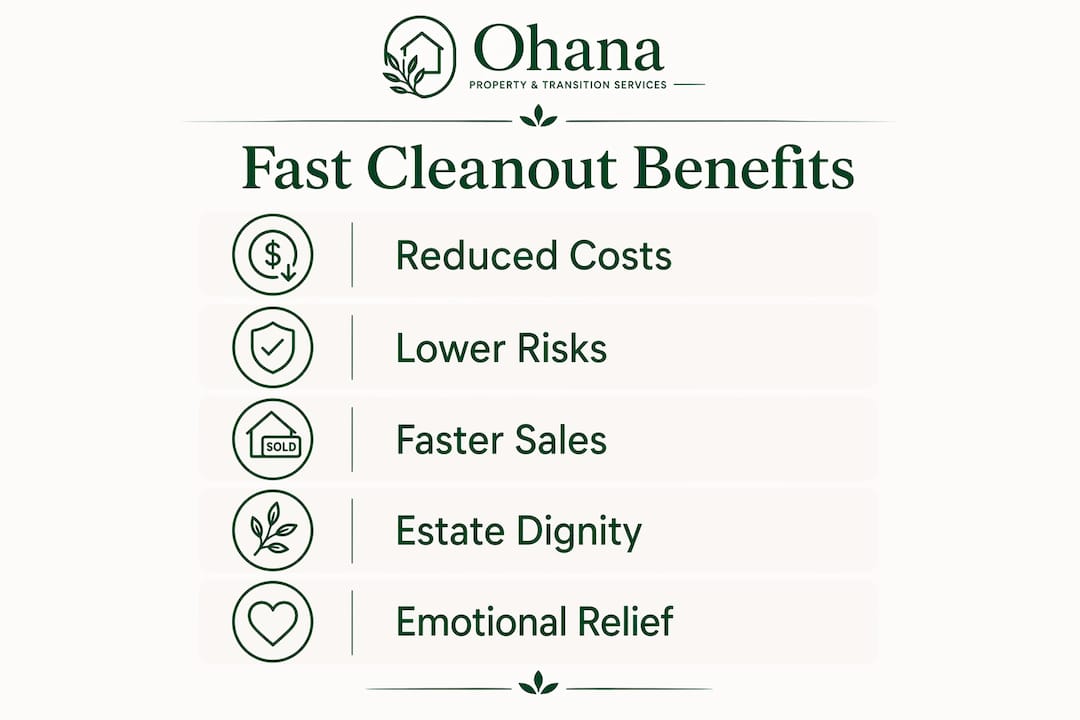
The financial benefits of a quick cleanout are direct and measurable. Reduced carrying costs, faster access to sale proceeds, and a stronger listing price all flow from moving quickly. Families who delay often spend more on holding costs than they recover from trying to sell individual items.
The emotional benefits are just as real. A drawn-out cleanout forces heirs to revisit grief repeatedly over weeks or months. Each sorting session reopens decisions about what to keep, sell, or discard. A focused, professional cleanout compresses that process into days, giving families space to grieve and move forward.
Family conflict is another hidden cost of delay. When multiple heirs share responsibility for a property, unclear timelines and undefined roles create friction. Setting a firm cleanout date and assigning clear responsibilities prevents disagreements from escalating into legal disputes over the estate.
The fastest path through grief is not avoidance. It is completing the practical work with support, so the family can focus on honoring the person rather than managing their belongings indefinitely.
Professional cleanout services also preserve estate dignity. Ohanapropertyexperts approaches every estate cleanout with care for the family’s situation, handling items respectfully and identifying donation opportunities where possible.
Key Takeaways
Fast cleanouts protect estate value, reduce risk, and give families a clear path forward after inheriting a property.
| Point | Details |
|---|---|
| Carrying costs accumulate fast | Monthly taxes, insurance, and utilities drain estate value every week a home sits uncleared. |
| Vacancy creates security risk | Vacant homes become targets for theft and vandalism after 30 days, increasing liability exposure. |
| Buyers prefer cleared homes | Uncluttered, staged homes sell faster and at higher prices than cluttered inherited properties. |
| Confirm authority before disposal | Executor rights must be established before removing items to avoid probate disputes. |
| Professional crews save time and money | A professional cleanout completed in 24–48 hours costs less than weeks of DIY carrying costs. |
What I have learned from watching families navigate inherited home cleanouts
Families almost always underestimate how long a DIY cleanout will take. They plan for a weekend and end up with a property still half-full three months later, paying carrying costs the whole time. I have seen this pattern repeat itself, and the cause is almost always the same: emotional attachment to ordinary objects that have no real resale value.
The hardest mindset shift is separating memory from market value. A dining room set that held decades of family dinners is meaningful. It is rarely worth more than a few hundred dollars at an estate sale, and it costs the estate real money every week it sits in the house. Families who make that distinction early move faster and grieve more cleanly.
The other mistake I see regularly is skipping the valuables sweep. People assume they know what is in the house. They do not. Cash tucked in old coat pockets, jewelry in medicine cabinets, and important documents in filing boxes get thrown out every day during rushed cleanouts. A methodical sweep before any removal begins takes a few hours and can recover items worth far more than the cleanout itself costs.
My honest advice: set a firm date, confirm executor authority, do the sweep, and then call professionals for the rest. The estate is not served by a perfect sort. It is served by a fast, respectful, and thorough cleanout that gets the property to market.
— Olga
Ohanapropertyexperts: fast, respectful cleanouts for inherited homes in Central Indiana
When a family needs to clear an inherited home quickly, Ohanapropertyexperts handles the entire process with care and efficiency.

Our team serves Columbus, Indianapolis, Greenwood, Franklin, Seymour, and surrounding Central Indiana communities. We complete most estate cleanouts in a single visit, handling furniture, appliances, debris, and general junk removal so you do not have to coordinate multiple vendors. We identify donation opportunities, provide receipts where available, and treat every home with the respect the family deserves. For a full look at what we offer, visit our cleanout services page or call us at (812) 302-6833 for a free estimate.
FAQ
What is an inherited home cleanout?
An inherited home cleanout is the process of removing a deceased person’s belongings from a property to prepare it for sale, rental, or occupancy. It typically includes furniture removal, junk hauling, debris disposal, and donation coordination.
How long does a professional inherited home cleanout take?
Professional cleanout services can complete most inherited home clearances in 24–48 hours. DIY efforts often take weeks due to emotional exhaustion and limited disposal resources.
When should I hold an estate sale instead of a full cleanout?
An estate sale makes sense when the home contains items with sufficient resale value to justify the time and cost. For most inherited homes, the majority of goods are low-value items where a direct cleanout is faster and more cost-effective.
What legal steps do I need to take before clearing an inherited home?
Confirm executor authority through the probate process before disposing of any items. Premature disposal can trigger legal disputes among heirs and complicate the estate settlement.
How do I handle donations during an inherited home cleanout?
Verify acceptance conditions with charities before scheduling pickups. Many organizations reject stained, worn, or damaged items, which results in unexpected junk removal fees if you have not planned for alternative disposal.