
Carpet Removal Cost: How Much to Budget and Why
Learn about the costs of carpet removal, including factors influencing price and budgeting tips to help you plan your flooring project.
Carpet Removal Cost: How Much to Budget and Why
Professional carpet removal typically costs $120 to $720 per job, with most homeowners landing around $280 to $500 depending on room size and installation type. On a per-square-foot basis, expect to pay $1 to $5, with stretch-in carpet on the low end and glued-down or double-glued carpet pushing toward the top of that range.
That range is a starting point, not a promise. Final pricing shifts based on how the carpet was installed, whether there’s a pad to pull up, how much disposal costs in your area, and what your crew finds once the old flooring comes up.
Quick budgeting bands:
- Stretch-in carpet: $1 to $2 per sq ft
- Glued or double-glued carpet: $2 to $5 per sq ft
- Stairs: priced per step, not per square foot
- Basements: add a premium if moisture or mold shows up
Skip to the estimate section below for sample math on a bedroom, living room, and whole-house job.
Key Takeaways
Carpet removal costs typically fall between $120 and $720 per job nationally, and the biggest cost swings come from installation method, stairs, and disposal fees, not room size alone.
| Point | Details |
|---|---|
| National range | Budget $120 to $720 for most rooms, with $1 to $5 per square foot depending on installation type. |
| Glued carpet costs more | Glue-down and double-glue removal runs $2 to $5 per sq ft versus $1 to $2 for stretch-in. |
| Stairs price separately | Expect $3 to $6 per step rather than a per-square-foot rate for staircases. |
| Disposal varies widely | Confirm whether haul-away is bundled into your quote or billed as a separate flat fee. |
| Ohanapropertyexperts scopes it upfront | Photo-based quotes and included haul-away make budgeting predictable for Central Indiana homeowners. |
Table of Contents
- What Does Carpet Removal Cost Nationally?
- What Actually Moves Your Price Up or Down
- Stairs, Basements, Glued Carpet, and Padding: The Line Items That Add Up
- Disposal Fees and Carpet Recycling Options
- Should You Remove Carpet Yourself or Hire a Pro?
- Estimate Your Carpet Removal Job
- How a Local Cleanout Crew Actually Scopes a Carpet Removal Job
- Why Most Cost Guides Undersell the Disposal Question
- Get a Fast, Transparent Quote for Your Carpet Removal
- Sources
What Does Carpet Removal Cost Nationally?
National pricing data lines up fairly tightly across the major cost-estimate sites, which is reassuring if you’re trying to sanity-check a contractor’s quote. Angi reports a typical range of $120 to $720, with the average homeowner spending close to $280. HomeAdvisor’s figures land in nearly the same place: $120 to $720, with per-square-foot rates between $1.10 and $5.10. Modernize widens the average band slightly to $210 to $850, largely because their sample includes more glue-down jobs, which run higher.
Here’s how those per-square-foot bands translate into real room sizes:
- 100 sq ft (small bedroom): roughly $100 to $500, typically $150 to $250 for stretch-in
- 200 sq ft (living room or two bedrooms): roughly $200 to $1,000, typically $300 to $500
- 400 sq ft (whole floor or large open space): roughly $400 to $2,000, typically $600 to $1,000
Homewyse’s calculator pegs national averages closer to $1.37 to $2.49 per square foot when disposal and basic cleanup are bundled in, which tracks with the lower half of the ranges above. The gap between sources usually comes down to what’s included. A quote that looks cheap on paper may exclude disposal, furniture moving, or tack strip removal, while a higher quote might bundle everything into one number.
Regional labor costs matter too. Contractors in higher cost-of-living metros charge more per hour, and Bureau of Labor Statistics wage data confirms that flooring and general labor wages vary significantly by state and metro area. A quote in a small Indiana town will almost always undercut one from a major coastal city for the same square footage.
What Actually Moves Your Price Up or Down
Two jobs of identical square footage can cost twice as much depending on how the carpet was installed and what’s underneath it. Understanding these variables helps you read a quote instead of just reacting to the total.
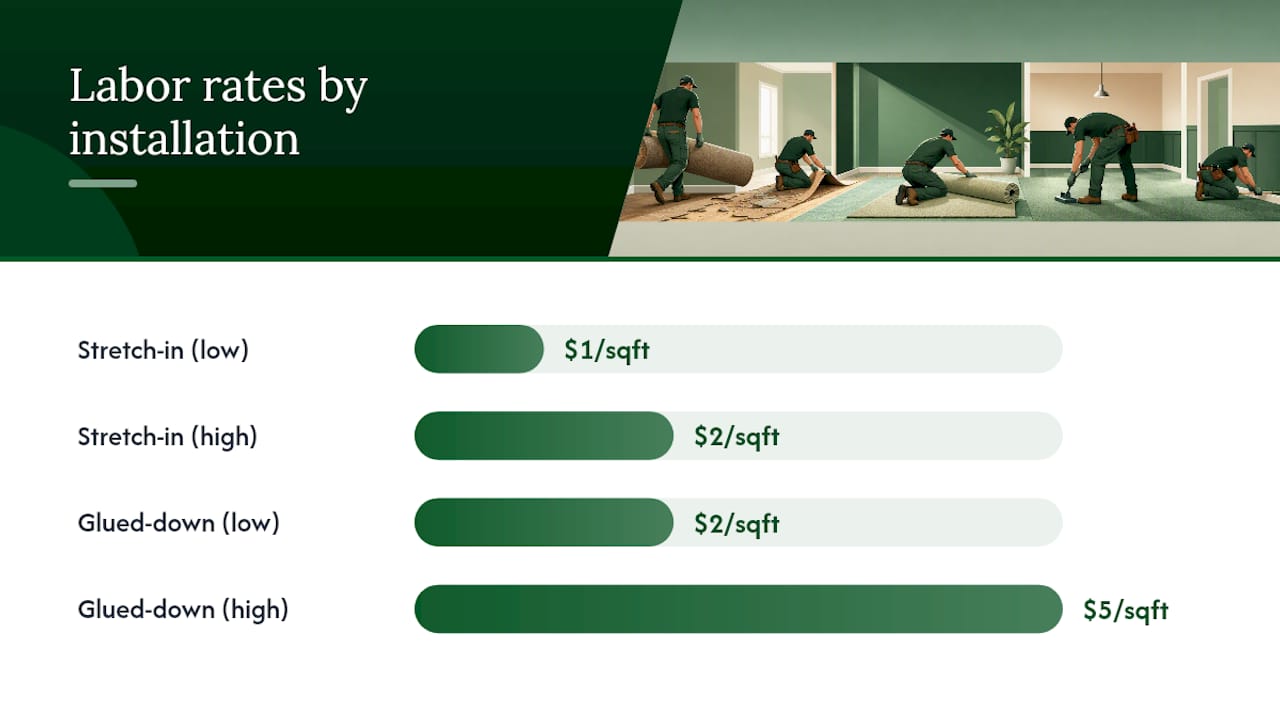
Installation method is the single biggest factor. Stretch-in carpet, held down by tack strips around the room’s perimeter, pulls up fast. A crew can often clear a bedroom in 20 minutes. Glued-down carpet is a different story. Modernize notes that glue-down and double-glue jobs push labor to roughly $2 to $5 per square foot, compared to $1 to $2 for stretch-in, because scraping dried adhesive off a subfloor takes real time and often requires a floor scraper or chemical adhesive remover.
Room complexity adds line items you won’t see in a simple per-sqft quote:
- Stairs: usually priced per step or per tread, not folded into square footage
- Closets and odd angles: more cutting, more labor per square foot covered
- Furniture-heavy rooms: moving furniture is often a separate charge unless you clear the space yourself
Site conditions can turn a routine job into a bigger one. Mold, water damage, or suspected asbestos (common in flooring materials installed before the 1980s) usually means the contractor stops and recommends a specialist before continuing. Remediation costs vary too widely to estimate here, but budget for a delay and a second quote if your crew flags anything unusual once the carpet comes up.
How contractors price labor also affects your total. Some quote flat per-square-foot rates, some charge hourly with a trip minimum, and some blend both for jobs with a lot of cutting or stairs. Ask which model you’re getting quoted before comparing two bids side by side, because a $300 flat quote and a $75-an-hour quote aren’t apples to apples until you know the expected hours.
Pro Tip: Ask your contractor for a written breakdown separating removal, disposal, and any furniture moving before you sign anything. A one-line total makes it impossible to know what you’re actually paying for, and it’s the number one source of “surprise” charges on removal day.
Stairs, Basements, Glued Carpet, and Padding: The Line Items That Add Up
Some spots in the house cost more to clear than a flat per-square-foot number suggests. Knowing which ones ahead of time keeps your budget realistic.
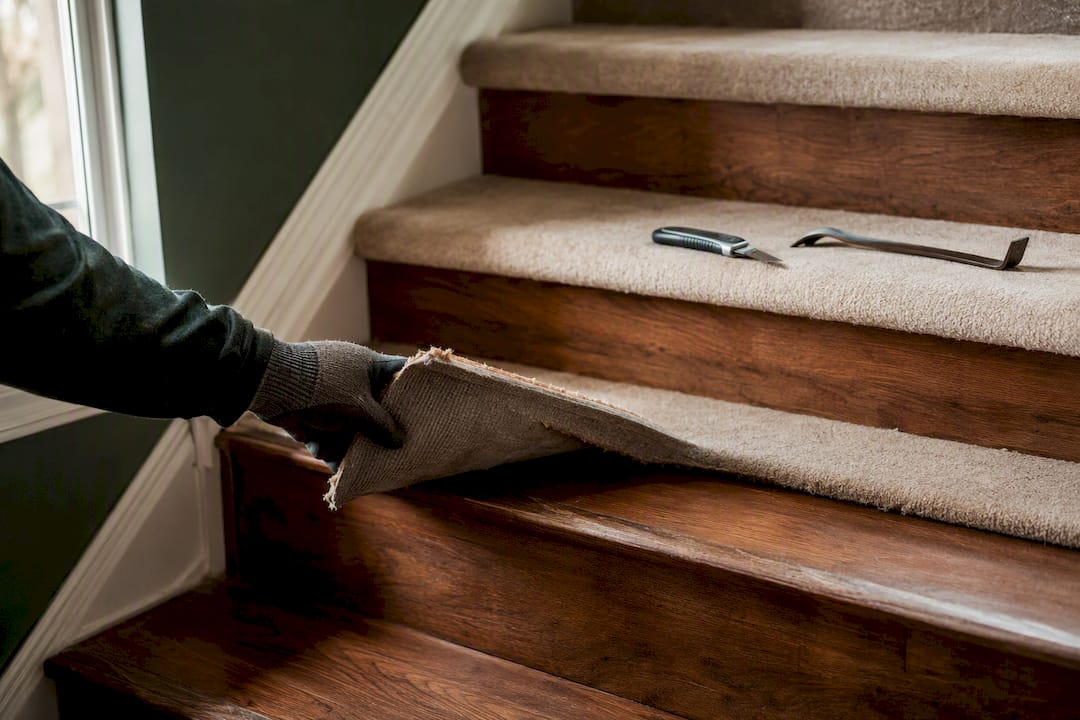
Stairs are priced per step in most markets, not by square footage, since each tread and riser takes individual attention. HomeGuide’s data shows typical per-step pricing in the $3 to $6 range for straightforward staircases, climbing higher when carpet is glued to the treads or wrapped around unusual angles. A 13-step staircase can easily add $40 to $80 to a job that otherwise looked simple.
Basements carry their own risk premium. Below-grade carpet is a common spot for hidden moisture damage, and if your crew finds mold under the padding, that’s a separate remediation conversation, not a carpet removal one. Budget extra time (and possibly a mold inspection) if your basement carpet feels damp, smells musty, or has never been pulled up before.
Glued and double-glue carpet is the most labor-intensive category across every pricing source reviewed here. Beyond the higher per-square-foot rate, double-glue installations disproportionately increase labor time because the crew is scraping through two adhesive layers instead of one, sometimes requiring a floor grinder to finish the job cleanly.
Padding removal changes both time and disposal costs:
- Carpet-only removal is faster and lighter to haul
- Carpet-plus-pad adds bulk, weight, and often a second disposal fee since foam padding is bagged separately in many landfill systems
- Old, crumbling padding (common after 10+ years) can slow the job further since it tends to tear into small pieces instead of pulling up in one sheet
Old or deteriorated carpet sometimes hides subfloor problems that only surface once the flooring is gone: soft spots, old water stains, or nail pops. These aren’t part of a standard carpet removal quote, so ask your contractor what happens if they find subfloor damage before work begins.
Disposal Fees and Carpet Recycling Options
Disposal is where a lot of quotes quietly diverge. Some contractors fold hauling into their per-square-foot rate; others charge a flat haul-away fee on top, often $30 to $100 depending on volume and local landfill tipping fees. Always confirm whether disposal is included before comparing two bids.
Your main hauling options break down like this:
- Contractor-included haul-away: simplest option, usually bundled into the quote
- Hiring a separate junk hauler: worth considering for larger jobs; see our guide on post-renovation debris hauling for how to weigh this against a dumpster rental
- Dumpster rental: can save money on multi-room jobs but adds a delivery/pickup fee and requires driveway space
Carpet recycling is more available than most homeowners realize, though it varies heavily by region. The Carpet Recovery Initiative’s collector-finder map lets you search for nearby recycling centers that accept old carpet instead of sending it straight to a landfill. In some metros, recycling costs about the same as standard disposal; in others, it costs more because collection points are farther away. For a full walkthrough of your options, check our carpet removal disposal guide.
Should You Remove Carpet Yourself or Hire a Pro?
DIY removal looks cheap on the surface, but the real cost includes more than a utility knife and a free Saturday.
- Tool costs: a pry bar, knee kicker, utility knife, and gloves run $30 to $60 if you don’t already own them
- Disposal: most landfills charge by weight or by the truckload, and many won’t accept carpet without a fee
- Time: a single room takes an inexperienced DIYer 2 to 4 hours; a whole house can eat an entire weekend
- Vehicle needs: carpet rolls are bulky and heavy, often requiring a truck or trailer to haul
DIY also carries real risk. Tack strips are lined with sharp nails, subfloors can be damaged by aggressive scraping, and carpet rolls are heavier than they look, especially when wet or padded. A professional quote typically covers cleanup, hauling, and insurance against accidental damage, which is worth factoring into your comparison, not just the sticker price.
Before hiring, ask for a written scope, confirm whether disposal is included, and get proof of insurance. Our DIY-versus-pro checklist walks through the exact questions to ask before you sign.
Pro Tip: If your carpet is glued down or you suspect asbestos-backed flooring underneath, skip the DIY route entirely. Scraping old adhesive without the right tools can take an entire day for one room, and disturbing older flooring materials without testing them first isn’t a risk worth taking.
Estimate Your Carpet Removal Job
Here’s a formula you can run in under a minute:
- Measure your room’s square footage (length × width)
- Pick your per-sqft band: $1 to $2 for stretch-in, $2 to $5 for glued carpet
- Multiply square footage by both ends of the band for a low and high estimate
- Add stair charges separately if applicable (roughly $3 to $6 per step)
- Add a buffer of 10 to 20% if you suspect subfloor repairs or heavy padding
| Scenario | Square Footage | Installation Type | Estimated Cost Range |
|---|---|---|---|
| Small bedroom | 120 sq ft | Stretch-in | $120 to $720 |
| Living room | 250 sq ft | Stretch-in | $250 to $500 |
| Living room (glued) | 250 sq ft | Glued/double-glue | $280 to $500 |
| Whole house | 2,000 sq ft | Mixed (mostly stretch-in) | $600 to $1,000 |
These numbers assume standard access, no furniture moving, and no subfloor surprises. Thumbtack’s aggregated contractor data shows a median around $509 for single-room jobs, which sits comfortably inside the living room range above, confirming these formulas hold up against real-world quotes.
Expect bigger deviations from these numbers when stairs are involved, when carpet is glued rather than stretched, or when your crew finds moisture damage once the old flooring comes up. Those three variables account for most of the gap between a “cheap” quote and an expensive one.
How a Local Cleanout Crew Actually Scopes a Carpet Removal Job
At Ohanapropertyexperts, we handle carpet removal as part of full property cleanouts, estate cleanouts, and rental turnovers across Columbus, Indiana and the surrounding Central Indiana communities. Here’s what a typical job flow looks like:
- We start with a photo-based quote, so you get a clear cost picture before we ever step on-site
- Our estimate accounts for square footage, installation type, and whether pad and tack strips need to come up too
- Haul-away and disposal are part of the process, and we route usable items to donation whenever possible instead of defaulting to the landfill
- Before we arrive, clear a path to the room and move small breakables. We handle the heavy lifting from there.
We serve homeowners, landlords, realtors, and estate executors who need a property cleared fast and done right.
Fast, transparent quotes and a crew that treats your home with care are the real cost-savers most guides skip.
Why Most Cost Guides Undersell the Disposal Question
The conventional advice on carpet removal cost fixates on per-square-foot rates, and that’s the wrong obsession. Every major pricing source, from Angi to Homewyse, converges on similar bands once you strip out disposal and prep work. The real variance in what homeowners actually pay comes from what happens after the carpet is off the floor, not the pulling-up part itself.
Glued carpet, hidden moisture, and disposal logistics are where quotes diverge and where homeowners get blindsided. A contractor who quotes low on the per-square-foot rate but tacks on a separate hauling fee, excludes padding removal, or doesn’t mention adhesive scraping until the crew is already on-site isn’t necessarily dishonest. They’re just following an industry norm of itemizing loosely.
My advice: prioritize a written, itemized quote over a low headline number every time. Ask what happens if the subfloor needs repair, ask if pad and tack strips are included, and ask where the debris actually goes. The homeowners who get burned aren’t the ones who paid the highest per-square-foot rate. They’re the ones who never asked what that rate covered.
— Olga
Get a Fast, Transparent Quote for Your Carpet Removal
Ohanapropertyexperts gives you something most flooring contractors can’t: a single crew that handles the carpet, the padding, the hauling, and everything else you’re clearing out of the room, all quoted from photos before we ever show up.

If your carpet removal is part of a bigger project, an estate cleanout, a rental turnover, or getting a house ready to sell, you don’t need to coordinate a flooring crew and a separate hauling service. We handle both in one visit, with donation-conscious recovery built into the process so usable items don’t end up in a landfill by default. That’s a real time savings for homeowners juggling a move, a listing deadline, or a property transition on a schedule.
Ready to see what your job actually costs? Send us a few photos through our services page and we’ll get you a free, no-obligation quote before you commit to anything.
Sources
For readers who want to verify these figures directly, the core pricing data in this guide comes from Angi, HomeAdvisor, Modernize, Homewyse, HomeGuide, and Thumbtack. For labor-cost context by region, the Bureau of Labor Statistics publishes occupational wage data. To locate a recycling center for old carpet, use the Carpet Recovery Initiative’s collector finder.
- How Much Does Carpet Removal Cost? 2026 Data
- How Much Does It Cost to Remove Carpet?
- How Much Does Carpet Removal Cost? 2026 Guide
- Cost to Remove Carpet
- Carpet Recovery Initiative collector finder