
Avoid Closing Delays: Property Cleanout Timeline for 5–6 Week Closings
Plan a cleanout for a 5–6 week closing. Get a photo quote, book a crew on contract day, and follow five stages to meet closing.
Avoid Closing Delays: Property Cleanout Timeline for 5–6 Week Closings
Most quick cleanouts wrap up in a few hours to a day. Removal work with a crew usually runs 1 to 5 days depending on square footage and volume. Full estate preparation, meaning sorting, donations, sales, and deep cleaning, typically takes 2 to 6 weeks. Complex situations involving hoarding, damage, or contamination can stretch into months.
TL;DR:
- Quick cleanouts for single rooms or small properties typically take a few hours to one day with a small crew, while full estate cleanouts usually span 2 to 6 weeks.
- Complex situations involving hoarding, damage, or contamination can extend the timeline to several months due to additional remediation, legal, or disposal requirements.
- Starting planning immediately after contract signing ensures scheduling removal crews early, preventing last-minute delays that can push back closing dates.
- Hazardous materials, access issues, and legal delays are the main factors that can significantly slow down a cleanout process.
- Booking removal and cleaning services the day the property goes under contract is the most effective way to avoid delaying a property sale.
Table of Contents
- How Long Does a Property Cleanout Timeline Usually Run?
- What Does a Step-by-Step Cleanout Timeline Look Like?
- What Factors Speed Up or Slow Down a Cleanout?
- How Do You Plan and Schedule a Cleanout Before Closing?
- Should You DIY the Cleanout or Hire a Crew?
- How Ohana Schedules and Delivers Cleanouts
- The One Rule That Prevents Closing Delays
- Get a Free Estimate for Your Property Cleanout
- Where to Verify Hazardous, Recycling, and Donation Rules
- Sources
- FAQ
How Long Does a Property Cleanout Timeline Usually Run?
The right property cleanout timeline depends almost entirely on what’s inside the property and who’s making the decisions about it. A single garage full of old tools is a different job than a five-bedroom house where someone lived for 40 years. Knowing which category your project falls into is the first real step in scheduling everything else, from junk haulers to closing dates.
Quick cleanouts cover single rooms, garages, storage units, or light rental turnovers with minimal furniture and no sentimental sorting required. These jobs typically take a few hours to one full day with a two or three-person crew. A landlord clearing a studio apartment after a tenant moves out, for example, might have the unit hauled and swept in an afternoon.
Average full-house or estate cleanouts are the most common scenario for sellers and executors. A typical 3-bedroom family home with a garage and basement generally takes 2 to 6 weeks from first walkthrough to broom-clean handoff. That window includes time for family members to claim items, donation drop-offs, an optional estate sale, and a final cleaning pass. Here’s roughly how that time gets used:
- Week 1: Initial walkthrough, sorting decisions, and scheduling the removal crew.
- Weeks 2 to 3: Room-by-room sorting, donation runs, and possibly an estate sale weekend.
- Weeks 4 to 5: Bulk removal and hauling, appliance and furniture pickup.
- Week 6: Deep cleaning, touch-ups, and final walkthrough prep.
Complex cleanouts involve hoarding situations, water or fire damage, pest infestations, or properties tied up in probate. These stretch timelines because they layer in remediation work, legal waiting periods, or specialized disposal that a standard crew can’t handle in a normal visit. A hoarded 2,500 square foot estate with structural cleanup needed, for instance, can realistically take 2 to 4 months once you factor in contractor scheduling and probate approvals. Knowing early which bucket you’re in keeps you from underbooking a crew or missing a closing date.
What Does a Step-by-Step Cleanout Timeline Look Like?
A cleanout runs cleanest when it follows the same five-stage sequence every time: assessment, sorting, removal, cleaning, and final readiness. Skipping steps or running them out of order is the single biggest reason cleanouts run long.
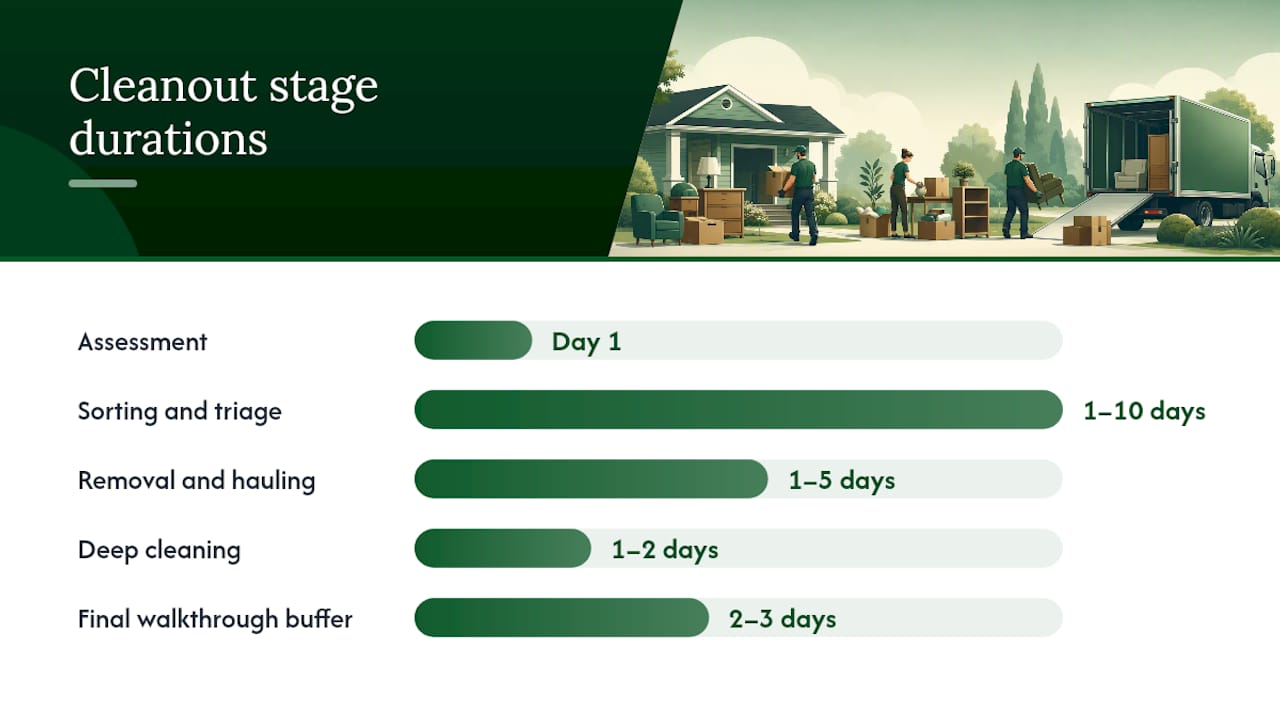
Assessment (Day 1, usually same-week) Most reputable crews offer a free estimate based on photos or a short walkthrough, which cuts out the guesswork before anyone shows up with a truck. A phone call or photo quote can often confirm scope and pricing within 24 to 48 hours, letting you lock a removal date immediately instead of waiting on multiple in-person visits.
Sorting and triage (Days 1 to 10, longer for estates) This is where most delays actually happen, because sorting is emotional and decision-heavy in a way hauling never is. Break it down by room and delegate:
- Kitchens and bathrooms: usually fastest, since most items are utilitarian.
- Bedrooms and closets: slower due to clothing, personal papers, and keepsakes.
- Garages, attics, and basements: often the largest volume and the most hazardous materials.
- Home offices: watch for documents that need shredding or estate-related paperwork.
Pro Tip: Assign one family member as the final decision maker for sentimental items. Splitting that authority across siblings or heirs is the number one cause of stalled sorting timelines in estate cleanouts.
Removal and hauling (1 to 5 days depending on volume) Crew-day math is simple: a two-person crew typically clears one truckload per day for an average home, so a 3-bedroom house with a full garage might need two to four truckloads across two or three days. Larger estates or hoarding situations may need a dumpster on-site for a week or more.
Deep cleaning and touch-ups (1 to 2 days) Once the space is empty, plan for carpet cleaning, wall patching, and a final sweep. This is also when small cosmetic fixes, like a quick industrial-style living room refresh, can make a property show better without a full renovation budget.

Final walkthrough buffer (2 to 3 days before closing) Build in slack here. Keys, garage door openers, and any documentation of the property’s condition need to be ready before the buyer’s final walkthrough, and rushing this step is where avoidable disputes start.
What Factors Speed Up or Slow Down a Cleanout?
Volume and access are the two biggest multipliers on any cleanout timeline. A cluttered house with narrow hallways and no elevator access takes noticeably longer than an open, single-story home with a driveway a truck can pull straight up to.
- Volume and access: More rooms, more stairs, and tighter parking all add crew days.
- Hazardous or regulated materials: Items like asbestos siding, old paint cans, solvents, and pesticides require special handling rather than a standard haul. The EPA’s asbestos guidance notes that older homes often contain materials that shouldn’t be disturbed without care, and household hazardous waste frequently has to go through a local HHW collection program rather than the regular haul, which can add days to weeks of lead time depending on your area’s schedule.
- Legal and estate constraints: Probate approval or a pending estate sale can pause physical removal entirely until paperwork clears.
- Property damage or contamination: Mold, pests, or fire damage need remediation before a general cleanout crew can even start safely.
- Season and crew availability: Spring and summer moving season, plus holidays, tighten booking windows for haulers, cleaners, and donation pickups.
Local hazardous waste programs are appointment-based in most areas, which means waiting until the week of your cleanout to schedule one is a common way a fast job turns into a two-week delay.
How Do You Plan and Schedule a Cleanout Before Closing?
Start planning the moment a property goes under contract, or the moment your family makes the decision to move forward on an estate, whichever comes first. Waiting until the week before closing is the single most common mistake that pushes a closing date back, since crews, cleaners, and donation programs all book ahead.
Here’s a workable sample timeline tied to a 5 to 6 week closing window:
- Week 1: Get estimates, confirm scope, and book your removal crew’s date. Crews with tight availability often need 1 to 2 weeks of lead time.
- Week 2: Begin sorting room by room and schedule any donation pickups. Both Habitat for Humanity ReStores and Goodwill generally want advance notice for larger loads, and The Salvation Army offers similar drop-off and pickup guidance worth confirming locally.
- Weeks 3 to 4: Complete removal and hauling, route electronics to a certified e-waste recycler, and keep donation receipts for tax purposes.
- Week 5: Deep clean and handle cosmetic touch-ups.
- 48 to 72 hours before walkthrough: Confirm keys, garage remotes, utility shutoff dates, and a final visual sweep of every room.
Pro Tip: Keep a simple folder, physical or digital, with every donation receipt and disposal record. It saves real time if a buyer’s agent or estate attorney asks for proof the property was cleared properly.
Coordinating a cleanout around an estate sale adds its own lead time, since sale weekends usually need to happen before the bulk hauling starts.
Should You DIY the Cleanout or Hire a Crew?
Homeowners doing a cleanout themselves usually spend far more calendar time on it than they expect, mostly because of multiple dump runs and the physical toll of sorting alone. A DIY 3-bedroom cleanout often stretches across two or three weekends once you count landfill trips, truck rentals, and the fact that most people can only manage a few hours of hauling before burning out.
- Hidden time drains: repeated trips to the landfill, waiting in line at transfer stations, and underestimating how heavy furniture and appliances actually are.
- When a pro is worth it: tight closing windows, emotionally difficult estate situations, or rental units where every vacant day costs money.
- Questions to ask any provider: Can they guarantee a specific date? Are they insured? How do they route donations versus disposal?
If your move-out timeline is already tight, a professional crew’s ability to guarantee a date is usually worth more than any money saved doing it solo.
How Ohana Schedules and Delivers Cleanouts
Ohanapropertyexperts handles full property cleanouts, estate cleanouts, and donation-conscious recovery across Columbus, Seymour, North Vernon, Edinburgh, Franklin, Greenwood, Indianapolis, Lafayette, and the surrounding Central Indiana area. Every job starts with a free, photo-based estimate, which locks in scope and pricing without waiting on multiple in-person visits. Once scheduled, a crew handles removal, routes usable items to donation partners, and provides documentation of what left the property. That sequence, estimate to scheduled crew to removal to donation records, is built to keep a property cleanout moving without the guesswork that stalls most DIY timelines.
The One Rule That Prevents Closing Delays
If there’s one scheduling rule worth following above all others, it’s this: book your removal crew the day the property goes under contract, not the week before your walkthrough. Donation programs, hazardous waste appointments, and hauling crews all run on their own calendars, and a property cleanout timeline only holds together when the biggest, least flexible piece gets locked in first.
— Olga
Get a Free Estimate for Your Property Cleanout
Ohanapropertyexperts is the direct alternative to piecing together a DIY haul, a rented dumpster, and separate donation runs. One family-owned crew handles the full property cleanout from sorting through donation routing, with photo-based quotes that lock in a schedule fast instead of waiting on multiple walkthrough visits.
For estates specifically, the estate cleanouts service is built around compassionate, social-worker-informed handling of sentimental items, not just a truck and a crew. Smaller jobs, like a single garage or a few pieces of furniture, can go through junk removal instead of a full-property booking. Request a free photo-based estimate online to get a scheduled date before your closing window gets tight.
Where to Verify Hazardous, Recycling, and Donation Rules
- EPA household hazardous waste programs
- EPA electronics recycling guidance
- National recycling and waste data
Sources
- Collections for household hazardous waste (HHW) | US EPA
- Electronics donation and recycling | US EPA
- Habitat for Humanity ReStores
FAQ
How Long Does an Estate Cleanout Take?
Most estate cleanouts typically last several weeks from initial sorting to final cleaning, depending on how much needs to be sorted, sold, or donated. Complex estates involving probate delays or hoarding conditions can extend the timeline significantly.
How Long Should It Take to Clean Out a 2,500 Square Foot House?
A house of this size with average furnishings usually requires a few days for hauling after sorting is complete, and several weeks total when including triage, donation runs, and final cleaning. Heavy clutter, tight access, or hazardous materials can add extra days to the removal phase.
How Do Estate Cleanouts Work?
An estate cleanout generally starts with a walkthrough or photo-based estimate to assess scope, followed by sorting items into keep, sell, donate, and dispose categories. A property cleanout service like Ohanapropertyexperts then schedules a crew for removal, routes usable goods to donation partners, and finishes with a cleaning pass before the final walkthrough.
How Much Does an Estate Cleanout Cost?
Cost depends heavily on volume, access, and whether hazardous materials are involved, so pricing is typically quoted after a photo-based estimate rather than as a flat rate. Ohanapropertyexperts’ estate cleanouts and related junk removal services, priced roughly $100 to $500 for standalone junk-haul jobs, list current pricing details on the site after a free estimate.