
Avoid Illegal Venting: U.S. Refrigerator Disposal Rules (EPA Sec. 608)
Know EPA Section 608 and the compliant U.S. routes for old fridges: retailer pickup, RAD/utility bounties, transfer stations, or certified recyclers....
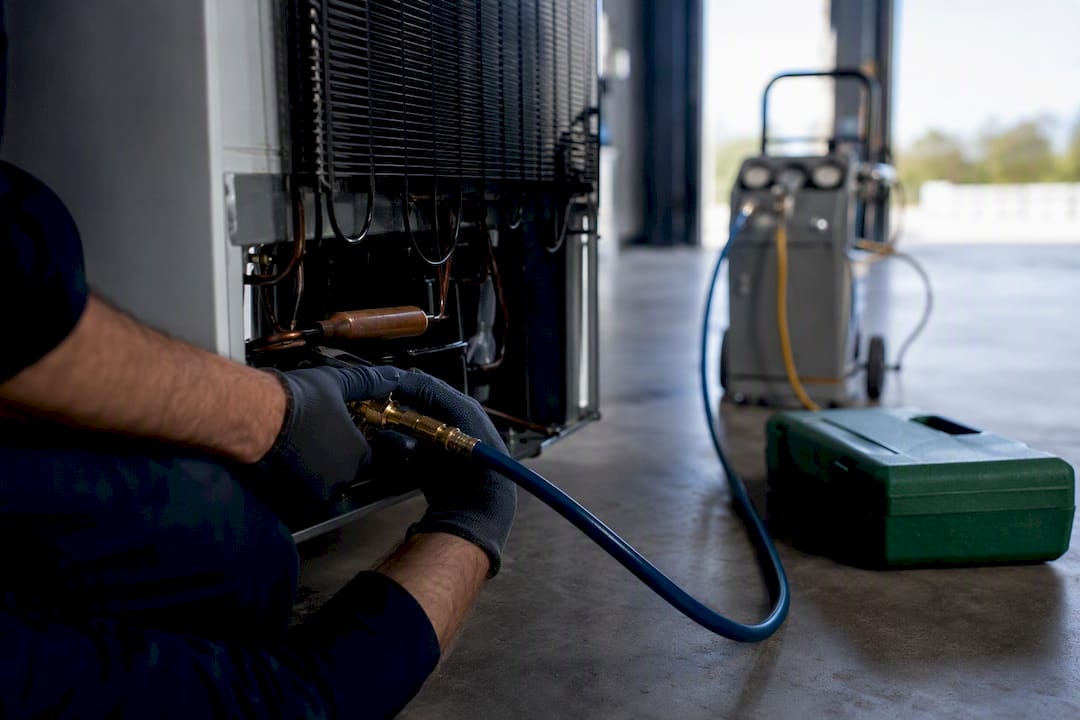
Avoid Illegal Venting: U.S. Refrigerator Disposal Rules (EPA Sec. 608)
Under federal law, you may not vent refrigerant into the air, and you cannot legally send a refrigerator to a landfill, shredder, or scrap yard until the refrigerant has been recovered. The single right move for most homeowners is to route the unit through a certified channel: a retailer haul-away program, a utility rebate partner, an EPA Responsible Appliance Disposal (RAD) partner, or a municipal pickup service that already follows these rules. State and local ordinances can add extra steps on top of that federal floor, so a quick call before pickup day saves you from a rejected load.
TL;DR:
- Homeowners should verify that disposal services recover refrigerant correctly, as illegal venting fines are severe and can carry criminal charges.
- Most certified recycling programs and retailers either recover refrigerant themselves or partner with licensed processors, making them the safest disposal options.
- State and municipal rules often add requirements like scheduling appointments or proof of refrigerant removal, making local verification crucial.
- Only certified technicians with Type I certification should attempt refrigerant recovery, which most homeowners are legally prohibited from doing themselves.
- Keep signed refrigerant removal documentation for three years to ensure compliance and proof of proper disposal if questioned later.
Table of Contents
- What Federal Refrigerator Disposal Rules Actually Require
- Do You Need a Certified Technician to Remove Refrigerant?
- Do State and Local Refrigerator Recycling Rules Add More Requirements?
- What Are Your Practical Options for Disposing of an Old Refrigerator?
- How Do You Prepare a Refrigerator for Pickup or Drop-Off?
- What Are Recyclers and Scrap Yards Required to Do With Old Refrigerators?
- What Happens if Refrigerant Gets Vented Illegally?
- Where Can You Verify Rules or Find a Certified Program?
- What Do Removal Crews See That Homeowners Don’t?
- What Should Homeowners Actually Prioritize Here?
- How Ohana Property & Transition Services Handles Appliance Removal
- Sources
What Federal Refrigerator Disposal Rules Actually Require
Clean Air Act Section 608, codified at 40 CFR Part 82, Subpart F, bans venting refrigerant from any appliance, including the small hermetically sealed systems in household refrigerators and freezers. That refrigerant has to come out before the unit gets buried, shredded, or dismantled for scrap. The rule doesn’t just target big HVAC contractors. It follows the appliance all the way to the end of its life, which means everyone who touches it, from the homeowner setting it at the curb to the recycler crushing it for metal, has a role to play.
The EPA’s appliance disposal guidance spells out where responsibility lands at each stage:
- Homeowners aren’t required to recover refrigerant themselves and shouldn’t attempt it without training.
- Final processors (scrap yards, landfills, recyclers) must either verify the refrigerant was already removed or remove it themselves before the unit is destroyed.
- Technicians who service or dismantle appliances professionally generally need Section 608 certification, with a narrow exception covered in the next section.
Read the regulation’s full text on eCFR if you want the exact legal language rather than a summary. For most homeowners, the practical takeaway is simpler than the statute sounds: pick a disposal channel that already handles recovery correctly, and you’re covered.
Do You Need a Certified Technician to Remove Refrigerant?
Not always, and this is where a lot of confusion sets in. EPA’s own guidance draws a line between commercial refrigeration work and small household appliances headed for disposal.
- Type I certification covers small appliances like window units and household refrigerators.
- Type II covers high-pressure systems, Type III covers low-pressure chillers, and Universal covers all three.
- Section 608 certification is required for technicians who service appliances or recover refrigerant as part of ongoing repair work.
- A documented exception applies to people recovering refrigerant from small appliances already in the waste stream, who are not required to hold Section 608 certification, though the EPA’s FAQ on safe disposal still holds the final processor responsible for confirming removal before shredding or burial.
That exception is narrow, and it’s not a green light for a homeowner with a wrench. Refrigerant lines carry pressurized gas that can cause frostbite on skin contact, and older units may still contain CFC or HCFC refrigerants that damage the ozone layer if released. Venting refrigerant yourself is illegal under federal law and dangerous enough that it’s simply not worth the risk.
Pro Tip: If a “we’ll take it for cash” offer sounds too easy, ask who recovers the refrigerant. A legitimate buyer or recycler always has an answer ready.
Do State and Local Refrigerator Recycling Rules Add More Requirements?
Federal law sets the floor, but plenty of states build higher walls on top of it. Several states restrict or outright ban major appliances from landfills, and municipalities frequently layer on their own pickup logistics, according to a state-by-state appliance recycling roundup. That means the same refrigerator could face different disposal requirements depending on which side of a county line it sits on.
Municipal variation shows up in a few predictable ways:
- Bulky-item pickup that requires scheduling an appointment days in advance rather than curbside drop-anytime service.
- Transfer stations that only accept appliances with proof the refrigerant has already been removed.
- Local fees vary depending on the municipality and whether refrigerant recovery is included.
Before you set a fridge at the curb, confirm the current rules apply to your address. A short checklist covers most of it:
- Call your state environmental agency for landfill ban status on major appliances.
- Check your municipal public works or sanitation department page for bulky-item pickup rules and scheduling requirements.
- Ask your electric utility whether it runs a rebate or bounty program for old refrigerators.
- Confirm whether your local transfer station requires a receipt or signed statement showing refrigerant removal.
Homeowners in Central Indiana communities like Columbus, Seymour, and Greenwood deal with this same patchwork. Local pickup rules and transfer station requirements can shift from one town to the next, which is exactly why checking first beats guessing.
What Are Your Practical Options for Disposing of an Old Refrigerator?
Once you know your local rules, the actual disposal decision usually comes down to convenience and cost. Here’s how the main routes stack up:
- Retailer haul-away. Many appliance retailers will remove your old unit when they deliver a new one. Ask directly whether they use a RAD partner or can confirm the fridge will be properly recycled rather than simply resold or scrapped without documentation.
- Utility or RAD bounty programs. ENERGY STAR’s recycling finder lists utility and retail programs that often pay a small rebate or offer free pickup in exchange for the old unit, since removing an inefficient fridge from service also cuts grid demand.
- Municipal bulky-item pickup or transfer station drop-off. This is often the cheapest option if your city runs one, but it usually comes with scheduling requirements and sometimes a fee.
- Certified scrap recyclers. If you’re hauling it yourself, ask for a signed refrigerant removal statement before you leave the unit, both for your records and because a legitimate recycler will have one ready.
- Local appliance removal or junk removal services. This is the fastest option when you have multiple items to clear at once, but confirm the company routes appliances through a compliant recycler rather than an informal scrap buyer.
Pro Tip: Ask any removal service one direct question: “Where does the refrigerant go?” A company that can’t answer clearly isn’t one you want handling your appliance.
How Do You Prepare a Refrigerator for Pickup or Drop-Off?
Getting the fridge ready properly keeps the pickup crew safe and avoids a rejected load at the transfer station.
- Unplug the unit at least a day ahead and let it defrost fully.
- Remove all food, shelves, and bins so the interior is empty.
- Secure or tape the doors shut so they don’t swing open in transit.
- Never cut refrigerant lines or puncture the compressor. That’s the exact venting behavior federal law prohibits.
- Keep any paperwork tied to pickup, whether that’s a receipt, a program confirmation email, or a signed refrigerant removal statement, in case a transfer station or rebate program asks for proof later.
What Are Recyclers and Scrap Yards Required to Do With Old Refrigerators?
The paperwork trail is what actually makes this system enforceable at the ground level. Under EPA’s safe disposal guidance, the facility accepting your old fridge, not you, carries most of the compliance burden.
- Final processors must verify refrigerant removal or recover it themselves before shredding, crushing, or landfilling the unit.
- Facilities recovering refrigerant on-site need certified recovery equipment and proper technician oversight.
- Processors are required to keep signed verification statements on file for three years, which gives inspectors a paper trail to check.
- Reclaimed refrigerant that gets resold must go through certified reclamation; refrigerant that’s simply destroyed doesn’t carry the same resale path.
Responsible recyclers, especially those working through RAD partnerships, typically go beyond refrigerant alone. They also pull mercury switches, PCB-containing capacitors, and compressor oil, and many recover the foam insulation’s blowing agents as a matter of environmental practice rather than strict legal requirement.
What Happens if Refrigerant Gets Vented Illegally?
The most common illegal practice isn’t a homeowner mistake. It’s opportunistic “peddlers” who grab curbside refrigerators, vent the refrigerant on the spot to strip out the copper tubing for scrap value, and disappear before anyone notices. That single act releases ozone-depleting gas and violates the federal venting ban outright.
- Illegal venting carries fines and, in serious cases, criminal liability under the Clean Air Act.
- Abandoning a fridge at the curb “for anyone to take” makes you complicit if a peddler vents it.
- Report suspected violations to EPA’s regional enforcement office or your state environmental agency; most accept anonymous tips.
Where Can You Verify Rules or Find a Certified Program?
A few official tools do most of the legwork for you.
- ENERGY STAR’s fridge and freezer recycling finder surfaces utility and retail programs by ZIP code.
- The EPA RAD program lists partners who follow best practices for refrigerant and foam recovery, not just the federal minimum.
- 40 CFR Part 82, Subpart F on eCFR is the primary legal text if you want the regulation itself rather than a summary.
EPA guidance also confirms that final processors must hold onto signed refrigerant removal verification for three years, which is worth remembering if a program or recycler ever asks you to sign something at drop-off. That signature is doing real regulatory work, not just filing paperwork for its own sake.
What Do Removal Crews See That Homeowners Don’t?
Most calls we get about an old refrigerator start the same way: someone set it out at the curb weeks ago hoping the city would grab it, and it’s still sitting there. In our experience clearing estates and rental properties across Columbus and the surrounding area, curbside refrigerators are exactly the units peddlers target for the copper inside, which is the illegal venting problem playing out in real driveways.
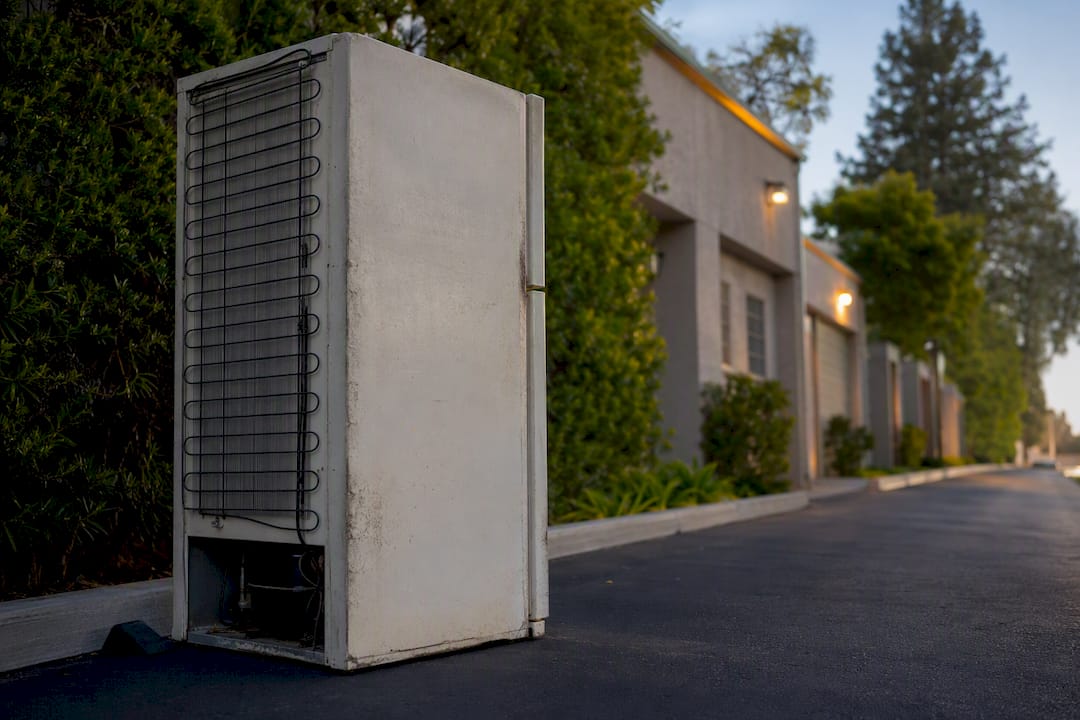
Before hiring any removal service, ask two things: how they handle refrigerant, and whether they can confirm the unit goes to a compliant recycler rather than an informal scrap buyer. A reliable crew answers both without hesitation.
What Should Homeowners Actually Prioritize Here?
Most of the advice floating around treats refrigerator disposal like a simple hauling problem. It isn’t. The federal requirement to recover refrigerant before disposal is the fixed point everything else has to work around, and the biggest mistake homeowners make is picking a disposal route based purely on price without asking who handles that recovery step.
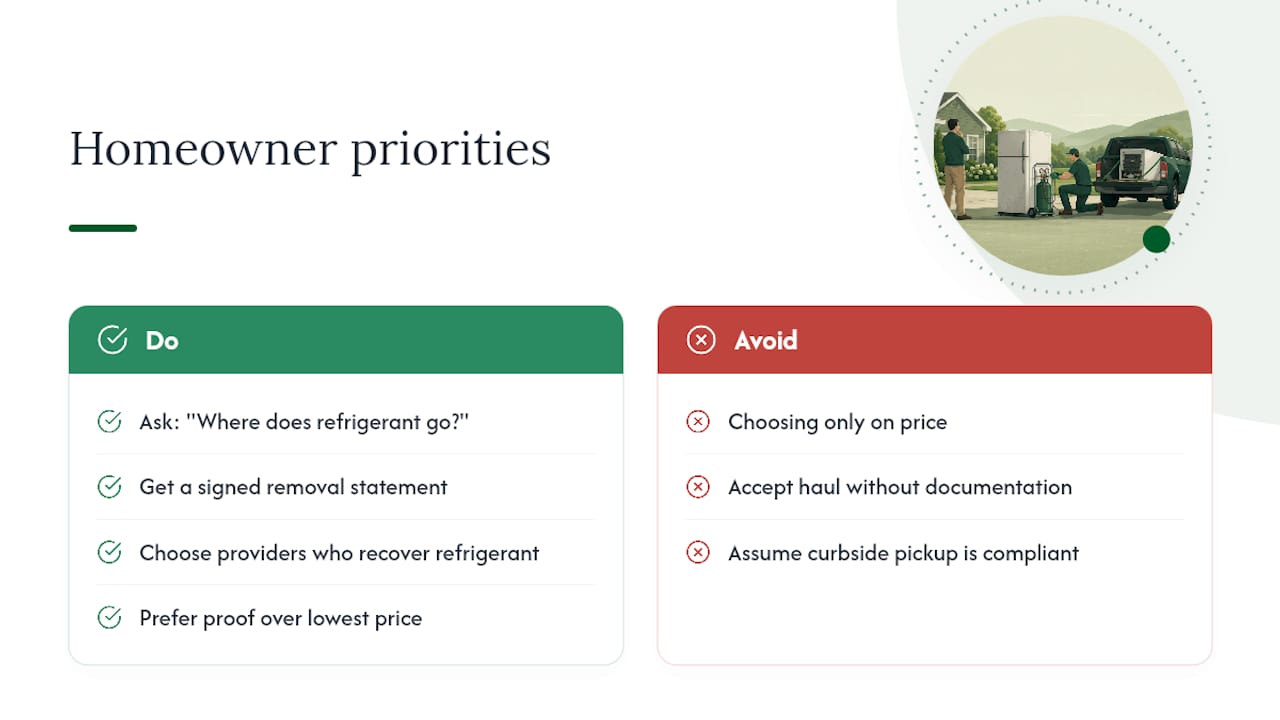
Convenience and compliance aren’t opposites here, which is the part conventional advice tends to miss. A retailer haul-away, a utility bounty program, or a RAD partner can be both the easiest option and the legally sound one, provided you ask the right question up front: where does the refrigerant go? Skip that question, and even a “free” curbside pickup can turn into an illegal venting situation you never see happen.
If you take one thing from this, prioritize the paper trail over the price tag. A signed removal statement or program confirmation is worth more than saving $20 on a haul, because it’s the only proof you have if anyone ever asks how that fridge was actually disposed of.
— Olga
How Ohana Property & Transition Services Handles Appliance Removal
A local property service company can be a practical alternative to hunting down a compliant disposal program yourself. Instead of calling three utilities, checking your county’s landfill ban status, and scheduling a separate transfer station appointment, one call handles the pickup and the routing to a responsible recycler.

We regularly remove old refrigerators as part of full property cleanouts, estate cleanouts, and standalone appliance pulls for homeowners, landlords, and estate executors across Columbus, Seymour, North Vernon, Edinburgh, Franklin, Greenwood, and Indianapolis. When booking, it is advisable to ask how refrigerant recovery is handled and where the unit is disposed of. If you’re coordinating a larger move alongside a cleanout, Bridges Bros. Movers is a solid resource for the moving side of the equation.
Ready to clear that old fridge out for good? Visit our services page or call (812) 302-6833 for a free estimate.