
What Is a Preferred Vendor Cleanout? A Local Guide
Discover what a preferred vendor cleanout is and how it benefits homeowners, landlords, and realtors in Central Indiana for efficient property management.

What Is a Preferred Vendor Cleanout? A Local Guide
A preferred vendor cleanout is a property cleanout — estate, move-out, debris removal, or appliance hauling — performed by a pre-approved, on-file contractor on a landlord’s or realtor’s trusted vendor list. For homeowners, realtors, landlords, estate executors, and property managers across Central Indiana, working with a pre-vetted local crew like Ohana Property & Transition Services LLC means faster scheduling, consistent documentation, and a Certificate of Insurance (COI) already on file before the job starts. Most professional crews complete jobs within a 1–3 day turnaround window, which directly cuts vacancy days and reduces liability exposure.
Table of Contents
- What does a preferred vendor cleanout actually cover?
- Why a preferred vendor cleanout saves you time, money, and headaches
- How to vet and hire a preferred vendor cleanout crew
- How pricing generally works and what triggers extra fees
- What to expect on the day of the cleanout
- How repeat preferred vendor relationships reduce operational friction
- Key Takeaways
- The part most people skip — and why it costs them
- Ohanapropertyexperts serves Central Indiana with fast, documented cleanouts
- Useful sources and further reading
What does a preferred vendor cleanout actually cover?
The scope is broader than most people expect. A full-service preferred vendor cleanout typically includes:
- Full property cleanouts: — every room, floor, and outbuilding cleared to broom-clean condition
Donation-conscious recovery is a genuine differentiator. Top providers sort for reusable items and supply written donation receipts, which support tax documentation for estates and demonstrate responsible disposal to landlords managing security deposit disputes. Disposition records showing where each category of items went — donated, recycled, or landfilled — give estate executors a clean paper trail that holds up during probate or family review.
Why a preferred vendor cleanout saves you time, money, and headaches
Speed is the clearest financial argument. According to Rentec Direct, professional cleanout partnerships enable faster turnovers and typically offer a 1–3 day turnaround for market-ready properties. For a landlord, every extra day a unit sits vacant is lost rent. For a realtor, a delayed cleanout pushes the listing date and the commission. A pre-approved vendor who already knows your documentation standards and access protocols skips the back-and-forth that slows a first-time hire.
The liability angle matters just as much. Documented disposal and donation records protect landlords when tenants dispute security deposit deductions. Estate executors benefit from the same paper trail when beneficiaries question what happened to personal property. A preferred vendor relationship, built on consistent vendor processes, also means the crew understands your standards before they arrive — fewer surprises, fewer callbacks.
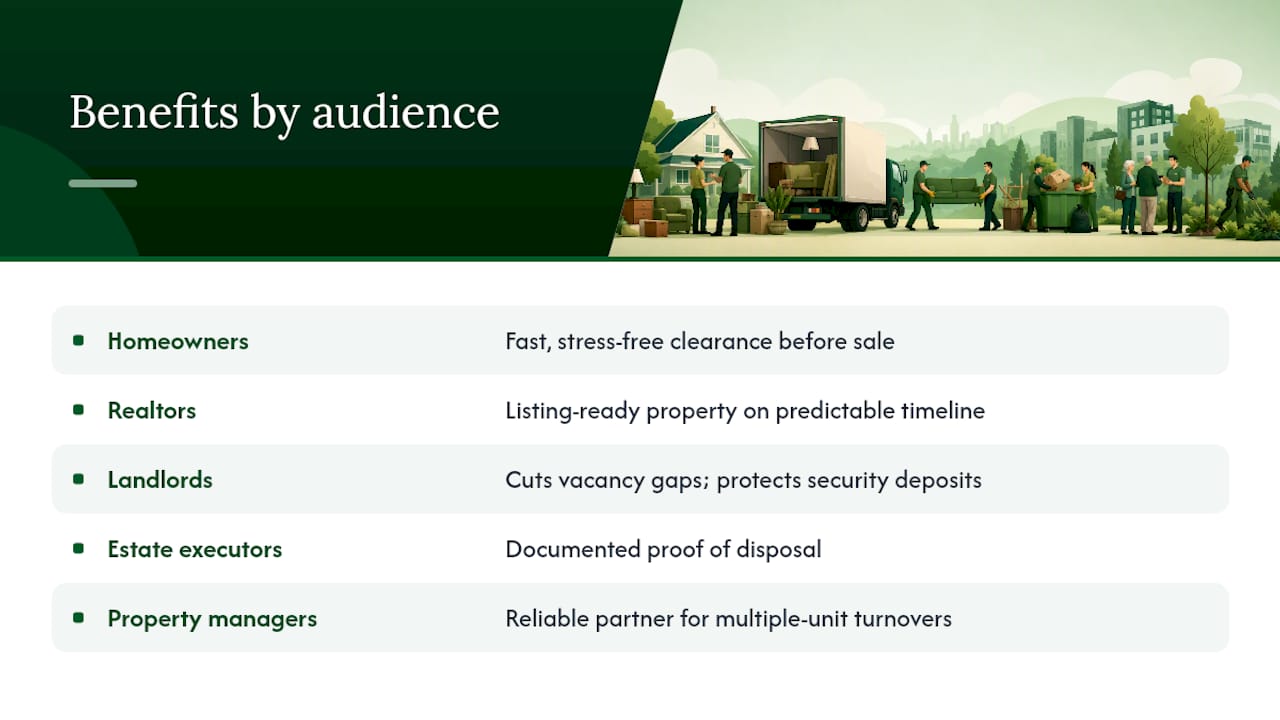
Audience-specific payoffs break down this way: homeowners get a fast, stress-free clearance before a sale; realtors get a listing-ready property on a predictable timeline; landlords cut vacancy gaps and protect deposits; estate executors get documented proof of disposal; property managers get a reliable partner for multiple unit turnovers without re-vetting a new crew each time.
How to vet and hire a preferred vendor cleanout crew
Use this checklist the same day you start your search:
- Request a photo-based quote. Photo-based estimates speed approval and reduce the risk of scope creep. Send photos of every room and any outbuildings.
- Review the contract before signing. Scope, pricing model, extra-fee triggers, donation and resale policy, timeline, and the change-order process all need to be in writing. See the cleanout service agreement guide for sample language.
Pro Tip: Require before-and-after photos and written donation receipts as conditions of final payment. This single requirement filters out low-quality vendors before the job starts.
How pricing generally works and what triggers extra fees
Two pricing models dominate the market:
| Pricing Model | When It’s Used | Pros | Cons |
|---|---|---|---|
| Flat-rate per job | Well-defined scope, standard volume | Predictable cost, easy to approve | May not account for hidden volume |
| Hourly labor + disposal | Large, uncertain, or hoarding-level jobs | Flexible, fair for complex work | Harder to budget; watch for slow crews |
| Hybrid (flat base + itemized extras) | Mixed-scope jobs with known core and unknown add-ons | Balances predictability and flexibility | Requires clear contract language |
Common extra-fee triggers include stairs and long carry distances, heavy items like pianos or safes, hoarding-level volume, hazardous materials (paint, chemicals, propane), specialty appliance disposal, and third-party dumpster fees. Always ask whether dump fees are included in the quoted price — they often are not.
Get your estimate from photos, not a phone call. A photo-based quote gives the vendor enough detail to price accurately and gives you a written record of what was visible at the time of estimate.
What to expect on the day of the cleanout
A professional crew arrives within the agreed window, does a brief onsite walkthrough with you or your representative, and begins sorting before any hauling starts. The sequence typically runs: arrival and access confirmation, walkthrough and photo log, sorting by destination (donate, recycle, landfill, retain), removal and loading, final cleanup, and a closing walkthrough.
Before you release final payment, documentation standards call for: before-and-after photos of every room, an itemized invoice, donation receipts with organization names and item descriptions, disposal manifests for any specialty items, and a signed final walkthrough checklist.
For estate jobs, keep a simple written log of any items retained by family members or set aside for sale. That log, combined with the vendor’s donation receipts, gives the executor a complete accounting of the property’s contents.
How repeat preferred vendor relationships reduce operational friction
A one-time hire is a transaction. A preferred vendor relationship is an operational asset. Setup involves vetting and credentialing, one or two trial jobs to confirm quality, a rate agreement, a documented response-time commitment, and agreed documentation standards. Preferred vendor programs create a go-to team with negotiated rates and priority scheduling — meaning your unit gets on the calendar before a new customer calling in cold.
The operational payoff compounds over time: consistent quality across turnovers, faster unit turns because the crew already knows your standards, fewer surprises during estate or eviction scenarios, and a vendor who flags potential issues (mold, structural damage, pest evidence) because they’ve seen your properties before.
Pro Tip: Keep 2–3 pre-vetted cleanout vendors on your list and audit credentials annually. A single-vendor dependency creates real scheduling risk during busy seasons or when a crew is already committed elsewhere.
Key Takeaways
A preferred vendor cleanout performed by a pre-approved, insured local contractor is the fastest and most defensible way to clear a property for sale, rent, or estate settlement.
| Point | Details |
|---|---|
| Verify COI before anything else | No Certificate of Insurance means no hire — this protects you from liability on your property. |
| Get photo-based quotes | Photos speed approval, reduce scope disputes, and create a written record of conditions at estimate time. |
| Require documentation as a payment condition | Before-and-after photos, donation receipts, and disposal manifests protect landlords and estate executors. |
| Professional turnaround | Pre-approved vendor relationships enable 1–3 day job windows that directly cut vacancy days and carrying costs. |
| Ohanapropertyexperts for Central Indiana | Ohana Property & Transition Services LLC offers estate, rental, and debris cleanouts with COI, photo documentation, and donation-conscious recovery across Central Indiana. |
The part most people skip — and why it costs them
Most landlords and estate executors focus on price when hiring a cleanout crew. That’s the wrong filter. The real cost of a bad hire shows up three weeks later: a security deposit dispute with no documentation, a beneficiary questioning where grandma’s furniture went, or a property that sat vacant an extra two weeks because the crew couldn’t commit to a start date.
The vendors worth keeping on your preferred list are the ones who hand you a folder at the end of the job — photos, receipts, a signed walkthrough checklist — without being asked. That paperwork is what closes disputes before they start. A COI and a written contract aren’t bureaucratic formalities. They are the difference between a cleanout that protects you and one that creates new problems.
For estate executors especially: the emotional weight of clearing a loved one’s home is real. A crew that communicates clearly, handles belongings with care, and documents everything gives you something to show the family. That transparency is worth more than saving $50 on the quote.
Ohanapropertyexperts serves Central Indiana with fast, documented cleanouts
When you need a trusted local crew on short notice, Ohana Property & Transition Services LLC delivers estate cleanouts, full property cleanouts, appliance and furniture removal, debris hauling, and donation-conscious recovery across Columbus, Indianapolis, Greenwood, Franklin, Seymour, and surrounding Central Indiana communities.
Every job comes with a COI on file, a written contract covering scope and change orders, before-and-after photo documentation, and donation receipts for any items routed to local charities. Realtors and property managers can set up a real estate partner relationship for priority scheduling and consistent turnaround commitments across multiple units.
Request a free photo-based quote today by visiting ohanapropertyexperts.com/services or calling (812) 302-6833. Send photos of the property and get a transparent, itemized estimate — no surprises, no hidden fees.
Useful sources and further reading
| Source | How it supports this guide |
|---|---|
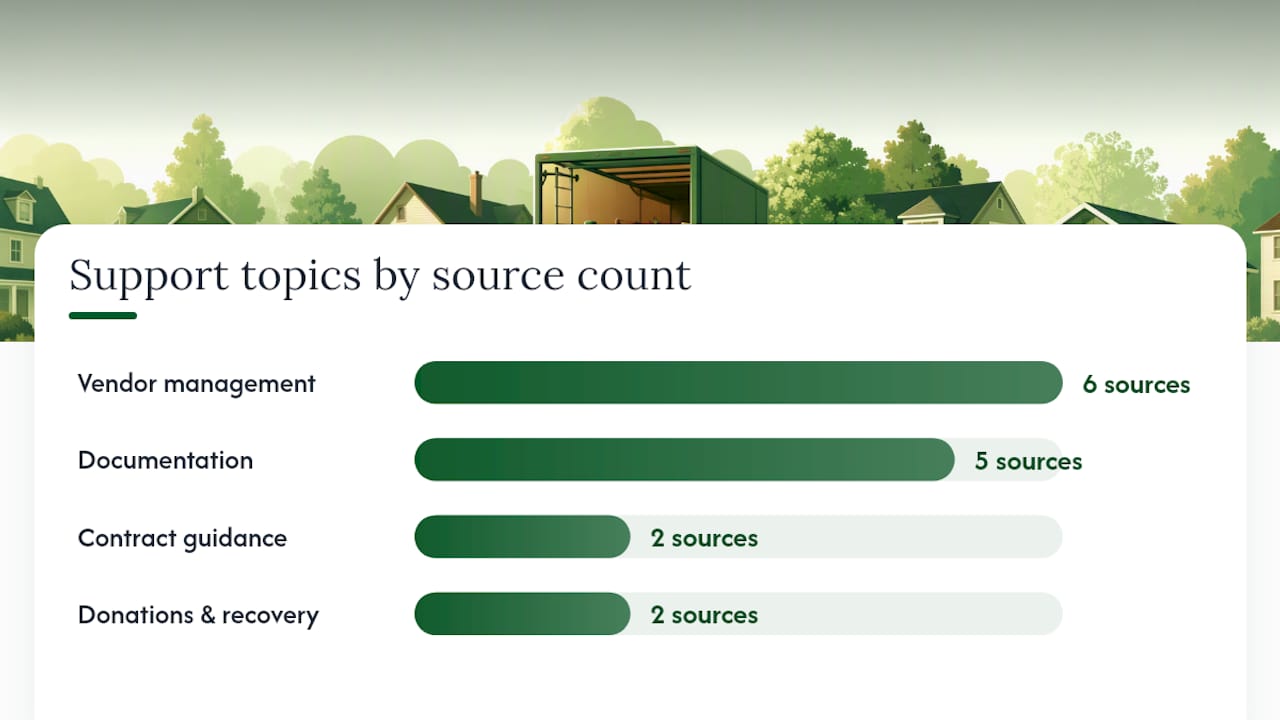
| Rentec Direct — Handyman for rentals | Supports the 1–3 day turnaround metric and the value of photo documentation in reducing vacancy |
| All Inclusive Realty Group — Vendor relationships | Hiring checklist: insurance verification, photo quotes, contract requirements |
| Executorium — Vetting estate cleanout companies | Contract clause guidance and red-flag examples for estate cleanouts |
| Rental Housing Journal — Vendor relationship processes | Feedback loops, trial jobs, and documented standards for preferred relationships |
| Ohana Property Services — Donation-conscious recovery | Donation routing, receipt documentation, and estate accounting support |
| Doral Damage Restoration — Preferred vendor programs | Negotiated rates, priority routing, and operational benefits of managed vendor lists |
| REI Prime — Vendor list glossary | Redundancy guidance: 2–3 vendors per trade, annual credential audits |
| BHHScaliber — Building a vendor list | Documentation as legal protection: before/after photos, disposal receipts, donation logs |
Recommended
- What Is a Realtor Cleanout Partner? Your Agent’s Guide | Ohana Property Services
- What Cleanout Companies Do Explained for Homeowners | Ohana Property Services
- How to Recommend Cleanout Services to Clients | Ohana Property Services
- What Is Central Indiana Cleanout Service? A Clear Guide | Ohana Property Services