
How to Manage Multiple Unit Cleanouts Efficiently
Discover how to effectively manage multiple unit cleanouts. Enhance efficiency, cut costs, and ensure timely turnover with our comprehensive guide.

How to Manage Multiple Unit Cleanouts Efficiently
Efficient multi-unit cleanout management is the practice of coordinating property clearance across two or more rental or investment units through standardized workflows, scheduled vendor partnerships, and documented compliance processes. Property managers who treat each cleanout as an isolated task lose time and money. Treating unit cleanouts as a portfolio-wide operation cuts turnover time, controls costs, and keeps new tenants moving in on schedule. This guide covers the types of multi-unit property cleanouts, preparation steps, execution workflows, common pitfalls, and how technology and vendor relationships make the whole system work.
What are the different types of multi-unit property cleanouts?
Multi-unit property cleanouts fall into four distinct categories, and each one demands a different approach. Misclassifying a cleanout at the start creates scope creep, budget overruns, and scheduling delays.
- Standard move-out cleanouts cover routine tenant departures. These involve removing leftover furniture, cleaning appliances, and clearing trash. Volume is predictable, and most vendors can schedule them within a few days of vacancy.
- Eviction cleanouts are more complex. Tenants may leave behind large quantities of personal property, and state law governs how long you must store those items before disposal. Handling tenant belongings legally requires written notification and a defined waiting period before removal.
- Foreclosure and bulk estate cleanouts involve properties that have been vacant for months or years. Accumulated debris, appliances, and sometimes hazardous materials make these the most labor-intensive category. A full property cleanout at this scale requires a crew with specialized equipment and disposal contacts.
- Investment property turnovers sit between standard and bulk. Investors flipping or repositioning units need fast clearance with minimal damage to walls and floors. Speed matters more than cost per unit when a renovation crew is waiting.
Prioritize cleanouts by urgency and complexity before scheduling anything. Eviction cleanouts with legal timelines go first. Bulk estate clearances need the longest lead time for crew and disposal logistics. Standard move-outs can batch together efficiently.
Pro Tip: Photograph every unit before the cleanout crew arrives. Pre-cleanout photos are your best protection if a tenant later disputes what was removed or damaged.
What tools and preparation steps make cleanouts run smoothly?
Preparation is the single biggest factor separating a cleanout operation that runs on time from one that stalls mid-project. Property managers who skip the prep phase spend twice as long fixing problems on cleanout day.

Pre-walkthrough inspections with photo documentation prevent scope misunderstandings and provide legal protection if tenant belongings become a dispute. Walk every unit before scheduling the crew. Note the volume of items, any hazardous materials such as paint or chemicals, and the condition of appliances. This information feeds directly into your vendor quote and scheduling window.
Standardized checklists are the next layer. Create a scope-of-work template for each cleanout type: move-out, eviction, estate, and foreclosure. Each checklist should specify what gets removed, what gets donated, and what requires special disposal. Vendors work faster and make fewer errors when the scope is written down before they arrive.
Vendor screening matters as much as crew quality. Establish preferred vendor agreements with at least two cleanout providers. Service agreements should define flat-rate pricing, rate adjustment terms, lead times, and re-clean policies. That structure eliminates the back-and-forth that slows down high-volume operations.
| Preparation element | Purpose | Outcome |
|---|---|---|
| Pre-walkthrough with photos | Documents condition and scope | Legal protection, accurate quotes |
| Standardized checklist | Defines scope per cleanout type | Fewer errors, faster crew execution |
| Preferred vendor agreement | Locks in pricing and availability | Budget predictability, priority scheduling |
| Hazardous material log | Tracks restricted items before cleanout day | Compliance with disposal regulations |
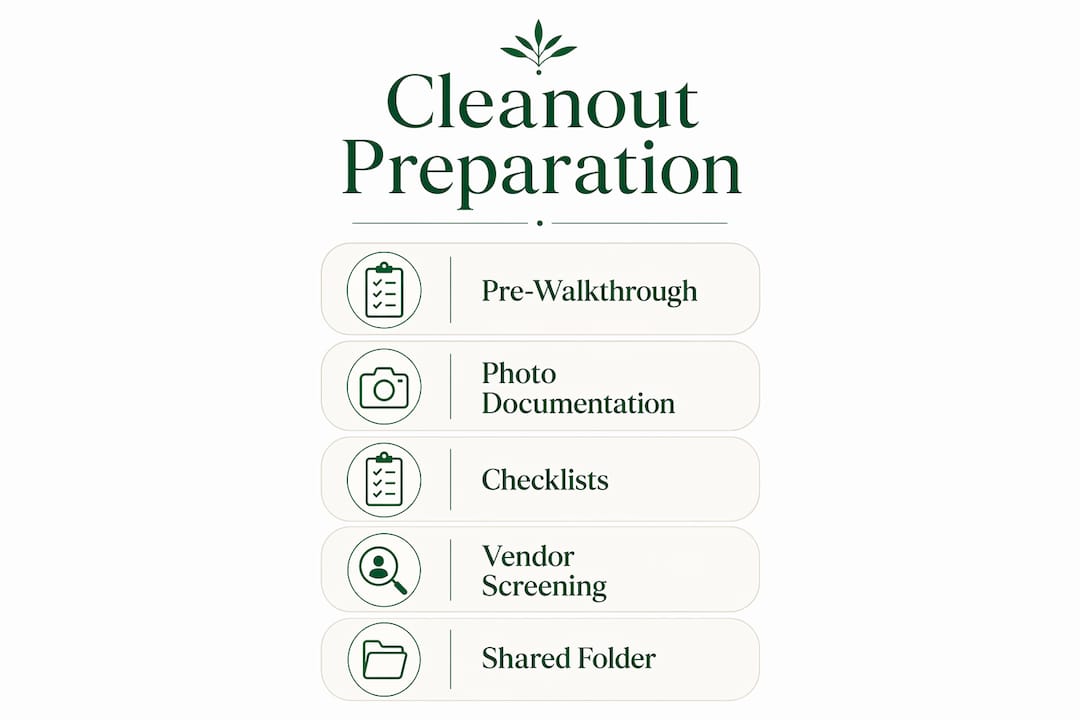
Pro Tip: Build a shared digital folder for each unit with the pre-walkthrough photos, checklist, and vendor contact. Your crew lead, property manager, and vendor all work from the same file.
How do you execute cleanouts step by step across multiple units?
A repeatable execution framework is what separates a property manager who handles 10 units from one who handles 50. Each cleanout job generates 6–8 coordination touchpoints, meaning a 50-unit portfolio can produce 360–480 touchpoints per month. That volume makes manual tracking unsustainable.
- Send tenant notification. Issue written notice of the cleanout date, access requirements, and any legal obligations regarding abandoned property. Do this at least 72 hours in advance for standard move-outs and earlier for evictions.
- Complete the pre-walkthrough. Walk the unit, photograph every room, and fill out the scope checklist. Flag hazardous materials for separate handling.
- Schedule the crew and confirm logistics. Assign the vendor, confirm the date and access window, and share the unit checklist. Batch scheduling two or three cleanouts within the same week reduces per-unit cost and keeps vendor crews on-site longer.
- Brief the crew on arrival. Walk the lead crew member through the unit. Confirm what stays, what goes, and where donated items will be dropped.
- Document during and after. Take photos at midpoint and completion. Collect the vendor’s post-clean checklist and invoice before the crew leaves the property.
- Conduct the final inspection. Walk the unit against the original scope checklist. Note any items missed or damaged. Issue a re-clean request immediately if the scope was not met.
Contingency planning belongs in step three. If a unit contains unexpected construction debris, biohazard materials, or a volume of items that exceeds the original estimate, you need a pre-approved escalation path with your vendor. Agree on that process before cleanout day, not during it.
Pro Tip: Batch your cleanouts quarterly or seasonally when possible. Bundling multiple cleanouts within a defined window gives you negotiating leverage for volume discounts and guarantees vendor availability during peak turnover seasons.
What common challenges do operators face in multi-unit cleanouts?
Coordination overload is the most common failure point. Property managers who track cleanouts through email threads and phone calls lose visibility fast. Missed confirmations, double-booked crews, and undocumented scope changes pile up quickly across a large portfolio.
- Scheduling conflicts happen when multiple units turn over simultaneously. Solve this by maintaining a rolling 30-day cleanout calendar shared with your preferred vendors. Visibility prevents double-booking.
- Vendor inconsistency degrades quality across units. Consistent crew assignments build institutional knowledge of your property layouts and quality standards. Request the same crew lead for your portfolio whenever possible.
- Scope creep occurs when crews discover conditions not captured in the pre-walkthrough. A written scope checklist and a clear escalation protocol limit unauthorized work and surprise invoices.
- Hazardous material compliance is a legal risk. Hazardous materials and tenant personal property require specialized handling and separation before cleanout day. Never allow a general crew to dispose of paint, chemicals, or electronics without confirming proper disposal channels.
- Abandoned property laws vary by state. Indiana law requires landlords to provide written notice and a waiting period before disposing of items left behind by tenants. Document every step.
Treating cleanouts as isolated one-off jobs is the fastest way to lose control of a portfolio. The operators who scale successfully are the ones who build a system: standardized scopes, consistent crews, and documented handoffs at every stage. Without that system, every cleanout starts from zero.
How can technology and vendor relationships improve cleanout operations?
Technology reduces the coordination burden that grows with every unit you add to your portfolio. Platforms that integrate scheduling, quoting, invoicing, and photo reporting can cut monthly communication touchpoints from hundreds to a manageable level. That reduction directly translates to fewer errors and faster turnovers.
Vendor relationships deliver a different kind of value: cost stability and scheduling priority. Committing to six or more annual cleanouts typically unlocks priority scheduling with your vendor during high-demand turnover seasons. That matters most in spring and fall when every property manager in your market is competing for the same crew availability.
| Approach | Benefit | Best for |
|---|---|---|
| Volume-based service agreement | Locked rates for 12 months reduce cost by 15–25% vs. one-off pricing | Portfolios with 10+ units |
| Consistent crew assignment | Builds property familiarity, reduces coordination errors | Any multi-unit operation |
| Automated scheduling platform | Cuts touchpoints per job, centralizes documentation | Managers handling 20+ units |
| Batch seasonal scheduling | Maximizes vendor availability and discount leverage | Portfolios with predictable turnover cycles |
Standardized documentation including post-clean photos, checklists, invoices, and reporting has become an industry best practice for service accountability. Property managers who require this from every vendor build a paper trail that protects them legally and gives them data to negotiate better terms at contract renewal.
Key Takeaways
Efficient multi-unit cleanout management requires standardized scopes, consistent vendor partnerships, and documented workflows applied across every unit in your portfolio.
| Point | Details |
|---|---|
| Classify cleanouts before scheduling | Identify type (move-out, eviction, estate, foreclosure) to set the right scope and timeline. |
| Document every unit before and after | Pre-walkthrough photos and post-clean checklists protect you legally and reduce vendor disputes. |
| Batch and commit for cost savings | Volume agreements and seasonal batching cut costs and secure vendor priority during peak seasons. |
| Assign consistent crews | The same crew lead builds property familiarity and reduces errors across your portfolio. |
| Automate coordination touchpoints | Technology platforms reduce hundreds of monthly touchpoints to a manageable, trackable workflow. |
What I’ve learned from managing cleanouts at scale
After working through hundreds of property transitions across Central Indiana, the single biggest mistake I see property managers make is treating each cleanout as a fresh problem. They call a vendor, negotiate a price, supervise the job, and move on. Then they do the exact same thing for the next unit. That approach works for one or two properties. It falls apart at ten.
The operators who handle large portfolios well do one thing differently: they build a system once and run every cleanout through it. Same checklist. Same vendor. Same documentation format. Same escalation path when something unexpected shows up. The system removes the decision fatigue that slows everything down.
Negotiating a preferred vendor agreement feels like extra work upfront. In practice, it pays back within the first two or three jobs. You stop renegotiating price every time. Your vendor shows up knowing your standards. Your crew lead knows which units have tricky access or older appliances that need special handling. That institutional knowledge is worth more than a slightly lower one-off rate from a vendor you’ve never used before.
My practical advice: start with your documentation. Get your pre-walkthrough checklist and your scope templates in order before you do anything else. Everything else, including vendor agreements, scheduling platforms, and batch pricing, builds on top of that foundation. Without solid documentation, no system holds together under pressure.
— Olga
Ohanapropertyexperts: built for multi-unit property transitions
Property managers and real estate investors across Central Indiana trust Ohanapropertyexperts to handle the full scope of unit cleanouts, from standard move-outs to bulk estate clearances and foreclosure cleanouts.
Ohanapropertyexperts offers multi-unit cleanout services with free estimates, transparent flat-rate pricing, and post-clean photo documentation on every job. Whether you manage a 5-unit building or a 50-unit portfolio, our team provides consistent crew assignments and the kind of reliable scheduling that keeps your turnovers on track. Preferred vendor agreements are available for property managers who need volume pricing and priority availability. Reach out to Ohanapropertyexperts at (812) 302-6833 or explore our full cleanout and removal services to request a free estimate today.
FAQ
What is a multi-unit cleanout service?
A multi-unit cleanout service is a coordinated property clearance operation covering two or more rental or investment units, typically during tenant transitions, evictions, or property sales. It includes debris removal, furniture hauling, and post-clean documentation.
How do I manage multiple unit cleanouts without losing track?
Use a standardized checklist for each unit type, maintain a shared 30-day scheduling calendar with your vendor, and require post-clean photos and invoices on every job. Automation platforms that integrate scheduling and invoicing reduce coordination errors significantly.
What types of cleanouts apply to multi-unit investment properties?
The four main types are standard move-out cleanouts, eviction cleanouts, foreclosure or bulk estate clearances, and investment property turnovers. Each type has different legal requirements, crew needs, and timelines.
How much can I save with a volume cleanout agreement?
Volume-based service agreements with locked rates for 12 months typically reduce cost by 15–25% compared to one-off pricing, and they secure vendor priority during high-demand turnover seasons.
What legal risks apply to multi-unit cleanouts?
The biggest legal risks involve tenant abandoned property and hazardous material disposal. Indiana landlords must provide written notice and observe a waiting period before removing tenant belongings, and hazardous materials require certified disposal channels.