
Prevent Disputes in 2–6 Weeks: Estate Cleanout Checklist for Executors
A concise executor checklist: confirm authority, secure documents, sort Keep/Donate/Sell/Dispose, and complete the cleanout in 2–6 weeks with safe...

Prevent Disputes in 2–6 Weeks: Estate Cleanout Checklist for Executors
Before you touch a single box, confirm you have legal authority to act, usually as the court-appointed executor or personal representative, then secure the property by changing the locks and forwarding mail. From there, sort every room using four categories: Keep, Donate, Sell, and Dispose, with a firm claim deadline for family members, typically a few weeks. That order, authority first, security second, sorting third, is what keeps an estate cleanout checklist from turning into a family conflict.
TL;DR:
- Confirm legal authority as executor and secure the property before beginning any sorting or disposal to avoid legal risks and conflicts.
- Document every room with photos before removing items, and set clear claim deadlines for family members to prevent disputes over sentimental possessions.
- Prioritize securing valuables, the will, and important documents early, and conduct thorough hazard checks during the initial assessment phase.
- Use staging zones and color-coded tags to organize items for keep, donate, sell, or dispose, with strict deadlines to prevent decision fatigue and family disagreements.
- Hire experienced estate cleanout crews only after sorting is complete, ensuring they have proof of insurance, clear estimates, and understand disposal regulations for hazardous materials.
Table of Contents
- Estate Cleanout Checklist for the First Two Weeks
- The Step-by-Step Estate Cleanout Process, Phase by Phase
- Locating and Securing Documents and Valuables
- How to Sort and Stage Items Without Family Conflict
- Donation, Disposal, and Hazardous Material Rules for an Estate Cleanout
- Selling Valuables: Estate Sales, Consignment, or Individual Listings
- Hiring an Estate Cleanout Crew: What to Ask Before You Sign
- Estate Cleanout Timeline: A Realistic 2 to 6 Week Schedule
- Coordinating Family During an Estate Cleanout
- Final Walkthrough and Property Handoff Checklist
- Ohana’s Field Experience with Estate Cleanouts
- A Compassionate Note on Getting Through It
- How Ohana Property & Transition Services Can Help
- Sources
Estate Cleanout Checklist for the First Two Weeks
The first 72 hours set the tone for everything that follows. Rushing into sorting before you’ve confirmed legal standing or secured the home is the single most common mistake families make, and it’s the one that creates the most headaches later.
Day 1 priorities:
- Confirm you’re the legally recognized executor or personal representative before moving or disposing of anything.
- Change the locks or rekey the property, and secure any firearms, medications, or cash on-site immediately.
- Locate the will, trust documents, and any safe or lockbox.
- Notify the estate attorney and the homeowner’s insurance carrier of the death and the property’s vacancy status.
- Photograph every room before anyone removes a single item.
Week 1 tasks:
- Forward mail through USPS to your address or a P.O. box you control.
- Walk every room and log contents, drawer by drawer if the estate is complex.
- Set a claim deadline for family members (two to three weeks is typical) and communicate it in writing.
- Mark off staging zones near exits for Keep, Donate, Sell, and Dispose piles.
Who to call this week: the probate attorney, the homeowner’s insurance agent, utility companies (don’t cancel electricity yet if you need lights to work), a locksmith, and a donation pickup service if you already know some furniture is leaving fast.
The Step-by-Step Estate Cleanout Process, Phase by Phase
An estate cleanout process runs in four distinct phases, and skipping ahead is where most families lose time. Treat each phase as a gate. Don’t open the next one until the current one is done.
Phase 1: Assessment (1 to 3 days). Walk the entire property, room by room, including attics, garages, sheds, and crawl spaces. Photograph everything before anything moves, since documented condition protects you if a family member later questions what happened to an item, and it supports any insurance or probate record you need to file. Flag hazards during this walkthrough: old paint cans, expired chemicals, a garage full of motor oil, or a medicine cabinet stocked with decades of prescriptions.
Phase 2: Secure valuables and documents (1 to 2 weeks). Pull the will, deeds, insurance policies, financial statements, and any safe-deposit box keys into one secure location before anything else happens. This is also when you formally open the claim window for family members, giving everyone a fixed date to request specific items rather than an open-ended free-for-all.
Phase 3: Room-by-room sorting and staging (1 to 3 weeks). This is the bulk of the labor. Work one room at a time, sort into Keep, Donate, Sell, and Dispose, and label everything clearly so momentum doesn’t stall out on decision fatigue.
Phase 4: Sales, donations, and final removal (final 1 to 2 weeks). Run any estate sale or online listings, schedule donation pickups, and bring in a cleanout crew for whatever remains. Finish with a deep clean so the property shows well for sale, rent, or handoff.
- Assessment and hazard flagging
- Securing documents and valuables
- Room-by-room sorting and staging
- Sales, donation, and final removal
Pro Tip: Photograph the inside of closets, drawers, and cabinets before you empty them. It takes an extra ten minutes per room and it’s the cheapest insurance policy against a sibling’s “I thought Mom wanted me to have that” months later.
Only someone with confirmed legal authority to sell or dispose of estate assets should be making final calls on any of these phases. Acting without that appointment, even with good intentions, can create real legal exposure for you personally.
Locating and Securing Documents and Valuables
Before sorting begins, hunt down the paperwork that keeps the estate legally and financially organized. Missing a single document here can stall probate for weeks.
- Original will and any trust documents
- Property deeds and vehicle titles
- Life insurance policies and beneficiary paperwork
- Bank, investment, and retirement account statements
- Safe-deposit box keys and the bank branch that holds it
- Outstanding bills, tax returns, and Social Security documentation
Check unusual hiding spots older generations favored: inside book covers, taped under drawers, in freezer bags in the freezer, or folded into coat pockets in the back of a closet. Photograph or digitize anything fragile or one-of-a-kind, like handwritten letters or old photographs, before it gets boxed up.
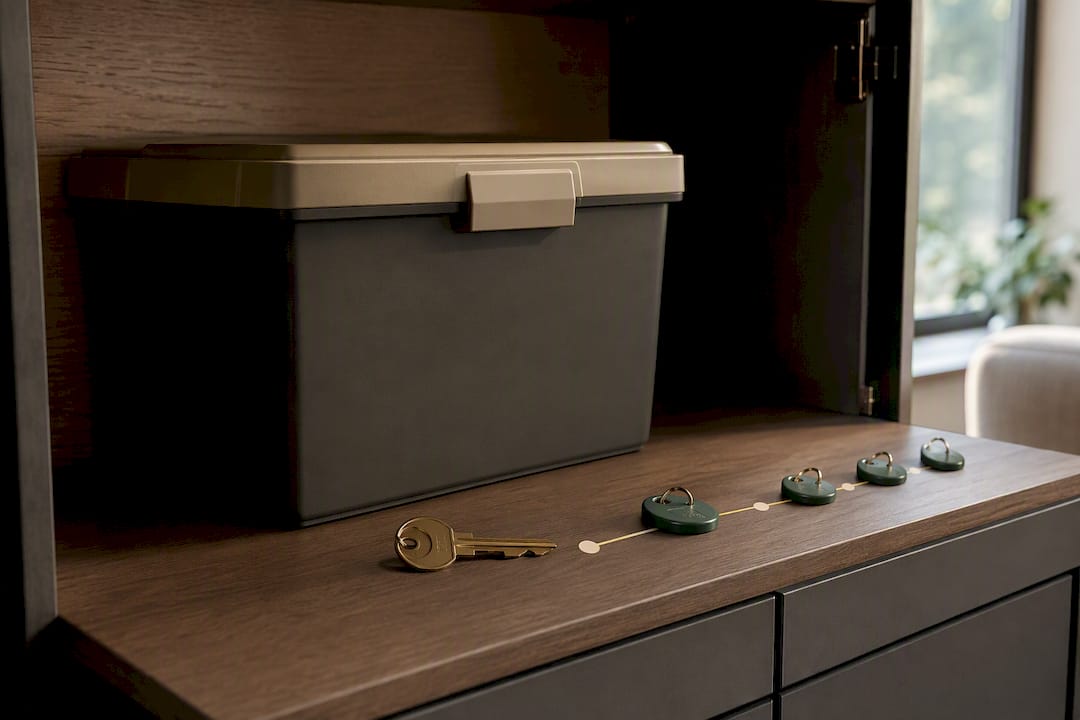
For chain-of-custody, keep valuables and documents in one locked room or a single labeled tote rather than scattered across the house. If multiple family members have access to the property, log who removed what and when. This isn’t about distrust. It’s about preventing an honest misunderstanding from becoming a legal dispute months later.
How to Sort and Stage Items Without Family Conflict
Staging zones work best near exits, one for each of the four categories, clearly labeled with painter’s tape or printed signs. Assign each room to a specific day or weekend so the project has visible momentum instead of dragging indefinitely.
- Use colored sticker tags: one color per family member claiming an item, a different color for Donate, another for Sell.
- Post a written claim deadline on the front door and in a group text so nobody can say they didn’t know.
- Keep a signoff sheet where each family member initials next to what they’ve claimed.
- Default unclaimed items to Donate after the deadline passes, no exceptions, no extensions.
Conflict usually shows up around sentimental items with no clear monetary value, like handwritten recipe cards or a specific quilt. The fairest fix is a simple round-robin: each person picks one item in turn until the disputed pile is gone, or an appraiser assigns a value and one heir buys out the others’ shares.
Pro Tip: Put the claim deadline in writing and send it to every sibling or heir by text or email, not just verbally at the house. A written deadline is nearly impossible to argue with later; a spoken one always is.
Donation, Disposal, and Hazardous Material Rules for an Estate Cleanout
Most furniture, clothing, and household goods can go straight to donation, but a meaningful share of what’s in an aging relative’s home falls under special hazardous waste handling rules that regular trash pickup won’t cover.
- Schedule furniture and household goods pickups through Habitat for Humanity ReStore or a locator like DonationTown, and always request a donation receipt for the estate’s tax records.
- Old paint, solvents, pesticides, and used motor oil need a household hazardous waste drop-off, not the curb.
- Batteries, refrigerants, and old electronics require certified e-waste or appliance recycling, since these materials can contaminate soil and groundwater if landfilled.
- Unused prescription medications belong at a pharmacy drug take-back location, never flushed or tossed in household trash.
Donation partners commonly accept furniture, small appliances, and clothing in usable condition, though policies vary by location, so a quick call before loading the truck saves a wasted trip. Estate cleanout crews that work regularly with local charities will typically know which ones take what, and a good crew hands you a donation receipt without being asked twice.
Selling Valuables: Estate Sales, Consignment, or Individual Listings
An estate sale makes sense when a home has volume: furniture, tools, collectibles, and everyday items across every room. A company runs the sale on-site, typically over a weekend, and takes a commission that usually falls in the 30% to 40% range of gross sales, though rates vary by firm and region.
- Choose an estate sale when the home has broad, moderate-value inventory that would take too long to list piece by piece.
- Choose individual online listings (Facebook Marketplace, eBay) when you have a handful of higher-value items and time to manage buyer messages yourself.
- Choose consignment for furniture or décor that’s in demand but not urgent to move.
- Get a formal appraisal before selling anything that could be worth real money: jewelry, fine art, firearms, coins, or antique furniture with a maker’s mark.
An appraisal changes how you handle disposition. A ring that looks like costume jewelry but turns out to have real stones shouldn’t go into a donation box, and a professional appraiser’s written valuation also protects you if the estate later faces a dispute over fair distribution.
Hiring an Estate Cleanout Crew: What to Ask Before You Sign
Bringing in professionals makes sense once the sorting is done and what’s left is volume: furniture nobody claimed, appliances, and general debris that needs to leave the property fast.
- Ask for proof of insurance and at least two references from recent estate jobs, not general moving jobs.
- Ask which charities they partner with and whether they provide written donation receipts for your records.
- Get a written estimate after an in-person or photo-based walkthrough, never a phone quote with no visual.
- Clarify the pricing model up front: per room, hourly, or a flat buy-out rate for the full property.
- Confirm what “broom clean” means in their contract, since definitions vary between crews.
Red flags include a company that quotes a firm price without ever seeing photos or the property, and any crew that won’t put donation or disposal details in writing. Before the crew arrives, walk the property one more time yourself, remove anything still undecided, and have your written inventory ready so there’s no confusion about what’s leaving and what’s staying.
Estate Cleanout Timeline: A Realistic 2 to 6 Week Schedule
A typical estate cleanout runs 2 to 6 weeks from the first walkthrough to final handoff, though professional crews can compress that to as little as 1 to 10 business days when a closing date or lease deadline is forcing the issue.
- Week 1: Confirm authority, secure the home, locate documents, begin room-by-room photos.
- Weeks 2 to 3: Sort and stage every room, run the claim window, schedule donation pickups.
- Weeks 4 to 5: Run an estate sale or online listings, finalize appraisals on high-value items.
- Week 6: Final removal, deep clean, and handoff.
Hoarding situations, long-distance family coordination, or items that need formal appraisal can all stretch this timeline well past six weeks. If a real estate closing or lease deadline is fixed and immovable, bringing in a professional crew earlier rather than later is usually what keeps the schedule intact.
Coordinating Family During an Estate Cleanout
Grief doesn’t follow a project plan, and pushing siblings to move faster than they’re ready for usually backfires into resentment instead of progress. Build in breaks. A cleanout doesn’t need to happen in one exhausting weekend.
- Use a fair claiming method up front: round-robin picks, an appraiser to equalize value, or simple colored tags with a deadline.
- Schedule work in shorter shifts rather than marathon days, especially in the first few weeks after a loss.
- Digitize photos as you find them, and set aside one memory box per family member instead of letting sentimental items multiply into a dozen boxes nobody can part with.
Final Walkthrough and Property Handoff Checklist
Once the big furniture is gone and the dumpster’s been hauled away, the job isn’t done until the fine details are handled. This is the phase that determines whether the property actually shows well.
- Check every closet, cabinet, garage shelf, and shed for anything left behind.
- Wipe down counters, vacuum or mop floors, and patch any nail holes or scuffs that would concern a buyer or landlord.
- Take final photos of every room to document the condition at handoff.
- Hand over keys, garage door openers, and any donation or disposal receipts to the executor or new owner.
This final documentation matters for the estate’s records and for anyone closing on a sale shortly after.
Ohana’s Field Experience with Estate Cleanouts
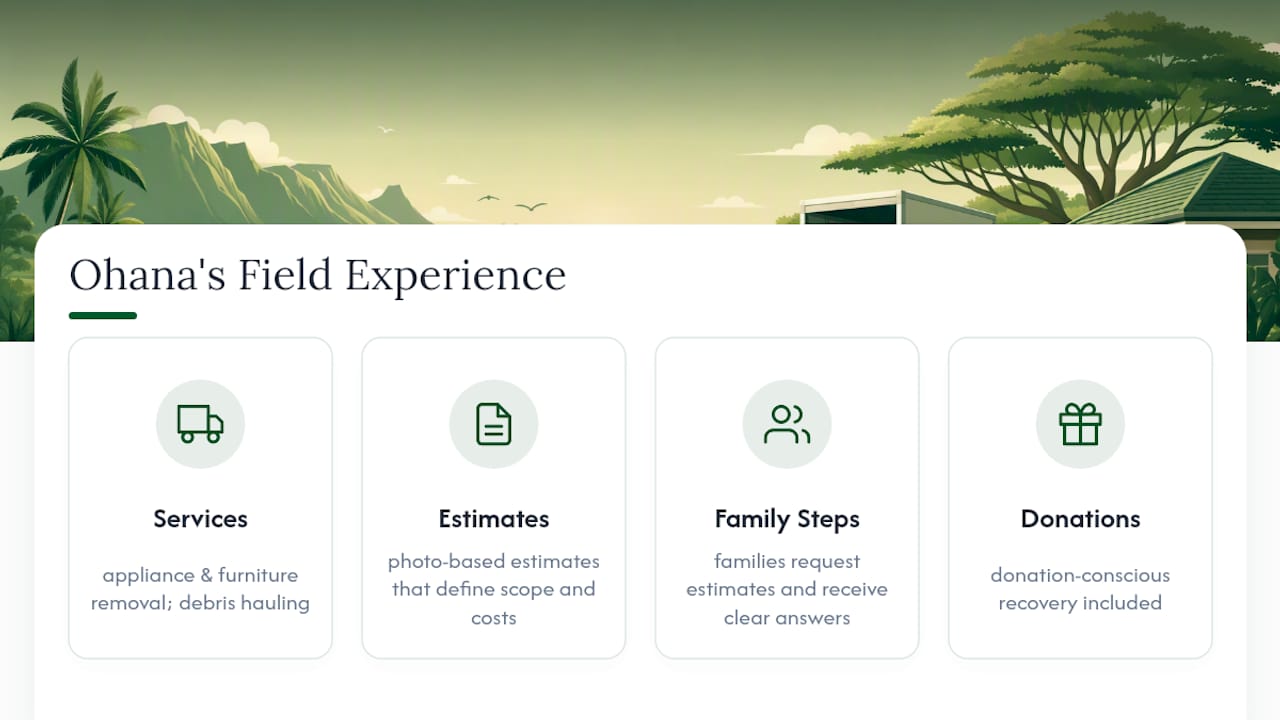
Estate cleanout services typically include estate cleanouts, appliance and furniture removal, debris hauling, and donation-conscious recovery, often quoted through photo-based estimates. Families can request estimates and get clear answers on scope and costs before committing.
A Compassionate Note on Getting Through It
Clearing out a parent’s or spouse’s home is never just a logistics project, no matter how many checklists you follow. Give yourself permission to move slower than you planned some days, and faster on others. If there’s one habit worth building into every single room: photograph before you discard, and set a short, written claim deadline before conflict has a chance to start.
— Olga
How Ohana Property & Transition Services Can Help
Ohana Property & Transition Services is the practical alternative to managing an entire estate cleanout alone, especially when you’re grieving, coordinating siblings long-distance, or racing a closing date. We handle the physical labor, families keep control of the decisions, and every job starts with a simple photo-based quote rather than a guessing game over the phone.

On-site, our crew walks the property with you, documents condition, sorts donation-eligible items to local charity partners, and finishes with a broom-clean handoff ready for showing, renting, or closing. Full-service estate cleanouts work best once the family has claimed what they want and sorted valuables, but we also step in earlier for larger property cleanouts or straight debris removal when time is short. If you’re facing a tight deadline in Columbus, Seymour, North Vernon, Edinburgh, Franklin, Greenwood, Indianapolis, Lafayette, or the surrounding Central Indiana area, call (812) 302-6833 or request a free estimate through our services page to get a real number before you commit to anything.
This article is general information, not a substitute for advice from a qualified lawyer. Consult a qualified legal professional about your own circumstances before acting on anything here.
Sources
- What authority does an executor have to sell estate assets? — Rmozawa Law (blog)
- Household hazardous waste (HHW) — EPA
- Disposal of unused medicines: What you should know — FDA
- Estate cleanout timeline: What to expect — Otesse