
Cleanout Standards for Units: A Landlord's Checklist
Establish clear cleanout standards for your rental units with our landlord checklist. Ensure smooth inspections and secure deposits.

Cleanout Standards for Units: A Landlord’s Checklist
Set your unit cleanout standard as one sentence: every room must be broom clean, every completed task backed by a dated photo, every professional service backed by a receipt, all keys returned to the walkthrough, and a written holding period for anything left behind. Paste this into your lease addendum: “Tenant agrees the unit will be returned in broom clean condition in every room, with photo documentation provided at move-out inspection, and understands that professional service receipts (if any repairs are tenant-caused) will be required to close the security deposit file.”
Companies that manage this well, from independent landlords to firms like Ohana Property & Transition Services, treat documentation as non-negotiable rather than optional paperwork. Industry benchmarking from Buildium and DiscoveryMark backs this up: turns with clear documentation close faster and generate fewer disputes.
- Standard: Broom clean + dated photos + receipts + keys returned + written holding period
- Policy line: One sentence, added to your lease or move-out notice, no exceptions
Key Takeaways
A cleanout standard only works when it pairs a written room-by-room checklist with mandatory photo and receipt documentation at every stage of the turn.
| Point | Details |
|---|---|
| One-sentence standard | Broom clean rooms, dated photos, receipts for hired work, keys returned, and a written holding period. |
| Vacancy has a daily cost | On an $1,800 unit, each vacant day costs about $60, so slow turns compound losses fast. |
| Sequencing controls speed | Repairs, then paint, then flooring, then final clean can finish a turn in three to five days. |
| Documentation wins disputes | A dated photo plus an itemized invoice closes deposit arguments before they start. |
| Ohana handles the physical load | Ohana Property & Transition Services offers photo-based quotes for cleanouts, debris removal, and appliance removal across Central Indiana. |
Table of Contents
- What Does It Mean to Set Cleanout Standards for Units?
- The Six Core Components Every Cleanout Standard Needs
- What Does a Room-by-Room Move-Out Checklist Look Like?
- How Should You Document a Unit Turn?
- How Fast Should a Turnover Take, and What Should Reinspection Cost?
- What Happens to Items Tenants Leave Behind?
- How Do You Put These Standards Into Daily Practice?
- Copy-Ready Inspection Checklist and Notice Language
- Let a Cleanout Partner Handle the Physical Work
- Frequently Asked Questions
- Sources
What Does It Mean to Set Cleanout Standards for Units?
Setting cleanout standards for units means writing down, in advance, exactly what “move-out ready” looks like, then requiring proof it happened. Without a standard, every turnover becomes a negotiation. With one, it becomes a checklist.
Here’s the number that should drive this decision: on an $1,800 monthly rental, each vacant day costs roughly $60 in lost rent. A turnover that drags from five days to twelve because nobody defined “clean” in writing just cost you over $400. Standards aren’t paperwork for its own sake. They’re how you protect that money.
- Revenue protection: Every vacancy day has a dollar cost you can calculate before it happens
- Fewer disputes: Written standards mean tenants know what “clean” means before they leave
- Faster vendor scheduling: Pre-defined scope lets you book cleaners and contractors before move-out day, not after
- Consistent communication: One standard applied to every unit removes “but my last landlord let me…” arguments
The Six Core Components Every Cleanout Standard Needs
A workable standard is short enough to fit on one page and specific enough that two different inspectors would reach the same conclusion. Build it around these six pieces:
- Scope and definitions. Spell out the difference between normal wear and tenant damage. A ten-year-old carpet with faded traffic patterns is wear. A carpet with pet stains or burns is damage. Dirt, importantly, is neither. Move-out guidance across the industry treats dirt as outside the definition of normal wear and tear entirely — a dirty oven or grimy baseboard is a cleaning failure, not an aging issue, and it’s chargeable.
- Room-by-room standards. What “clean” means for each space, stated plainly enough to check off.
- Documentation requirements. Photos and receipts, required, not optional.
- Timeline and reinspection policy. When the walkthrough happens and what triggers a second one.
- Disposition rules. What happens to anything left behind.
- Cost and fee schedule. Published charges so nobody is surprised.
Pro Tip: Require a photo and a receipt for every chargeable line item, even small ones. A $75 oven-cleaning charge with no photo is an argument waiting to happen. The same charge with a timestamped photo and an invoice is a closed file.
What Does a Room-by-Room Move-Out Checklist Look Like?
Copy this directly into your inspection form or tenant move-out packet. Each line should be checkable, not open to interpretation.
General, every room:
- Floors vacuumed or mopped, no visible dirt or stains
- Walls free of marks, holes patched (nail holes from hanging pictures are normal wear; large holes are not)
- Windows and window tracks free of dust and debris
- Light fixtures and vents dusted, all bulbs functioning
- Closets emptied and swept
Kitchen:
- Oven interior and stovetop degreased (this is the most commonly disputed item industry-wide, and sample charge guides list oven cleaning around $75 when tenants skip it)
- Refrigerator emptied, wiped down, left running unless otherwise instructed
- Cabinets and drawers empty and wiped
- Countertops and backsplash free of grease and residue
Bathrooms:
- Toilet, tub, and shower free of soap scum and mildew
- Mirrors and fixtures streak-free
- Grout free of visible mold buildup
Bedrooms and closets:
- Carpets professionally cleaned if soiled beyond light vacuuming, or noted for replacement if worn past its useful life
- Closet rods, shelving intact
- All personal items and hangers removed
Exterior and yard:
- Lawn mowed, debris and personal items cleared
- Patios and walkways swept
- Trash and yard waste hauled, not left curbside beyond pickup day
Basements and garages:
- Floors swept, no stored personal items remaining
- No hazardous materials left (paint cans, chemicals, batteries)
Leave appliances plugged in and running through the final walkthrough so functionality can be verified on the spot, not disputed later.
How Should You Document a Unit Turn?
Photos and receipts are what turn a “he said, she said” deposit dispute into a closed case. Set the standard once and apply it identically to every unit.
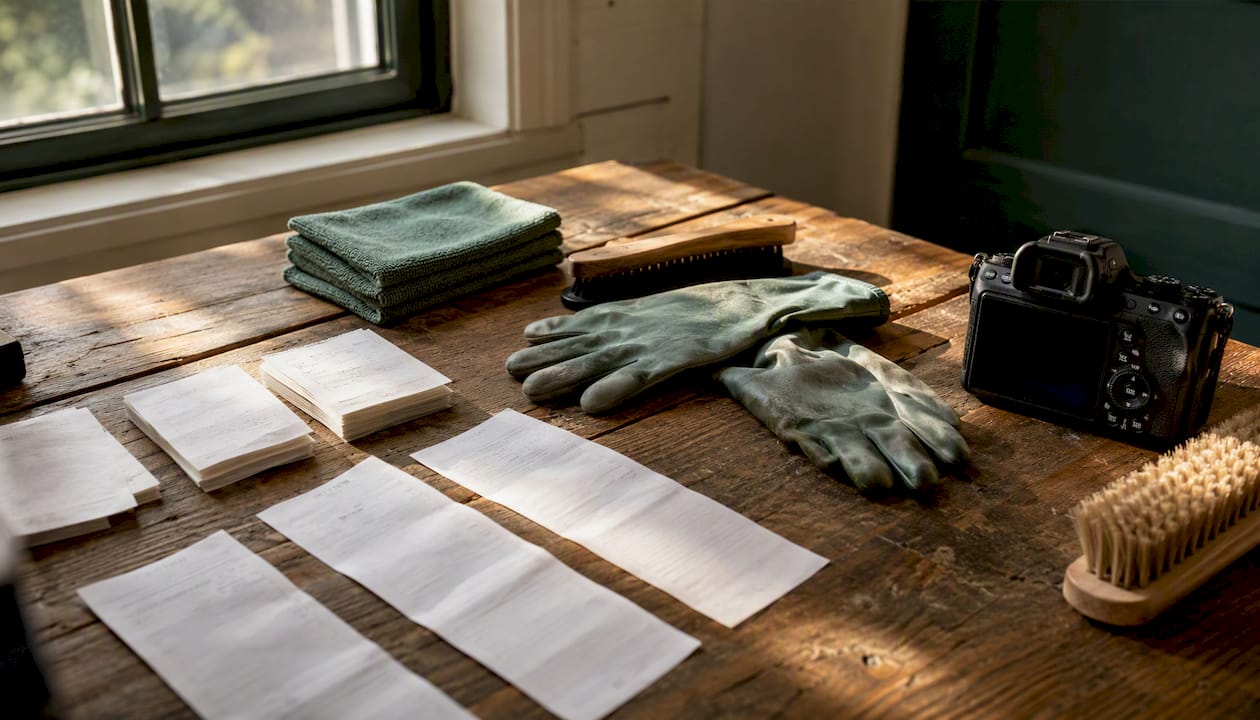
Photo standard: Take one wide shot and one close-up of every room, from the same angles used at move-in, timestamped automatically by your phone’s camera settings. File names should include the unit address and date. Store everything in one central folder per property, not scattered across text threads.
Receipt policy: Keep invoices for any professional service tied to a tenant charge, carpet cleaning, appliance repair, pest treatment. Store digital copies alongside the photo folder for that unit.
Inspection form: A one-page form with room-by-room checkboxes, a notes line for damage beyond wear, and a signature line for both the inspector and, when possible, the tenant.
Pro Tip: Document every chargeable repair with three things together: the dated photo, the itemized invoice, and a ledger entry noting the deduction. That triple record holds up in deposit disputes far better than any single piece alone.
How Fast Should a Turnover Take, and What Should Reinspection Cost?
A well-sequenced make-ready, repairs first, then paint, then flooring, then final clean, can finish in three to five days. Poor sequencing routinely stretches the same job to seven to fourteen days, which is where vacancy losses pile up.
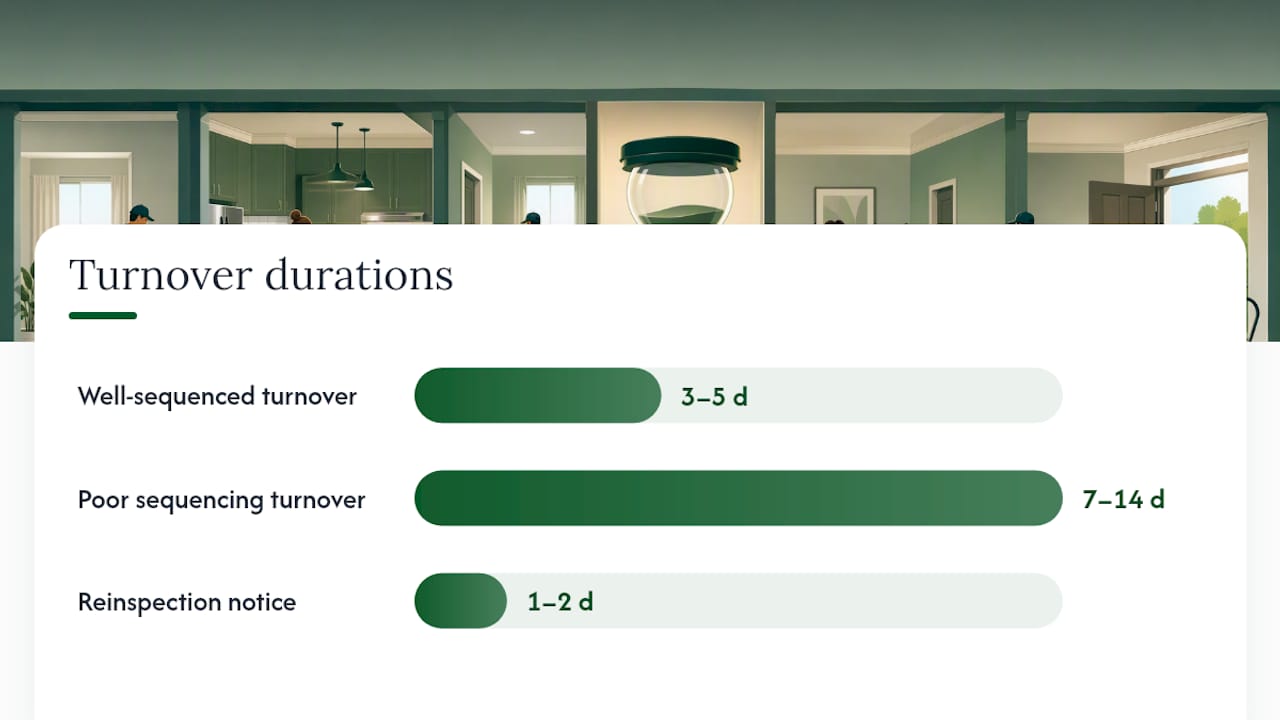
Set a reinspection policy for units that fail the first walkthrough: give the tenant 24 to 48 hours’ written notice, and charge a flat reinspection fee, $75 is a reasonable benchmark, if a second visit is needed because agreed items weren’t completed.
Publish your fee schedule up front so nobody’s surprised at move-out:
- Oven cleaning: around $75
- Carpet vacuuming or spot cleaning: $50 and up
- Trash and debris removal: roughly $200 per 4x8 truckload
A full standard 2BR turnover, cleanout, deep clean, and minor paint and repairs, typically runs $1,500 to $3,000 total when priced separately: $300 to $500 for cleanout, $200 to $400 for deep clean, $400 to $1,000 for paint and repairs. Local pricing varies, but publishing a range keeps expectations grounded before the walkthrough happens.
What Happens to Items Tenants Leave Behind?
Most states require a written abandoned-property notice and a retrieval window, commonly 15 to 30 days, before you can dispose of anything. Some jurisdictions allow faster disposal below a set value threshold, so check your state’s statute before writing your own policy.
A workable disposition process:
- Send written notice to the tenant’s forwarding address within days of move-out, stating what was left and the retrieval deadline
- Store items securely through the holding period
- Route usable furniture and household goods to donation partners, and log the transfer date and recipient
- Charge documented removal costs against the deposit when items require paid disposal
Hazardous materials, paint, chemicals, batteries, biohazards, need separate handling under local regulations, often requiring a licensed removal specialist rather than standard disposal. Sample notice clause: “Any personal property remaining after [date] will be considered abandoned and disposed of or donated in accordance with state law.”
How Do You Put These Standards Into Daily Practice?
Standards only work if your team and vendors actually follow them every time, not just on the units where someone remembers to check.
- Update your lease and move-out addendum with the one-sentence standard and fee schedule.
- Publish a move-out packet, room checklist plus notice language, and hand it to every tenant at lease signing, not at move-out.
- Schedule a pre-move-out walkthrough two to three weeks before the lease ends to flag issues early.
- Maintain a standing vendor list, junk removal, cleaners, a handyman, so you’re not sourcing help mid-turn.
- Track dates on a simple turn tracker: notice given, walkthrough done, cleanout complete, re-listed.
Train staff or vendors on photo technique and on distinguishing wear from damage consistently, since inconsistent calls are what tenants successfully dispute.
Pro Tip: Bundle vendors in sequence, junk removal first, then cleaners, then handyman repairs, to avoid paying someone to clean around debris that should have been hauled first. A pre-sourced vendor bundle removes the coordination lag that turns a five-day job into a two-week one, and it’s worth reviewing your multi-unit scheduling approach if you’re managing more than a handful of properties at once.
Copy-Ready Inspection Checklist and Notice Language
Use this short form at the final walkthrough:
- ☐ General condition (walls, floors, windows): pass / fail
- ☐ Kitchen (oven, fridge, cabinets): pass / fail
- ☐ Bathrooms (fixtures, grout): pass / fail
- ☐ Bedrooms/closets (carpet, storage): pass / fail
- ☐ Exterior/yard: pass / fail
- ☐ Basement/garage: pass / fail
- Inspector signature: ______ Date: ______
- Tenant signature (if present): ______ Date: ______
Notice paragraph: “Your move-out inspection is scheduled for [date]. The unit must be broom clean in every room, all keys and fobs returned at inspection, and any items left behind will follow the disposition timeline in your lease. Photos will be taken during inspection and compared to move-in records.”
Store the signed form and photo folder together under the unit address, not in separate systems.
A Note From the Field
I’ve watched more deposit disputes get lost over a missing photo than a missing receipt. The costliest mistake I see is landlords who skip the pre-move-out walkthrough entirely, then argue about “dirty” versus “damaged” three weeks later with no proof either way. Write it down before the tenant leaves, not after.
Let a Cleanout Partner Handle the Physical Work
Every checklist in this piece is yours to run yourself, but the physical labor, hauling debris, clearing a garage, prepping a unit for the deep clean crew, is where turnovers actually stall. Ohana Property & Transition Services handles full property cleanouts, estate cleanouts, debris removal, and appliance removal across Central Indiana, with photo-based quotes so you know the cost before anyone shows up.
That photo-based process does double duty: you get a fast estimate, and you get dated visual documentation of the unit’s condition before work starts, exactly the kind of record this article recommends keeping. We also route usable furniture and household goods to local donation partners and provide invoices you can attach directly to your turnover file. If you’re managing a rental turnover, an estate, or a property headed to sale, start with a free cleanout estimate and use the templates above for anything you’d rather handle in-house.
Frequently Asked Questions
What’s the fastest way to set cleanout standards for units if I’ve never had a written policy?
Start with the one-sentence standard from this article, broom clean, photos, receipts, keys, holding period, and add it to your next lease renewal or move-out notice. You don’t need a full manual on day one.
Do I need photos of every single room, or just problem areas?
Every room, every time, using the same angles as your move-in photos. Consistency is what makes the comparison defensible if a dispute goes to a deposit hearing.
How do I handle a tenant who disputes a cleaning charge?
Show the dated photo, the receipt, and the signed inspection form together. That triple record is what typically resolves the disagreement without escalation.
What if local law requires a longer holding period than 30 days for abandoned items?
Follow your state’s statute over any general guideline. Retrieval windows commonly run 15 to 30 days, but some states require longer notice periods, so check your local landlord-tenant code before disposing of anything.
Should I write my own cleanout standard or hire it out?
Writing the standard is something every landlord or manager should own since it reflects your lease terms and local law. The physical cleanout work itself, hauling, debris removal, appliance disposal, is where a local partner like Ohana Property & Transition Services saves the most time and reduces the risk of a missed deadline.
Sources
These sources back the benchmarks and process guidance used throughout this piece:
- Tenant turnover checklist | Buildium
- The Rental Turnover Playbook: Turn a Unit Between Tenants Without Losing a Month · DiscoveryMark
- Apartment make-ready checklist + Free toolkit (2026) | Lula
- Landlord turnover cleanout checklist | Titan Group
Local law governs deposit deadlines and abandoned-property timelines, so confirm your state’s specific rules before finalizing your own policy.
Recommended
- Why Landlords Need Cleanout Services: 2026 Guide | Ohana Property Services
- How to Manage Multiple Unit Cleanouts Efficiently | Ohana Property Services
- The Role of Cleanout in Property Maintenance | Ohana Property Services
- Assess Cleanout Scope Before Buying: Buyer’s Checklist | Ohana Property Services