
Trash Out vs. Cleanout: Which Service to Hire
Deciding between a trash out and a cleanout? Learn the differences, timelines, and who needs each service to make the right choice.
Trash Out vs. Cleanout: Which Service to Hire
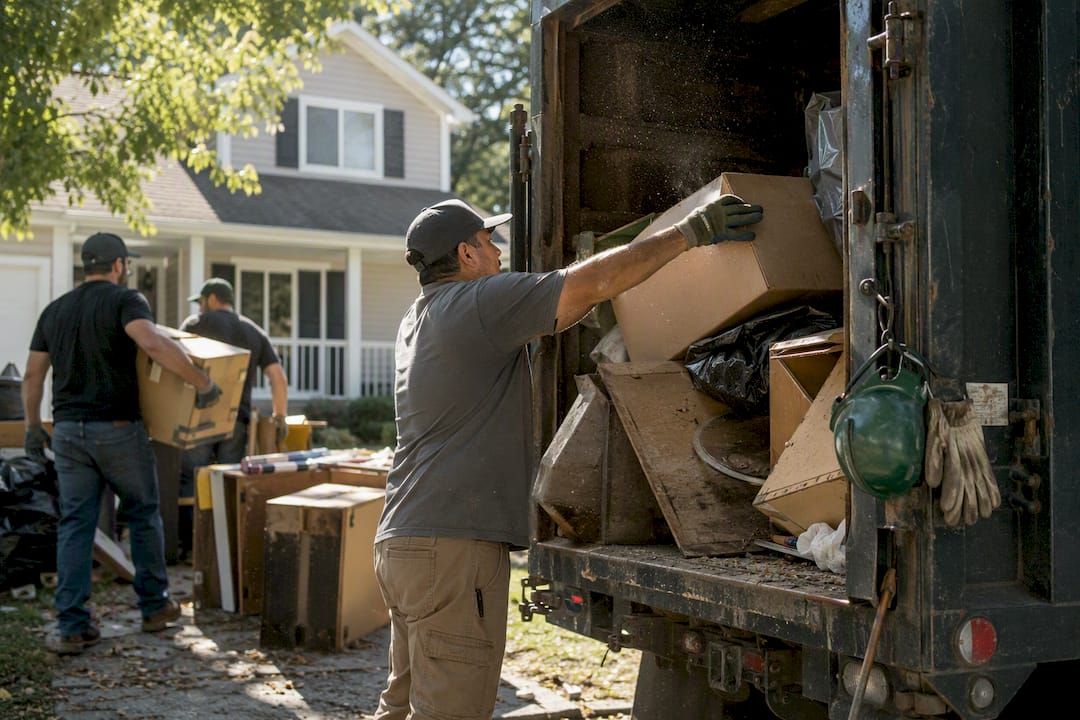
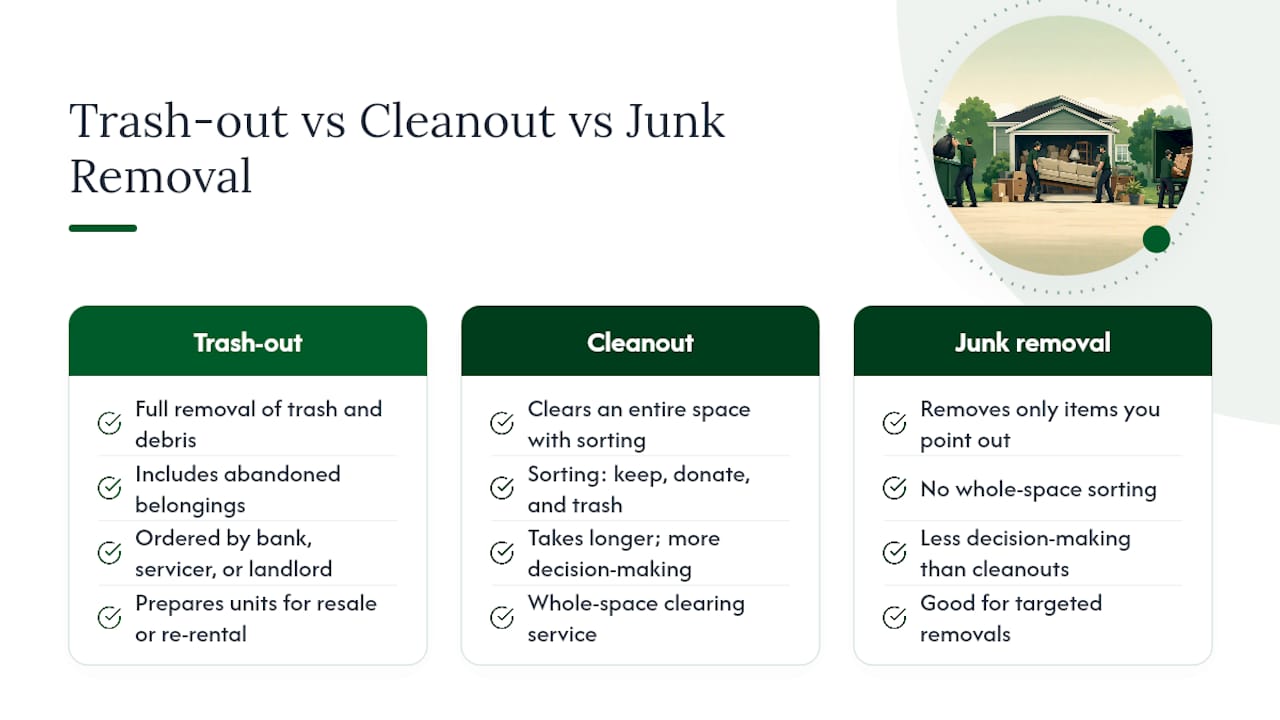
Junk removal clears a handful of items. A cleanout clears an entire space, room by room, with sorting for keep, donate, and toss. A trash out is a full-property removal ordered on a deadline, usually by a bank, landlord, or property manager after a foreclosure or eviction.
If you just need that old couch and three bags of yard waste gone, call for junk removal. If you’re clearing out a parent’s house after a move to assisted living, you want a cleanout. If you’re a bank, investor, or property manager staring down a vacant, trashed unit with a closing date looming, that’s a trash out.
- Scope: a few items (junk removal) vs. a full room or property (cleanout) vs. an entire vacant property under a deadline (trash out)
- Timeline: same-day or next-day (junk removal) vs. one to several days (cleanout) vs. compressed, contract-driven turnaround (trash out)
- Typical client: homeowners with a quick purge vs. families and estate executors vs. banks, landlords, and REO agents
Key Takeaways
Choosing between junk removal, a cleanout, and a trash out comes down to scope and deadline: select items call for junk removal, a full space calls for a cleanout, and a bank- or landlord-driven deadline calls for a trash out.
| Point | Details |
|---|---|
| Match scope to service | Junk removal handles select items; cleanouts clear entire spaces; trash outs clear whole properties under deadline. |
| Timelines differ sharply | Junk removal often finishes same-day; cleanouts take a day or more; trash outs run on contract-driven, compressed schedules. |
| Pricing models vary | Expect per-item, truckload, flat-rate, or contract pricing depending on which service you book. |
| Hazardous items need special handling | Paint, pesticides, and certain electronics usually require a household hazardous waste program, not standard hauling. |
| Ohana covers all three | Ohana Property & Transition Services offers estate cleanouts, full cleanouts, junk removal, and trash-out-ready property preservation across Central Indiana. |
Table of Contents
- What Is a Trash Out vs. Cleanout? Clear Definitions
- Trash Out vs. Cleanout vs. Junk Removal: Side-by-Side Comparison
- Which Service Fits Your Situation?
- What Happens on Job Day: The Process for Each Service
- What Does a Trash Out or Cleanout Cost?
- What Won’t Get Hauled Away, and Why It Matters
- How to Prepare and What to Ask Before Hiring
- What Our Crews See on Every Kind of Job
- How Ohana Property & Transition Services Can Help
- Frequently Asked Questions
- Sources
What Is a Trash Out vs. Cleanout? Clear Definitions
The confusion between these terms is understandable. They overlap in practice but describe different jobs with different urgency levels and different clients behind them.
Junk removal means picking up specific unwanted items, whether that’s a broken refrigerator, a stack of old furniture, or a garage full of odds and ends. It’s selective. You point, the crew hauls, and the job is often done in an hour or two.
Cleanout meaning, in the property services world, refers to clearing an entire space, not just select items. Think basements, garages, whole houses, or estates after a death or move. A cleanout involves sorting through belongings, deciding what gets donated, what gets tossed, and sometimes what family members want to keep. It’s slower and more deliberate than junk removal because someone has to make decisions about every category of item.

Trash out meaning, by contrast, is rooted in real estate and property preservation. A trash-out job clears an entire property of debris, abandoned belongings, and trash, typically ordered by a bank, mortgage servicer, or landlord preparing a foreclosed or vacated unit for resale or re-rental. Wiktionary defines the phrase as removing trash and items from an abandoned house, which captures exactly how the term gets used in REO and eviction work. Speed matters here because banks and landlords are losing money every day a unit sits unrentable or unsellable.
Pro Tip: If a listing agent or property manager asks for a “trash out,” they almost always mean a full, fast, no-sorting removal, not a careful estate cleanout. Confirm the timeline before you quote or book.
One more wrinkle worth flagging: “cleanout” also has a plumbing meaning, referring to the access pipe fitting used to clear a clogged sewer line. That’s a completely different service from anything covered here. We address that distinction directly in the FAQ below.
Trash Out vs. Cleanout vs. Junk Removal: Side-by-Side Comparison
Once you see these three services lined up against each other, the right choice usually becomes obvious.
| Factor | Junk Removal | Cleanout | Trash Out |
|---|---|---|---|
| Typical scope | Select items, single load or two | Entire room, basement, garage, or whole property | Entire vacant property, wall to wall |
| Primary goal | Remove specific unwanted items fast | Declutter and prepare a space, often with sorting | Make a property market-ready or rent-ready on deadline |
| Labor & time | Low to moderate; hours | Moderate to high; a day or more | High; compressed timeline, often contractor crews |
| Items handled | Furniture, appliances, yard debris | All of the above plus personal belongings, documents, sentimental items | All debris, abandoned belongings, sometimes biohazard-adjacent conditions |
| Pricing model | Per-item or by truckload/volume | Flat project rate or hourly, scaled to square footage | Often contract or fixed-fee per property for repeat bank/landlord clients |
| Add-on services | Minimal, sometimes appliance disposal | Donation routing, light cleaning, staging prep | Photo documentation, lock changes, boarding, property preservation |
A junk removal job looks like this: you’ve got a dead washing machine and a pile of storm debris, and you want it gone by Friday. A cleanout looks like clearing your grandmother’s three-bedroom house before the estate sale, sorting china from trash bags. A trash out looks like a bank ordering a crew into a foreclosed property with 48 hours’ notice, no time for sentiment, just full clearance and photo proof for the file.
- If sorting for donation matters to you, choose a cleanout, not junk removal.
- If you’re on a lender’s clock with documentation requirements, you need a trash-out specialist, not a general junk hauler.
- If it’s truly just one or two items, paying for a full cleanout is overkill.
Which Service Fits Your Situation?
Match your scenario to the service below, and you’ll skip the back-and-forth with providers who quote the wrong job.
- Estate settlement after a death: Cleanout. Expect sorting, family coordination, and possibly donation routing for items nobody’s keeping.
- Move-out purge before listing your home: Cleanout or junk removal, depending on volume. A garage and attic full of decades of stuff calls for a cleanout; a few bulky items call for junk removal.
- Foreclosure or REO property: Trash out. Lenders want fast, documented, full clearance, not a leisurely sort.
- Eviction cleanup: Trash out or cleanout, depending on the landlord’s timeline and whether tenant belongings need brief storage per local law.
- Landlord unit turnover between tenants: Cleanout, especially when past tenants left furniture, trash, and damaged items. Landlords managing several units at once often find a dedicated cleanout partner saves real time.
- Hoarding situation: Full cleanout, usually multi-day, with a compassionate, methodical crew.
- Renovation or construction debris: Debris removal, a close cousin of junk removal focused on drywall, flooring, and construction waste rather than household items.
- Single large-item removal (a dead appliance, an old mattress): Junk removal is the fastest and cheapest route.
For light volumes, your city’s bulky-item pickup program can be a free or low-cost option, though Sacramento’s municipal junk pickup program is a good example of how these programs cap volume and limit item types, which is exactly where commercial services fill the gap.
What Happens on Job Day: The Process for Each Service
Each service follows its own rhythm, and knowing the steps ahead of time helps you prep the space and avoid delays.
Junk removal, step by step:
- Get a quote, ideally from photos you send ahead of time.
- Crew arrives at the scheduled window.
- Items get loaded onto the truck.
- Everything is hauled away and sorted for disposal or recycling.
Full cleanout, step by step:
- Walk-through and inventory of the space.
- Sorting into keep, donate, and trash categories, often with family or client input.
- Packing and protecting items being kept.
- Full removal of everything else.
- Optional light cleaning once the space is empty.
Trash out, step by step:
- Work order received with bank or property-manager specifications.
- Photo documentation of the property’s condition before work begins.
- Total clear-out of debris and abandoned belongings.
- Property-preservation tasks as needed, such as changing locks or boarding windows.
Pro Tip: Clear a straight path from the front door to the street before your crew arrives. Narrow hallways, blocked driveways, or locked gates add time and sometimes cost to any of these three services.
What Does a Trash Out or Cleanout Cost?
Pricing structures vary by service type, and understanding the model helps you compare quotes accurately rather than just comparing final numbers.
Providers typically charge one of these ways:
- Per item: common for junk removal when the job is small and specific.
- By truckload or volume (measured in cubic yards): common for larger junk removal and cleanout jobs.
- Flat project rate: common for full cleanouts, scaled to square footage and estimated volume.
- Hourly: occasionally used for smaller cleanouts or when scope is uncertain.
- Contract or fixed-fee per property: common for trash outs handled under an ongoing relationship with a bank, servicer, or property management company, since industry writeups on trash-out pricing note these jobs often run under standing agreements with strict timelines built in.
Exact costs vary by region, property access, and volume, and any range you see online should be treated as a starting point rather than a quote. Always request a local, photo-based, or on-site estimate before committing.
To get an accurate number, send clear photos of the space, mention any stairs or long carry distances (both commonly add fees), and ask directly about disposal costs, donation routing, and whether the quote is final or subject to change once the crew sees the job in person.
Watch for these red flags when comparing providers:
- No written or photo-based estimate before the job starts.
- Vague scope with no breakdown of what’s included.
- Requests for a large cash-only deposit before any work begins.
What Won’t Get Hauled Away, and Why It Matters
Every reputable provider has a list of items they legally cannot or will not take, and knowing this ahead of time prevents a surprise on job day.
Common exclusions across junk removal, cleanout, and trash-out jobs include:
- Paint and paint thinners
- Pesticides and herbicides
- Asbestos-containing materials
- Certain chemicals and solvents
- Compressed gas cylinders
- Some electronics, depending on local e-waste rules
Ask any provider upfront how they handle hazardous items and whether they can direct you to your local household hazardous waste program. The EPA’s recycling basics guidance is a solid starting point for understanding proper disposal routes for materials that fall outside standard junk hauling.
On the insurance side, confirm the provider carries general liability coverage before anyone sets foot on your property. This matters more than people expect, especially in cleanouts involving stairs, heavy furniture, or older homes where floors and walls can get damaged during a large-volume removal.
How to Prepare and What to Ask Before Hiring
A little prep work speeds up the job and helps you get a tighter, more accurate quote.
Preparation checklist:
- Take photos of the space or items for a photo-based estimate.
- Clear walkways so the crew isn’t navigating around obstacles.
- Leave lock or entry instructions if you won’t be present.
- Set aside sentimental items separately so nothing gets hauled by mistake.
- Label piles or areas as donate versus disposal if you’re doing a cleanout.
Questions to ask a provider:
- What’s your pricing model, and is the quote firm or an estimate?
- Do you offer donation routing, and where do items go?
- What items won’t you take?
- Can you show proof of insurance?
- What’s your realistic timeline for this scope of work?
- Do you provide photo documentation, which matters for lender or landlord jobs?
Red flags to walk away from:
- No written estimate, only a verbal number.
- Pressure to sign or pay before you’ve seen a scope of work.
- Inconsistent answers about where items or trash actually go.
- No proof of insurance when asked directly.
Checking a provider’s standing with organizations like the Better Business Bureau before you hire is a habit worth keeping, regardless of which of these three services you need.
What Our Crews See on Every Kind of Job
Most people underestimate two things: how long sorting actually takes, and how emotionally heavy estate work can be, even when it’s “just stuff.” We see it constantly. A family thinks a cleanout will take an afternoon, and it turns into two days because every drawer holds a decision nobody wants to make alone.
The mistake we see most often isn’t hiring the wrong service. It’s not preparing before the crew shows up, then paying for extra time spent working around boxes, blocked stairwells, or unclear instructions about what stays and what goes.
- Photo quotes upfront prevent the biggest source of pricing disputes.
- Donation routing keeps usable furniture and household goods in the community instead of a landfill.
- Staging an empty space properly, right after a cleanout, tends to speed up how fast a property sells or rents.
[Author credentials placeholder] [Case study/testimonial placeholder]
How Ohana Property & Transition Services Can Help
Ohana Property & Transition Services is the local option built specifically for this decision, not a national call center guessing at your situation over the phone. We offer estate cleanouts, full property cleanouts, junk removal, debris removal, appliance removal, and donation-conscious recovery, all with upfront pricing based on photos you send us before we ever step onsite.
As a family-owned company serving Columbus, Seymour, North Vernon, Edinburgh, Franklin, Greenwood, Indianapolis, Lafayette, and the surrounding Central Indiana area, we understand the difference between a quick junk pull and a full estate cleanout that needs patience and care. Landlords and real estate agents get fast turnaround on rental unit transitions; families get a compassionate crew for estate work; investors and property managers get property-preservation-ready service for trash-out situations with tight deadlines.
Whatever your situation looks like, send us a few photos through our services page or call (812) 302-6833 for a free, no-pressure quote today.
Frequently Asked Questions
What is a trash out in real estate? A trash out is the full removal of trash, debris, and abandoned belongings from a property, typically ordered by a bank, mortgage servicer, or landlord preparing a foreclosed or vacated unit for resale or re-rental.
What is a cleanout, and how is it different from junk removal? A cleanout clears an entire space with sorting for keep, donate, and trash, while junk removal handles only the specific items you point out. Cleanouts take longer and involve more decision-making.
Does “cleanout” ever mean something other than clearing a property? Yes. In plumbing, a “cleanout” refers to the pipe fitting that gives access for clearing clogs in a sewer or drain line. That’s an unrelated plumbing fixture term, not a property clearing service.
How much does a trash-out job typically cost? Costs vary by property size, condition, and region, and are often set by contract when a provider works regularly with a bank or landlord. Always request a local, photo-based quote rather than relying on a national average.
Can I use my city’s bulky-item pickup instead of hiring a service? Sometimes, for small volumes. Municipal programs like Sacramento’s often limit item types, quantities, and pickup frequency, which is exactly why property owners with larger jobs turn to commercial junk removal or cleanout providers.
What items won’t a cleanout or junk removal crew take? Most providers exclude paint, pesticides, asbestos-containing materials, compressed gas, and certain electronics. Ask your provider directly and check your local household hazardous waste program for those items.
Sources
These background sources support the disposal guidance and definitions used throughout this article.
- Recycling basics | US EPA
- Household junk pickup | City of Sacramento Public Works
- trash_out - Wiktionary
Recommended
- What Cleanout Companies Do Explained for Homeowners | Ohana Property Services
- Cleanout Service Agreements Explained for Property Owners | Ohana Property Services
- How to Recommend Cleanout Services to Clients | Ohana Property Services
- What Happens During a Full Cleanout: A Homeowner’s Guide | Ohana Property Services