
What Cleanout Costs Investors Should Budget Per Property
Discover how much investors should budget for property cleanouts, covering everything from light clearouts to heavy biohazard remediation.
What Cleanout Costs Investors Should Budget Per Property
Budget $2,500 to $5,500 as your working allowance for most whole-property cleanouts, and plan higher the moment you spot hoarder-level clutter or anything biohazard-related. That range covers labor, hauling, and disposal for a typical single-family home. Most whole-property foreclosure and estate cleanouts run between $1,500 and $10,000, with mid-size homes landing in that $3,000 to $5,500 band most often.
Use these three tiers when you’re penciling numbers into a pro-forma before you’ve even seen the property in person:
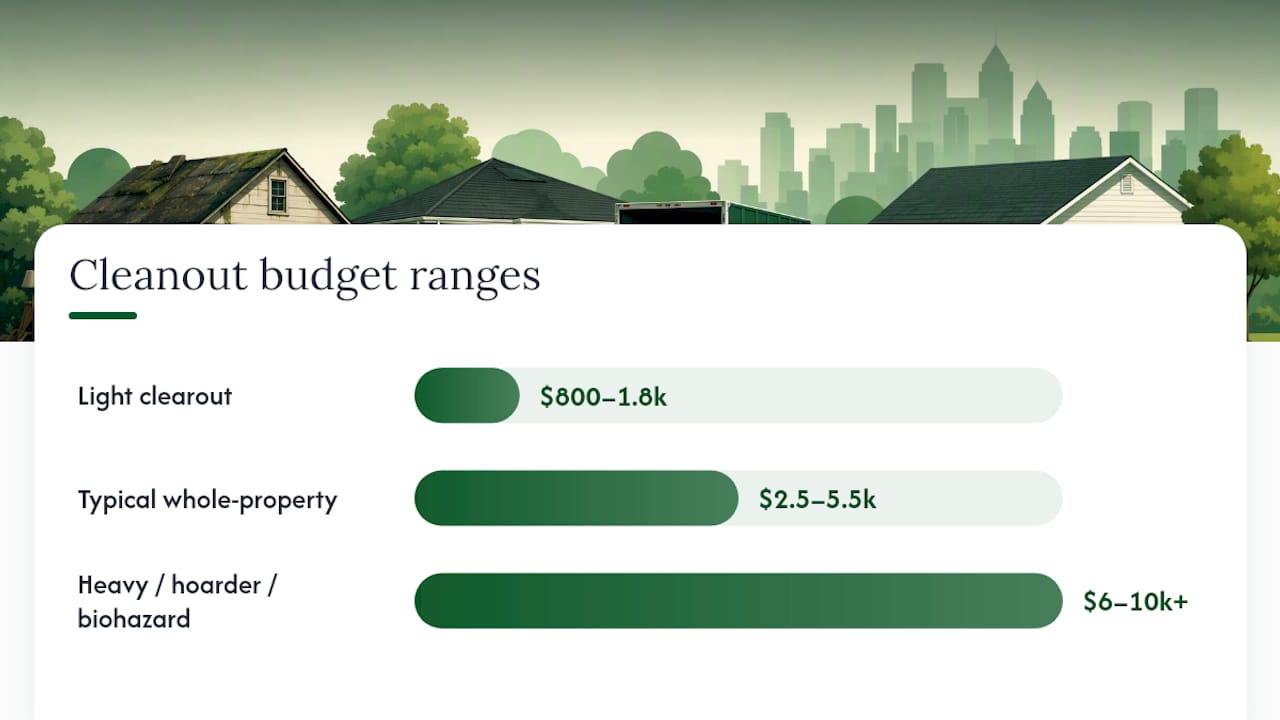
- Light or partial clearout: $500 to $1,800. A few rooms, minimal furniture, no structural access issues.
- Typical whole-property cleanout: $2,500 to $5,500. Full house, average clutter, one or two dumpster pulls.
- Heavy, hoarder, or biohazard cleanout: $6,000 to $10,000+. Multiple pulls, specialty disposal, possible remediation.
Pro Tip: Never lock in a budget number from a phone quote alone. Phone-only estimates can underprice a job by 20% to 30% compared to what a contractor quotes after walking the property, so budget worst-case at the offer stage and confirm the real number at walk-through.
Key Takeaways
Whole-property cleanout budgets range from $1,500 to $10,000, and the deciding factor is almost always density and hazard level, not square footage.
| Point | Details |
|---|---|
| Set a working allowance | Budget $2,500–$5,500 for a typical whole-property cleanout before adjusting for condition. |
| Confirm quotes in person | Phone-only estimates can run 20%–30% below a walkthrough-confirmed bid. |
| Line-item every cost | Include labor, dumpster hauls, specialty fees, and a delay reserve in your pro-forma. |
| Route items to donation first | Donation pickups before the crew arrives can cut landfill fees by $200–$600 per job. |
| Hire for speed and liability | Ohanapropertyexperts handles full property and estate cleanouts across Central Indiana with photo-based quotes and documented disposal. |
Table of Contents
- How Contractors Price Cleanout Jobs
- What Drives Cleanout Costs Up on a Walkthrough?
- Line-Item Checklist for Your Cleanout Budget
- Sample Cleanout Budgets by Property Condition
- When Should You DIY a Cleanout Instead of Hiring a Crew?
- How to Cut Cleanout Costs Without Cutting Corners
- What Should You Ask Contractors for Before You Sign?
- Who’s Behind This Advice: Olga and Ohana Property & Transition Services
- The Budgeting Mistake Most Investors Keep Making
- Get a Cleanout Quote Before You Lock In Your Offer
- Sources
How Contractors Price Cleanout Jobs
Cleanout pricing isn’t one standard formula. It depends on which contractor you call and how they’ve structured their business, so learning to read a quote matters as much as getting one.
Most contractors default to one of four models. Per cubic yard pricing runs $40 to $100 per yard and works well for volume-heavy jobs like garages or basements packed with boxes. Per square foot pricing runs $1.50 to $5.50 and tends to show up on whole-house bids where the contractor is estimating density against total livable area. Flat-bid pricing gives you one number for the entire job, which is easier to plug into a pro-forma but harder to challenge if scope changes mid-project. Per-item pricing applies mostly to smaller, targeted jobs rather than full cleanouts.
Dumpster rental sits underneath most of these models as a separate cost. Weekly rates run from roughly $75 for a small container up to $800 for a 40-yard roll-off, with a 16-yard container (the most common size for a single-family cleanout) typically landing between $400 and $800.
A few things that shift these numbers fast:
- Regional tipping fees at the landfill vary widely, so the same job can cost more in one county than another purely on disposal fees.
- Multi-story properties or homes with demolition debris mixed in often need more than one dumpster pull, and planning for a single container is often too optimistic once the crew starts loading.
- Flat bids can look cheaper upfront but leave less room to negotiate if the contractor discovers extra volume once work begins.
What Drives Cleanout Costs Up on a Walkthrough?
The number that ends up on your invoice depends less on square footage than most investors assume. Density beats size almost every time. A cramped 1,200 square foot house stuffed floor to ceiling can cost more to clear than a sparsely furnished 2,400 square foot property, because crews are billing time and truckloads, not floor plan.
Walk every property with these five drivers in mind, in roughly the order they’ll affect your bid:
- Volume and density. How much is actually in the house, not how big the house is.
- Accessibility. Stairs, narrow hallways, long carry distances to the truck, or no driveway access typically add $300 to $700 to a bid.
- Specialty items. Appliances, mattresses, pianos, and tires often carry per-item surcharges of $50 to $500 each because of separate disposal handling.
- Biohazard or hoarder conditions. These get quoted as an entirely separate tier, often $1,500 to $5,000 or more, and may require a remediation specialist rather than a standard hauling crew.
- Regional tipping fees. Landfill costs vary by county and can swing the final invoice even when labor hours are identical.
Pro Tip: If you see needles, mold, animal waste, or structural hoarding during a walkthrough, stop estimating in your head and call for a remediation-specific quote. Standard cleanout crews often decline these jobs outright, and pricing them like a normal cleanout will blow your contingency.
Line-Item Checklist for Your Cleanout Budget
Copy these categories directly into your rehab pro-forma. Missing even one of them is how investors end up eating cost overruns mid-project instead of pricing them in at acquisition.
| Line item | Typical budget consideration |
|---|---|
| Labor / crew-day minimums | Most crews bill a minimum day rate regardless of job size |
| Dumpster rental and hauls | $75–$800/week depending on size; budget for a second pull on dense jobs |
| Specialty-item fees | $50–$500 each for appliances, mattresses, tires, pianos |
| Hazardous-material allowance | Separate tier for paint, chemicals, or biohazard conditions |
| Pest and odor treatment | Often needed after hoarder or vacancy-related cleanouts |
| Initial cleaning | Sweep-out or deep clean after debris is removed |
| Security and lock change | Standard on any vacant property changing hands |
| Storage or staging | If items need holding before donation, sale, or disposal |
| Documentation (photos, dump tickets) | Protects you if a dispute arises over scope or disposal |
| Delay/holding reserve | Covers carrying costs if the cleanout runs past schedule |
A few of these deserve extra attention when you’re building the number:
- Dump tickets and photo documentation aren’t optional paperwork. They’re your proof of scope if a contractor’s final invoice doesn’t match the original bid.
- The delay reserve line is the one investors skip most often, and it’s the one that erodes margin fastest when a cleanout runs a week longer than planned.
Our guide on junk removal costs for flip properties breaks these line items down further if you’re building a repeatable rehab template.
Sample Cleanout Budgets by Property Condition
Numbers land differently depending on what’s actually inside the house, so here’s how the math plays out across three real scenarios.
| Scenario | Line items | Estimated total |
|---|---|---|
| Light clearout | Labor (1 day), single dumpster pull, minimal specialty fees | $800–$1,800 |
| Typical whole-property | Labor (2 days), 16-yard dumpster, one specialty item, security | $2,500–$5,500 |
| Heavy/hoarder/biohazard | Labor (3+ days), multiple dumpster pulls, remediation, pest treatment, extended delay reserve | $6,000–$10,000+ |
A light clearout is usually a partial job. Partial and per-item removal work nationally averages around $241, with most falling between $60 and $700, so don’t apply whole-house pricing logic to a single-room job.
For the heavy scenario, escalation items (a second dumpster pull, a pest treatment call, an extra crew day) are what push the number past $6,000.
That buffer covers the gap between what you see on a walkthrough and what the crew finds once they start pulling items out.
When Should You DIY a Cleanout Instead of Hiring a Crew?
DIY makes sense when the job is genuinely small: a light clearout with low volume, a flexible closing timeline, and access to a truck and a couple of extra hands. If you’re clearing one room of furniture and some boxes, renting a truck for an afternoon often beats paying a crew minimum.
Hiring a professional crew makes more sense once any of these show up; if you want stress-free handling, consider stress-free investment property management in Milwaukee.
- You’re on a tight closing or turnover deadline and can’t afford scheduling slippage.
- The job includes appliances, mattresses, or anything that requires specialty disposal handling.
- There’s any hazardous material, mold, or biohazard risk where liability outweighs the savings.
- You’re managing more than one property at a time and your hours are worth more elsewhere.
Portfolio investors sometimes go a step further and retain one contractor on a per-square-foot framework instead of re-bidding every job, which can save 8% to 12% versus collecting three fresh bids each time. Our breakdown on why investors outsource junk removal covers this trade-off in more detail. The hidden DIY cost most investors miss: dump fees, truck rental, and your own labor hours almost always add up to more than a flat-bid quote once you total them honestly.
How to Cut Cleanout Costs Without Cutting Corners
Coordinating a donation pickup before your crew arrives is the single highest-leverage move available. It routes usable furniture and household goods away from the dumpster, which can save $200 to $600 per job in landfill fees, and it can generate a tax receipt depending on the donation organization.
- Triage items fast: anything in resalable condition goes to donation or local salvage before the crew starts loading.
- Check your city or county’s municipal hazardous-waste collection events. Dropping paint, chemicals, and batteries there avoids the contractor’s hazardous-disposal surcharge entirely.
- If a piece of furniture has real resale value, a quick listing beats paying disposal fees on something a buyer would pick up for free.
Pro Tip: Call your local donation charity before the cleanout date, not the morning of. Pickup slots fill fast, and missing the window means those items go straight into the dumpster instead of saving you money.
What Should You Ask Contractors for Before You Sign?
A comparable quote requires structure. Use this sequence with every contractor you talk to:
- Insist on an in-person or video walkthrough. A photo list sent ahead of time helps the estimator price accurately instead of guessing over the phone.
- Request a line-item bid. Labor, disposal, and specialty fees should appear as separate numbers, not one bundled total.
- Require dump tickets and disposal receipts. These confirm where debris actually went and protect you if a dispute comes up later.
- Lock in a fixed turnaround date. Vague scheduling is how delay costs sneak into your holding expenses.
- Negotiate a contingency clause. A small retainage or a pre-agreed revision process covers undisclosed hazards found mid-job without a fight over the invoice.
Investors managing partnerships across multiple properties can find more on structuring these relationships through our real estate investor resources.
Who’s Behind This Advice: Olga and Ohana Property & Transition Services
This guide comes from Olga’s editorial work at Ohana Property & Transition Services, a family-owned company handling estate cleanouts, full property cleanouts, and debris removal across Central Indiana.
Photo-based quotes, documented dump tickets, and donation routing on every job aren’t add-ons. They’re the operational controls that keep a bid from turning into a surprise invoice three days into a job.
The Budgeting Mistake Most Investors Keep Making
Most cleanout advice online is written for homeowners clearing out a garage, not for investors running acquisition math on a deadline. That gap shows up constantly: generic guides talk about “decluttering tips” when what an investor actually needs is a dollar figure to plug into an offer before the property closes.
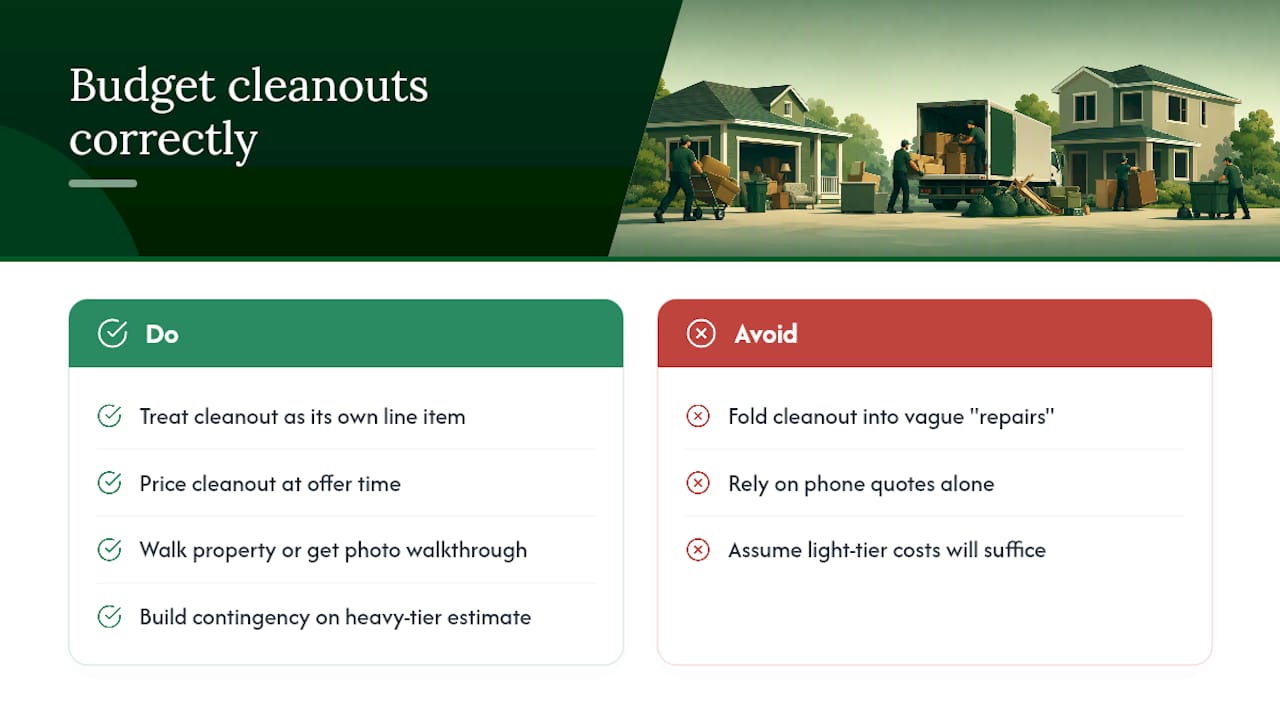
The research here points to one clear judgment call: treat cleanout as its own line item in the deal, priced at offer time, not discovered after closing. Folding it into a vague “repairs” bucket is how investors end up surprised by a $6,000 hoarder cleanout they budgeted at $2,000. The conventional advice to “get a quote” undersells the real risk, which is that phone quotes are structurally unreliable for this category of work.
What should you prioritize first? Walk the property yourself or get a photo walkthrough before you write an offer, and build your contingency off the heavy tier, not the light one. Overestimating costs you a little margin. Underestimating costs you the deal’s profitability.
— Olga
Get a Cleanout Quote Before You Lock In Your Offer
Ohanapropertyexperts handles full property cleanouts, estate cleanouts, and debris removal across Columbus, Indiana and the surrounding Central Indiana communities, built specifically around the accuracy problem this article just walked through: photo-based quotes replace the guesswork of a phone estimate, and every job gets documented with dump tickets so your invoice matches what was actually hauled.
For investors running multiple properties, that combination of upfront pricing and donation-conscious recovery keeps cleanout costs predictable instead of becoming the line item that blows up your rehab budget mid-project. Whether you’re clearing a light rental turnover or a heavy estate situation, request a free cleanout quote and get a real number before you finalize your offer, not after.
Sources
- Cleanout Costs Investors Forget on Foreclosure Flips - Foreclosure Flips
- Foreclosure Cleanout Pricing Checklist for First-Time Investors
- How Much Does a Foreclosure Cleanout Cost for a Bank-Owned Home?
Recommended
- Flip Property Cleanout: What Investors Need to Know | Ohana Property Services
- The Role of Cleanout in Property Maintenance | Ohana Property Services
- Assess Cleanout Scope Before Buying: Buyer’s Checklist | Ohana Property Services
- Property Cleanout Benefits Home Sales: Seller’s Guide | Ohana Property Services